Monthly Archives: August 2016

What do you mean I have to give a presentation?!

*Featured image: The Meep by James Hance*

Usually, our first responsive thought to the suggestion that we might have to get up on stage may be something like this: “you mean in front of people?!” Now, by “getting up on stage” I don’t mean singing, or dancing, or performing a comedy act – most people would probably prefer to do those instead. No, I mean the big, giant, enemy of our very souls, Public Speaking! =O (Cue scary music). Whenever the time comes to give that big presentation or speech, or maybe even something as simple as asking a question during a meeting, the scary thought of public speaking can send most of us running for the hills. I’m sure that we have all heard about the infamous surveys showing that people are more afraid of public speaking than they are of dying. Can you believe it? This basically states that some people would welcome death if it meant that they wouldn’t have to be involved in public speaking. I know that public speaking can definitely be intimidating, but it does not always have to be deadly. I personally love public speaking – I like the spotlight. Sure, right before I have to start, I feel like throwing up everything I consumed the night before, but I work my way around it. Mainly by making sure I don’t do that =). Nevertheless, as you read on you’ll find that there are some things you probably wish you knew about how to handle the big monster called “Public Speaking.”

1. I wish I didn’t get so nervous!

One thing you need to know firsthand is that nerves are your body’s way of preparing; they can actually be used as a tool. Instead of thinking “I’m so nervous,” you should change your thought process to tell yourself “I’m getting so ready for this!” instead. When you start feeling nervous about your public speaking performance, you can use that energy to your advantage with just a little focus. Doing this will help you speak clearly and firmly, and this energy will serve as a drive for the correct body movement, depending on the kind of public speaking you might be involved in. Before I was married I was actually a performer – certainly not a famous one, but I did a lot of singing and some acting. This was the advice I was given by my coaches. Now, I noticed that whenever I used this tool I would always do great. However, when I let my nerves get the best of me and didn’t focus on using them to my advantage (i.e., negative talk: “What if I mess up? What if I fall? I feel nauseous! Etc.), it was not a pretty show; talk about embarrassing performances! >_<. So, before you do your public speaking, make sure you embrace those nerves. Practice positive self-talk, and focus on using these to work for you rather than against you.

(For more on self-talk, read this article: 3 Reasons You Should Talk to Yourself)

2. Eh… I’ll just wing it.

Although the term “wing it” sounds appealing to our spontaneous side, if you rely on this for public speaking you will often be in a lot of trouble. And unless you’re one of those wonderfully, naturally charming “win-the-crowd-over-with-very-little-effort” kind of people, you will always need to prepare (and even the naturals do some kind of preparation). Your amount of planning will always vary depending on what you are doing, but it will always be essential even for the most minimal kind of public speaking. For example, if you’re nervous about asking a question during a meeting, write it down before asking it and read it to yourself. This will give you more assurance in what you’re asking and will help you sound confident and firm when you speak up during the meeting. Now, when it comes to something more involved, such as giving a speech or presentation, needless to say that you should write it up beforehand – if you wing that and you don’t freeze up midsentence, then I salute you! But seriously, make sure you do your due diligence and prepare what you will say before you stand in front of your peers trying to do the old “pretend they’re all in their underwear” trick (which, by the way, absolutely never works).

3. I kind of, sort of, know what I’m talking about.

Undoubtedly, if you’re going to be involved in public speaking you should absolutely know your topic. This does tie into the preparation tip, but it is a different kind of preparation altogether. It would be really pointless if you prepared a power point presentation, reciting your fancy bullet points out loud, for you to then get stumped during Q&A because you actually don’t know your topic very well. Granted, you will most likely not know the answers for everything. When this happens it is perfectly okay to say “I don’t have the answer for that at the moment, but I will work on getting one for you.” However, you should be as prepared as you can be to encounter these kinds of situations, so make sure you do your research. Not only will you be able to answer these questions (if applicable), but doing your homework will also dramatically boost your confidence – and of course we’re all on board with a little confidence boost (whoop-whoop!). So, what happens when you feel confident? Well, you will be able to take control of your nerves, and you will also come across your audience as reliable in your subject knowledge, gaining their attention and trust. There is nothing more captivating in a presentation than someone who seems confident in what they’re presenting. If you’re not sure about the amount of research you’ve done on your topic, a good way to test this is by going through your presentation/speech and ask yourself some questions about the topic. This will not guarantee that you’ll have absolutely everything covered, but it helps tremendously. You can also practice your speech with some friends! Another set of eyes/ears will always be beneficial, and it allows you to laugh at yourself during practice time without necessarily wanting to sprint out of the room in fear.

See? Public Speaking is not so bad – certainly not worse than death! Of course, we know that people are not really more afraid of public speaking than they are of death (I’d hope not!). Although it is funny how this was the first answer that came to mind for most of these individuals when asked what they feared most; fear of death usually ranked second O_O. Coming from someone that actually welcomes the rush of public speaking, I can definitely say that it is still a nerve-wrecking and not always pleasant experience. However, following these easy and simple guidelines always helped me do my best, and I am sure it can do the same for you. So no need to jump off the bridge just yet; let’s conquer the fear of public speaking and live to tell about it! =)

me_zpsext9iuth

Written by Nayadee Wilson

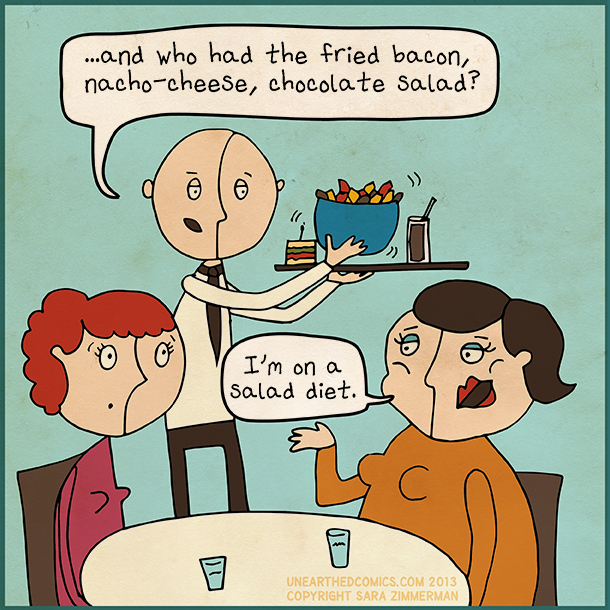
unearthedcomics.com

3 Baby Steps to a Healthier You

Featured image credit: Unearthed Comics

Let’s face it – when it comes to eating healthier and having a healthier life style, although we all have the best of intentions, most of us usually fall short of our goal to obtain a healthier diet and healthy lifestyle habits (at least I know I do). Typically, a reason why we might fail may be because we attempt to do a complete 180° turn with our diets, and actually end up making a 360° turn instead to be right back where we started. Rather than attempting to do these drastic changes all at once, why not try these few baby steps first? After all, what matters most is that you are indeed making progress and heading closer to the healthy life style that your body deserves. What better place to start these wonderful steps than your own workplace? Work is a great place to begin to make healthy habits, while also going at your own pace. In my opinion, a healthier lifestyle is really more like a marathon, not a sprint race. Therefore: On your mark, get set, Get Healthy!

1. Cut back on the sugar… Maybe way back.

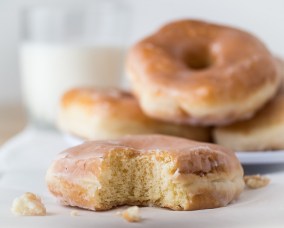
11433481726_d60b147542_z_zpshfzxuie0

Photo credit: Robert Pavich

One of the biggest enemies to our bodies is the incredible amount of sugar that we feed it. It can cause numerous problems with our digestive system since bad bacteria (stomach yeast) feed off of sugar, and it is also the cause of many other health issues – we all know the big one: Diabetes. Now, this is a tricky one; often times we consume sugar without even knowing it. A good way to start cutting back is to eliminate sugary drinks. Some of these include: Soda/Pop, Juices, Coffee (depending on the amount of sugar you put in it), energy drinks, etc. (I have personally eliminated all drinks altogether that are not water or the occasional cup of coffee – no sugar, just black! O_O). So, basically, my best advice would be for you to stick to water as much as you possibly can. When I was carrying my second child, this was a big struggle for me, I was a big Twinkie eater and juice drinker (you can imagine all the sugary cravings *_*). So my doctor recommended that instead of having a glass of juice, to just eat a piece of fruit, then drink some water. This is not to say that you can’t have any sugar at all (fruits are great for you and they have natural sugar), or that you shouldn’t have an occasional sugary drink (remember – baby steps!), but do your best to stay hydrated with the best that nature has provided us with: Water. While at work, get a bottle of water with your lunch instead, and encourage your fellow co-workers to join in on the water challenge. It can be a fun journey for everyone! It’s also good to remember that most packaged foods do not include the natural amount of sugar on their Nutritional Facts – for the most part, they only include the additional sugar added to the product. Can you imagine how much more sugar you are actually consuming with most of these things? Yikes!

2. To Snack or not to Snack?

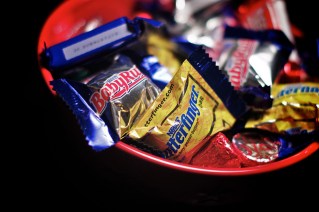
8339300799_062d795e03_z_zpsk3qjkpbq

Photo Credit:  Steven Guzzardi

Aaahh how we love a good snack; cheese puffs are my go-to! But let’s be real, cheese puffs do absolutely nothing good for my body. Snack time is usually a very weak time for a lot of us, because who doesn’t love to snack – especially at work? However, most of these snacks are filled with sugar, packed with carbs and calories, and since we’re only having them as “snacks” we might think that we’re in the clear. But we’re often mistaken – big time; a lot of us will eat endless, empty calories throughout the day without giving it a second thought. So what are some good alternatives to the bowls of chocolates, chips, and candy at work? For one, fruits are a great choice (I know, totally unexpected, right?). Fruits are packed with lots of vitamins and although they contain sugar, at least it is a natural sugar that’s going into your body. We all know the old saying “An apple a day keeps a doctor away!” Although this may not literally be the case, do take advantage of the great benefits that fruits have to offer. My personal favorites are bananas, cherries, and avocados (yeah, Avocado is not the most popular, but it is great for you!). Another alternative would be nuts. Nuts have great nutritional value and healthy fats that will turn into energy, so they serve as a good “boost” as well. Bring some of these to work with you and place some nuts in a bowl instead of candy or chocolates. On most mornings, I try to make a smoothie with lots of berries, a vegetable (usually kale or spinach), almond milk and nuts, and I drink it before or on my way to work. These are simple and take a few minutes to make, and although I’m no Mixologist, I think they’re pretty tasty =).

3. Got Milk? Maybe you shouldn’t…

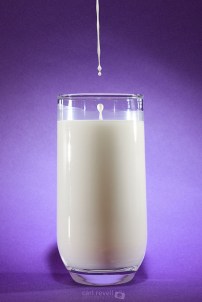
Many people will disagree with me on this one (my mother included), but I guess it’s all based on what you’ve researched. According to some scientific studies, milk does more harm to your body than it does well. Some of these studies claim that the calcium found in milk is actually not able to be absorbed by your body. Now, some also argue that raw milk is actually great for you, and that it’s the milk we find at our common grocery stores that is bad for you. Author of best-selling book “Grain Brain,” David Perlmutter, says that dairy can be enjoyed in moderation, and that what you definitely want to avoid is low-fat and skim milk/dairy products. His reasoning is that low-fat milk has less fat in it, and more lactose sugar. In our society we are wired to believe that in order to be healthy we have to stay away from “fat” like our life depended on it. But, as you will find it, healthy fats are great for you! (Notice I said healthy fats – these can be found in nuts, avocados, meats, and other delicious, natural treats).  A great alternative to milk is Almond milk. Almond milk is a great source of vitamins and, unlike milk (for some of us), it will most likely get along much, much better with your tummy ^_^.  So, stay away from milk altogether? Well, although I’d say yes, some will say that maybe not completely. Nevertheless, milk/dairy is definitely something you’d be advised to keep an eye on. Maybe instead of creamer or milk in your coffee, try bringing some almond milk to work and using that instead.

In conclusion…

Now you know of some good ways to start your healthy journey: cut back on sugar, eat healthier snacks, and cut back (or modify) your milk/dairy consumption. Maybe we’re not all cut out to easily be the absolute healthiest (although there are lucky ones who have no problem at all!), but we can always do our best. Whether it’s in the work place or in our own personal time, we can always try to move a step closer each and every day to treat our body as the beautiful temple that it is. And keep in mind that these are just some suggestions; if you have other and/or easier baby steps that work better for you, absolutely go for them! Remember it is a marathon, not a sprint. Go get healthy! =)

me_zpsext9iuth

Written by Nayadee Wilson