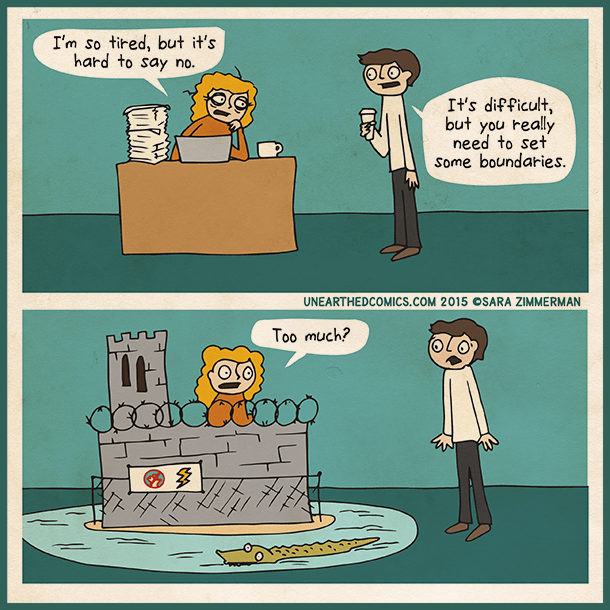
Featured image: “Boundaries” by Sarah Zimmerman – Unearthed Comics
The issue of life and work balance is so common that you hear it being discussed all the time – you read articles about it, talk about it with your colleagues, with your family, so on and so on. It’s a struggle that many of us have, sometimes for a lot longer than we anticipate, and oftentimes we sort of give up on trying to fix it; we say “it is what it is,” or “I do what I have to do.” Meanwhile, we, as well as the people we care about, are unable to escape the consequences.
In reality, the step to achieve a good work-life balance is a lot simpler than we’d think, although simple does not mean easy. However, you’re going to find out that although it may sometimes be difficult to apply this step, it is well worth it in the long run. Not only will it keep you from going insane, but family and loved ones will be grateful for it too. So what’s the secret? Simple: setting Clear Boundaries.
I want to emphasize the word “clear” because a lot of times we say that we’re setting boundaries between our work and our personal life, but in reality we just put up a fort with bendy straws. Having clear boundaries means you have specifics; you set a specific line for yourself that you will not cross when it comes to your work interfering with your personal life at home, and vice versa. Sometimes we realize our need to do this too late, and we might end up telling a story similar to the one below:
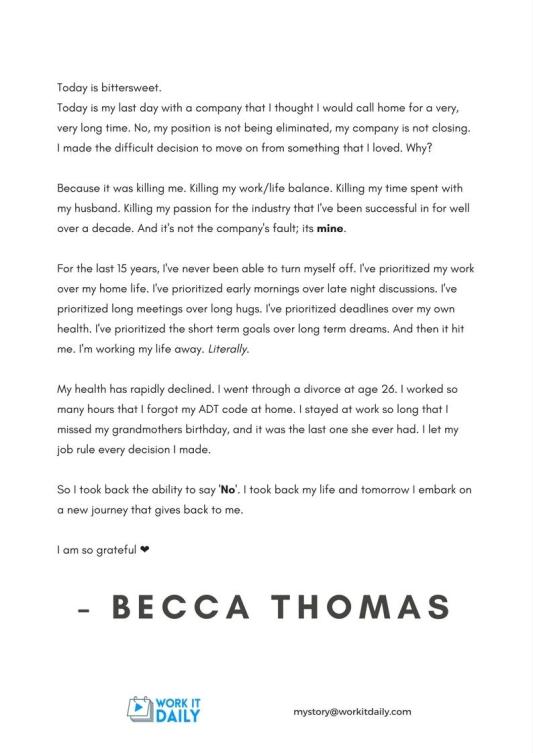
Shared story from Work it Daily
Becca Thomas mentioned how she “took back the ability to say ‘No’,” and while that is essentially what setting a boundary entails, for some of us simply saying “No.” is virtually impossible (at least for me it is). If you’re like me and have a relatively tough time saying “No.” to requests, there are other things you can do for yourself that make it easier to do so, like your time management.
When it comes to time management, there are a couple of ways you can go about it. For example, there are times when my husband has to do some work from home after a full day of work at the office. When this is the case, his boundary is to spend no more than 20 minutes working at home. You could also simply say “I will not work past 6:00pm,” and have that be your boundary instead.
These kinds of boundaries are clear, making them simple to follow, thus making them very effective. Are they easy to follow? Not always – there has been one or two times where Patrick goes a little over the 20 minute limit, but these are very rare occasions. The fact that the boundary has already been established makes it easier to be aware of how you’re handling your work-life balance, preventing you from going on a downward spiral of unbalance like Becca Thomas. Although, with stories like hers I would still argue that it’s better late than never, as you could see from her testimony this wouldn’t be a situation in which “fashionably late” is a good thing either.
So, what will your clear boundary be? Will it be “no working past 6pm”? No checking emails during dinner time? No more than 20 minutes working at home? Or maybe it’s “Thursdays are strictly family days – no phones, no emails”? Of course, it’s hard to decide to step away from your work at times, especially if your role is extremely involved in essential operations of a company. However, there are certain things that will always be more important, that also need your care and time – yourself being one of these. Having clear boundaries to maintain work-life balance will always work out in your favor, and you’ll also find that the business world will not fall apart when you decide not to be a 24/7 working robot. So have at it and take back the ability to say “No.” 🙂

By Nayadee Wilson
 ComputerPeople Staffing Blog