Author Archives: CPstaffing

“If Your Resume is More Than a Page Long, They Won’t Even Look at It”

A few weeks ago, maybe even a few months ago, I responded to a Facebook post of a friend who was asking for advice on the appropriate length of a resume. She was particularly interested in knowing if having a resume longer than one page would actually hurt her chances of getting a job. As I was skimming through the answers that she was being given, it amazed me how many people have such a misconception about resumes. I was seeing things such as “It should always be one page,” and “Nope! If it’s more than one page they won’t even look at it.” That last one actually made my eye twitch, because there was a time where I, too, fell for that lie. Part of what I do involves looking over and adjusting resumes for a lot of candidates, making them appropriate and relevant for our clients to see. So I can be the first one to tell you that a one page resume is not the be-all and end-all of resumes. Since I am still learning myself, I decided to do a quick survey around the office with some of our top recruiters in order to find out what is really essential within a resume. Here are some key things you should consider when putting together your resume.

  1. How many pages?
    The truth is: it depends. Although it truly bugged me when I heard someone say that if your resume is more than one page “no one will look at it,” there are situations in which your resume should in fact be no longer than one page. But in most cases, it can be. After my survey, we can safely come to the conclusion that the magic number, if you will, is two pages, but never more than three. But don’t take it from me; take a look at some of our recruiters’ responses:

    “It really depends on the years of experience the candidate has worked in a related field and their area of expertise.  In Finance & Accounting, a resume really should not be more than 2 pages.” – Debbie Kriess, Managing Partner at FinancialPeople Staffing – Pittsburgh.

     “Length depends on experience level.  Someone with five or less years of experience could probably get it on one page.  In IT, it’s not uncommon for someone to have a three page resume but I really don’t recommend any longer than that. For someone with 10-20 years of experience, I would expect a two page resume.” – Brooke DeLucia, Technical Recruiter / Manager at ComputerPeople Staffing.

    “A new college grad/entry level candidate: one page.  Someone with 10+ years of relevant experience: 2-3 pages. Beyond three you risk losing the attention of the reader.” – Kara Bermingham, Managing Partner at MedicalPeople Staffing.

     “A recent college graduate should most likely have a one page resume, where as an experienced professional (10+ yrs.) could very well have a three page resume. I do believe, however that three should be the limit.” – Faith Drew, Research Analyst at FinancialPeople Staffing.

    “A one page resume is perfect for early to mid-career employees but a two page resume is fine for people who are further along in their career. Except for rare exceptions, a three page or longer resume usually is not a good idea.” – Beth Courtney, Sr. Technical Sourcing Specialist at ComputerPeople Staffing.

  2. How should it be written?

    Too often I’ve come across a lot of resumes that look either too cluttered, have too much space, are not formatted properly or are just plain difficult to read. This would also include having too much jargon or words that seem out of place; i.e. words to make you sound “smarter.” Founder and CEO of Human Workplace, Liz Ryan, talks about this aspect and explains how your resume should have a “human voice,” and should not be laid out as if it’s some form of legal document. What you want to do is make sure that your resume is easy to read by organizing it appropriately, having a proper format, have a “human voice,” and being precise. Here are some tips from our recruiters:

     “Most people scan resumes – you want it to flow and have bolded or underlined words that highlight the important parts such as job title and company.” – Faith Drew.

     “Drop the objective! Use a summary style paragraph that pinpoints the role you are looking for along with your areas of expertise and what you can bring to the table. It’s like a quick “sell” that is meant to draw the reader in and make them want to learn more about you.” – Brooke DeLucia.

    “If a resume has long paragraphs without a break, it’s very unappealing to read and I often skip over that section. I like to see bullets (but not too many) and enough white space between sections that it’s easy to read. I’d much rather read a well-spaced 2 page resume than a one pager that’s all crammed together. Also VERY important to check for typos and remember that spell-check doesn’t catch everything. Have someone else proofread your resume for typos, misspellings, etc. ” – Beth Courtney.

  3. What should I put in it?
    So now you have an idea of how long your resume should be and how it should be written, but you’re not sure what exactly you should actually put in it. A lot of people, myself included, have believed the notion that you should put all of your experience on your resume, explaining what your responsibilities were during each position. However, while this is important, I will say that something we often forget is to include results in our resumes. A results-oriented resume will be a lot more appealing to a recruiter than a resume that simply states “I was in charge of accounts receivables.” Showing results, such as “I increased sales profit by 10% using procedure ABC,” shows the recruiters not only what you’re capable of but also what makes you valuable. Here are some additional tips from our recruiters on content:

    “(These are specific to a Technical resume), Skills section containing keywords/skills – Allows me to quickly skim the resume to see if the candidate has the basic skill set for a specific position. Highlight Accomplishments – To me this is important because it shows how the candidate differentiated themselves from their peers.” – Kevin Pyle, Technical Recruiter at ComputerPeople Staffing.

    “chronological work history, is usually the best way to go unless you are trying to change careers.  If so, a transitional resume which highlights skills may be the preferred way to go, just be sure to include work history at the bottom.” – Beth

    “For Technical resumes, it’s important to list the relevant technology ‘buzzwords’ in context with each job.  It’s good to have a Technical Skills section as a general overview but you still need to show where you used a particular skill and what you did with it.  Try framing your bullets as ‘Project, Action, Result,’ (saved or made the company money, saved time, improved a process or service)”. – Brooke DeLucia

    “Don’t forget accomplishments!  Does your resume sound like a generic HR job description? Your resume should set you apart from your competition and be very personal to you and the unique attributes and accomplishments you bring to the table.” – Brooke DeLucia

    “A resume should include key technical skills, and should be a mix of accomplishments and tactical day to day responsibilities” – Debbie Kriess

    “Dates – resumes that do not have dates of employment are a huge red flag. I want to see when you worked at certain companies, take note of any gaps in employment, and know if you are currently employed or unemployed” – Faith Drew

Now that you’ve gotten some tips, you can go ahead and make sure that your resume is in top shape. Make sure that you have someone else proof-read your resume, to ensure that all typos and inconsistencies are taken care of, and don’t forget to include important elements such as achievements and skills! Happy writing! 🙂

computer20people20-20talia-3875-final_zpsynpbyivy

By Nayadee Wilson

The “I’s” in “SACRIFICIAL GIVING”

Featured image: Give by Thomas Hawk

In a society where we are sometimes embedded in putting ourselves first, where “me, myself, and I” are the greatest priority in our lives, we may fail to see where “I” fits within the community around us. When I see people so ready and proud to tell the world “I have to take care of myself first,” I can’t help but feel a slight sense of sadness. While I agree to an extent (you certainly can’t pour anything out of an empty cup; you should definitely take care of yourself in order to give), such a strong notion of always putting yourself first might take out a very important element that oftentimes comes with the word “give:” sacrifice. The very act of giving is sacrificial – whether that may be of your time, money, or interests. In order for a community to always flourish, there will be times in which “I” will need to stand for something other than “myself.”

“I” for “Include”

Although some of us may be introverts or “anti-social,” at some point in time we may enjoy the company of others (even if that means just one person in your life that you can stand to be around 🙂). By nature, we are relational creatures, and if there was no interaction within our communities then we wouldn’t have one! When you choose to give your time to help a cause or someone in need, you include those who need our interaction the most – you make then an important part of our society, even if their circumstances may lead them to feel hopeless. This might mean giving up that golf outing with your friends, or that weekend you had set aside for an awesome full-body massage – for your community that needs you! There are people out there that will thank you for including them in your busy schedule and letting them know that they matter.

“I” for “Impress”

As I briefly stated before, some of our people in need oftentimes feel hopeless. When we decide to give to our community in a sacrificial way, the love behind that very sacrifice impresses hope on those who need it most. You give them hope that there are people who care, hope that they are not alone, and hope that they will conquer whatever they are going through. Even if you’re volunteering for a cause that seems fairly generic on the surface, the “behind the scenes” of it all is always much greater. Additionally, a great thing about this impression of hope on others is that it’s reciprocal; you also become hopeful! Giving to your community and to those in need has the awesome effect of changing us for the better: we become more hopeful for our society, we become more empathetic, more motivated to be involved, and we become more loving; all great attributes that are needed in a great society.

“I” for “Inspire”

            Did you know that giving is contagious? This is especially true when you are willing to sacrifice something of your own in order to do it. Sacrifice shows caring, it shows commitment, willingness, and it shows love. All of these things make those around you think to themselves: “I guess if he/she can do it, I can do it too.” The result: More people are inspired to contribute, bringing our society that much closer as a whole. When I think of inspiration in this sense, I like to think of my marriage. Do I always feel like loving my husband? No – sometimes he annoys the heck out of me. Nevertheless, it is during those times that I try my best to demonstrate my love for him anyway, even though I really might not want to (i.e. sacrificial love; purposeful love). What usually happens is that he’s inspired to love me back, and vice versa. Are we always perfect following this “sacrificial-loving” rule? No, but I notice that when we do, it always works out for the best; we never regret it. The take-away from this: the same way that marriage needs self-sacrifice in order to work in harmony, our society will also need our sacrifice in order to work in unity. Sacrificial giving inspires more giving! 🙂

“I” for “Improve”

            It is no surprise that when we work together, we improve together. I’m drawn to think of the phrase “there’s no ‘I’ in team,” but this is my way of showing you otherwise 😉. Volunteering and giving are some of the great ways in which we work as a team and contribute towards the improvement of our society. We have to keep in mind that we are all in this together – I know, cliché, but very true! Think about your children (if you have them), and the example that you set for them (or anyone who looks up to you); by sacrificing part of yourself for the benefit of others, you’re teaching them that it is not always about “me.” And, of course, what comes out of this teaching is a future society of self-giving citizens, willing to help each other when needed, deviating any sense of entitlement and selfishness that may otherwise form (are you with me yet?). In other words, children are our future, and we are the guide they need for the purpose of improving our world – I am rocking it with the clichés, aren’t I?

“I” for “Interconnect”

            The very last “I” in “Sacrificial Giving” is for interconnection. Everything that I’ve touched on in this piece shows the many ways in which we are all interconnected with each other. I truly don’t mean to sound all gushy, although I think I’ve outdone myself here (I blame it on the entire goopy, Valentine’s Day atmosphere), but it is so important to not forget this essential fact. The truth is that we need each other; we need each other for strength, encouragement, success, and our overall well-being. The minute we forget this truth and begin to drift into the “I come first” state of mind, that’s the moment we begin to lose sight of what we need: connection. This being said, by all means make sure that you take care of yourself (and do put your family first), but when you can, try to “care for yourself” also as a means of preparation for giving your help to those who need you. You’ll be surprised how much greater it is to give than to receive; you will not regret making a difference every now and again. 🙂

P.S.

I hope you had a great Valentine’s Day!

computer20people20-20talia-3875-final_zpsynpbyivy

By Nayadee Wilson

How to Win an Argument – Once and for All

Featured Image: Ways To Settle Arguments

So, lately I have witnessed my fair share of intense arguments, not only on my Facebook feed, but also on my LinkedIn, Twitter, as well as among my friends and family (I have actually partaken in some of these). It is no hidden fact that as a society we will have differences, which can result in conflict, but sometimes healthy debates are necessary and good in order for our society to function. I mean, could you imagine? A world where we all had the same thoughts, same likes, and same passions? Not sure about you, but to me, that sounds unpleasantly robotic. However, nowadays we see very few friendly debates; we mainly see full-blown arguments, with the sole intent of attaining victory and to change our opponent’s mind, as opposed to inform and simply listen to one another’s point of view. So, what is the fool-proof way of winning these arguments? That’s simple: avoid them – and here’s why.

  1. “You have a duty to speak up.” 

    I can see how the circumstances of unfairness and the human responsibility to look out for one another can send us into a down spiral “discussion.” However, the belief that we have a duty to always give our opinion is not true, and it is not what “speak up” means. When you start/enter into an argument in which your thoughts were not necessarily requested, it will only cause hostility. Doing this will not make your opponent like you; it will only make him/her strike back. I once saw a quote that said “instead of attacking what you hate, start promoting what you love,” and it truly stuck with me. If you truly want to speak up, start upholding and working towards what you believe in, and stay away from the unwanted, pull-your-hair-out arguments 🙂 .

  2. “You can prove them wrong.” 

    Yes, you can provide amazing facts, charts, examples, and use many other great tools all for the sake of proving your opponent wrong – but, at what cost? Although these things are great when used in friendly debates (those discussions that lead to information and communication rather than confrontation), it is counterproductive when used in a heated argument. Within the environment of an escalated dispute, proving someone “wrong” will not only insult your challenger’s intelligence, but it will also make that individual feel inferior, hurting whatever relationship you have (or could’ve had) with that person – even if the damage doesn’t show immediately. The take-away from this: always aim to simply inform and communicate, rather than using these great tools to humiliate and insult.

  3. “You win.” 

    Actually, you don’t. When you lose an argument, you lose. When you win an argument, you also lose. How? Because even though you will feel awesome, triumphant, and will want to tell your mom all about it, the other person does not. Their pride has been hurt, he/she feels degraded, their self-respect and judgment feel attacked, and most importantly: that person will just resent you for your great “win.” Oftentimes we believe that by proving someone wrong and proving ourselves to be right, we have won the person’s opinion in favor of ours. However, the truth is, as Dale Carnegie put it, “a man convinced against his will is of the same opinion still.” Winning an argument will never change anyone’s mind. What can change people’s minds, however, is your life example as to how you live by what you preach. This is not to say that you will never make mistakes; I have made plenty – yet it does not mean I have to advocate for the mistakes I’ve made. If you fall, pick yourself right back up; acknowledge and learn from your downfall. Doing so will not show that you’re a “hypocrite,” it will rather deepen your credibility and show your ability to correct yourself when you have failed.

I hope that by now you are as turned off from arguments as I am – it truly serves no good purpose! Of course, as I previously stated, friendly and informative debates/discussions are healthy, and needed for our society to function. Nevertheless, keep in mind that heated and escalated arguments are not debates; they fail to be properly informative (because the other person is not interested in listening), they do not serve the purpose of good communication, and they cause more harm than good. I am certainly not saying that I have not been caught up in these myself, especially when it comes to topics that I am passionate about, but slowly and steadily I am learning that this is not an effective way to have your voice be heard. Take the time to do some reading, keep yourself well-informed, and remember these words from Dale Carnegie:

Why prove to a man he is wrong? Is that going to make him like you? Why not let him save face? He didn’t ask for your opinion. He didn’t want it. Why argue with him? You can’t win an argument, because if you lose, you lose it; and if you win it, you lose it. Why? You will feel fine. But what about him? You have made him feel inferior, you hurt his pride, insult his intelligence, his judgment, and his self-respect, and he’ll resent your triumph. That will make him strike back, but it will never make him want to change his mind. A man convinced against his will is of the same opinion still.” – How to Win Friends and Influence People, by Dale Carnegie.

computer20people20-20talia-3875-final_zpsynpbyivy

By Nayadee Wilson

Is Your New-Year’s Resolution Useless?

As the new year approaches most of us have decided on, or are thinking about, a New Year’s resolution. Being carried away in my thoughts earlier today, it suddenly dawned on me: why do we have New Year’s resolutions, anyway? I mean, most of the time, let’s face it; we don’t exactly follow through. Time and time again I see myself, and others, fail miserably before the end of January to attain the infamous purpose that we had so excitedly set forth. Nevertheless, I did brainstorm a few reasons why having a New Year’s resolution is actually pretty beneficial, whether you’re able to achieve your goal or not.

  1. Everyone likes purpose.

    One thing that I know for sure is that having goals in life is essential for your overall wellbeing – it gives us a sense of purpose and meaning. Having goals, such as a New Year’s resolution, to work towards gives us the intrinsic motivation that otherwise we may not always find elsewhere. Although sometimes hard to achieve, and oftentimes we may fail to achieve the desired end result from these, we shouldn’t be too quick to overlook the inevitable impacts that come simply  as a side-effect of pursuing a goal. Whether your goal this year is to start a business, or to just be able to get out of bed before noon, goals are important no matter how big or small. 🙂

    Tip: if you’re having a hard time achieving your New Year’s resolution, try examining what your goals are. If you have too many of them, it can be overwhelming and will ultimately cause you lose focus on what should be your priority. Try listing all of your goals on paper, pick the top three that are most important, and focus solely on those instead. This will give you a greater chance of success.

  2. Adulting like a rock-star.

    What’s another great side-effect of setting goals? It forces you to be responsible. Of course, this will depend on how committed you are to your goals. Nevertheless, it is a great way to make you feel like you are awesome at being an adult :). I personally miss the time when I was 7 years old and had no idea where money came from. I remember asking my mom: “Where do you get money? Is it like a building where you go and they just give it to you?” Good times… Then, of course, I came to a rude awakening when I found out that people don’t just “hand” you money. Point is, we don’t always like living the responsible adult life, yet when we have goals, being responsible becomes a little easier and more habitual.

    Tip #1: One way to spark the responsibility side-effect is to set a time line for your goals. Want to lose/gain 10 pounds? What’s a reasonable timeline for accomplishing this? Or maybe you want to write a book; how many chapters or paragraphs would you like to have completed in a month? And so on, and so on.

    Tip #2
    :  Unless you’re incredibly disciplined, it may be hard to achieve your goal without some accountability. Find someone you trust to hold you accountable for your goals. This way, if you start to slack off, you’ll have someone to encourage you to keep going.

  3. More to come.

    Another awesome goal side-effect is that while we are pursuing goals we become hopeful. Hope is that thing that gives any human being motivation to do one thing: keep moving forward. Think about it; if you had no hope for anything lying ahead, what would be the point of doing anything towards your future? When you pursue your goals, you are being hopeful that you can achieve it, and a good result will come out of it – this is why you set it in motion in the first place.

    Tip #1: If you’re having a hard time having any hope of achieving your goals, what you might want to do is take some time to focus on the end result (although being careful not to dwell on it – remember that you also get lots of small victories in the process). If you can picture yourself at the end of it all, and remember why you wanted to do this in the first place, it can motivate you to keep working – one step at a time.

    Tip #2
    : To pick up on that first tip – take it one step at a time. Celebrate the small victories! So maybe you haven’t started your business yet, but perhaps you’ve made some great connections in the process. Or maybe you haven’t written a book, but you’ve written a few paragraphs and placed your heart on paper, letting yourself know you can do it – that’s a start!

  4. I can only get better.

    What else can we get out of having goals? We learn a lot about ourselves in the process. We learn what makes us tick, what doesn’t, what works for us, and what harms us. Anytime you take the initiative to work towards anything, it brings within itself an opportunity to learn. (For example, I have learned that no matter how hard I try or what I try, I am not a morning person… at all). No matter what the end result is, whether you succeed or fail, there is no doubt that you will learn things about yourself you might have not known before. And as you know – Knowledge is power!

    Tip
    : This will probably sound repetitive and cliché, but it is so true. If you’ve failed at achieving your goal, this failure is simply a lesson to be learned. When you fail, you learn about the things that did not work for you. Use this knowledge to improve yourself rather than to self-criticize.


  5. Time to straighten up.

    Lastly, as Jim Rohn put it, “Discipline is the bridge between goals and accomplishment.” When you are committed to your goals, the inevitable happens: self-discipline. A “goal” is something you have not achieved before, that you are willing to work towards; a desired result in your life. Working towards your goals will require you to do things that you may have never done before, forcing you to create new habits and commit to these – and this is a great thing! When you create self-discipline, it is a trait that stays with you past the desired achieved (or failed) result. So, regardless of the outcome, remember that the process of this very same pursuit will only benefit you in the end.

    Tip: If at first you don’t succeed, you can dust it off and try again! Don’t forget that there is always next year. 🙂

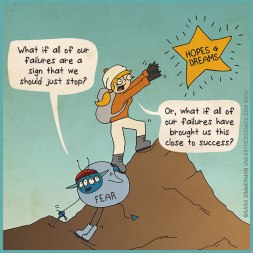
*All images/comics used in this blog were obtained from Unearthed Comics*

computer20people20-20talia-3875-final_zpsynpbyivy

By Nayadee Wilson

Getting Your Mojo Back After The Holidays

Even as I write this I am struggling to keep my focus and motivation. What others would call “writer’s block,” I am calling procrastination. To be fair, I believe that this is simply the effect from a cause that we all know too well: the “After-Holiday Blues” (I think I just made that name up, but you get my drift). There is no doubt that returning to work after the freedom of the holidays is hard; the heavy thought of “I don’t feel like going to work today” fills our mind like an ugly plague. To get out of the wishing-for-a-never-ending-holiday stage, here are some ideas that may help in getting your mojo back and start up some motivation.

Music heals all.

One thing you may want to try is playing some cheery music (quietly, if allowed) while you’re working. Music has the amazing effect of altering the way we feel. Playing music while you work will make you feel happier, and in turn, more productive and motivated to work. I, for example, like to listen to talk shows while I work – not necessarily “music,” I know, but it is something that soothes me and makes me feel good. When I don’t have my talk shows on, I love to listen to upbeat songs and have my own little party – you could do the same 🙂 . Additionally, if you wanted to keep the holiday season going in your own way, go ahead and play songs like “Sleigh Ride” (one of my favorites) over and over until you’re satisfied – whatever makes you happy! Whether cheery music means sad country songs or super upbeat Christmas songs, choose whatever works for you; get working while enjoying the beat.

Something nice to have.

I am always like a little kid on a sugar rush any time I have anything new – it could be something as simple as a nice pen (I do love nice pens *_*). If you’ve received something nice during the holidays and you can bring it to work, go ahead and take that with you. Having something nice to look at, especially something you really enjoy, will make you feel more at home and boost your mood. I’d recommend even getting some nice office supplies of your own (or something related to the job that you do) so that you’re motivated to use it. New things are always exciting! These can range from really cool mouse pads, to awesome pens, a fancy calculator, or even just a plant for your desk or a new picture for your screen background. Today, for me, my nice thing to have was a really nice sweater that I got over the holidays. I feel pretty and uplifted, and that is what counts! 🙂 Of course, not everyone has the same likes/dislikes, just make sure that you find something that makes you feel inspired and bring it with you – whatever that may be.

There is always a first step.

This blog is a prime example of the power of this tip. I was not initially motivated to start this, but without thinking I just opened up Word Document and started writing – now here we have a blog. Every job or task that you have needs to start somewhere, and all you have to do is take that first step. Chances are that once you get started on your task, you will gain momentum and follow through with the project; even if it is just for that day (then you have to take that first step again, the next day). Usually the first step is always the hardest to take, but, in most cases, it will always be the most simple. You will quickly find that just a few minutes after taking that step, you’ve actually already made some great progress. 🙂

We can be merry all year round.

I know there are times in which we all wish for longer breaks, but what fun would that be? After all, our breaks serve as great satisfaction after a job well done. Although some may be wishing for the holiday season to just be over with, most of us can agree that, even so, coming back to work can be mentally challenging. At least now you know that there is no need to fret, and you can easily get your groove back in the workplace. Just because the holiday season is over doesn’t mean that you can’t carry it on in your own way, if you wanted to. For this New Year, remember to stay merry, and never stop showcasing the best of your talents – that is what you are there to do!

computer20people20-20talia-3875-final_zpsynpbyivy

By Nayadee Wilson



4 Traits of a Company You’ll Want to Work for

Searching for a new job is not always nice and easy. It takes a lot of time, preparation, diligence, you name it! Not only is this search mentally exhausting, but it’s hard enough just getting an interview, let alone finding that awesome company you’ve always wanted to work with. Sometimes we get so caught up in our temporary state of desperation that we are ready to take whatever comes first. Or, the opposite may happen, where we are so stuck in our financial requirements or desired job title that we refuse to work with any company that does not meet those specific needs. Well, you may find that in either situation the decision to accept/refuse a job offer without considering the kind of company you will work for may cost you. Here are some things that I’ve learned say a lot about a company’s structure, which can help you make the right decision when it comes to your next career move.

  1. Let’s not forget about our community.

    13445778_733886806714802_800525899345431082_n_zpskfk2pq0g

    Cindy and Kaitlyn at the Susan B. Coleman Race for a Cure – June 2016

    One of my favorite traits of CP Staffing Solutions is the company’s ability and desire to care and be involved in the community that we are part of. Willingness to give and take care of the community says a lot about a company because it shows that they care about more than just making a profit. When the company cares about others, it means that they will care about you. When they care about you, it means you will have opportunity. Here is one of the messages our president, Cindy Neese, has sent to us:
    “Team,
    I wanted to share this email with everyone in the office.  Kaitlyn recently made me aware of this Volunteer WNY Newsletter that goes out by United Way.  If you sign up, you will get then notifications of different opportunities with non-for-profit organizations locally that are looking for volunteers for different fundraisers. As a company, I would like to see us do at least 2 of these each calendar year, but there may be opportunities for you to sign up as individual or family event that you might like to do.  Also, if we see something that we can do as a team, this would be a great way to get those notifications.   If you click on www.volunteerwny.org, it will take you to the main site where you can register for the monthly newsletter.

    Thank you, Cindy”

    If you’re not sure whether the company you’re interviewing with has much involvement in their community, then feel free to do some research. Additionally, this could be a good question for you to ask during the interview. When the dreaded “do you have any questions for me?” statement comes up at the end and you draw a blank, you could ask, “Do you have any outside projects that you participate in as company, such as volunteer work or anything like that?”

  2. Our employees make this baby run!

    untitled20design_zpstplhepqq

    Employee Appreciation Happy Hour!

    So maybe the company you’ve encountered doesn’t have the chance to do much volunteer work, but they have other ways in which they show they care: the unquestionable value of their employees. When higher management openly expresses appreciation for their employees, it says a lot about the kind of environment you will be working in. I’ve never met anyone who is a greater example of this than our very own Cindy Neese (I will talk about her a lot, because she truly is awesome).

    In a previous blog titled “Note from the President; Cindy Neese on Leadership,” Cindy wrote how “Many leaders could never imagine leading a company with Love – the verb not the emotion.  I am talking about actions, not feelings,” and I could honestly say she practices what she preaches. Cindy never misses the opportunity to let us know when we do a good job, (no matter how small the task is), she lets us know the ways in which our job is valuable and useful – just this morning she came in to ring a bell to tell everyone how they’re doing a wonderful job, due to some good news she had just received – and she does her best to do really nice gestures for us all. Not only does this kind of appreciation motivate employees, but it makes us happy to come and work with her.

  3. We’re like a second family.

    turtur_zpshvoh4wrx

    Facebook post from a valued employee 🙂

    One of the most important facts about valuing employees is that the expression of care is contagious! As a leader, Cindy teaches all of us how to treat each other in the same manner, which makes for a great atmosphere in the workplace. A great company will not only have top management care for you, but it will also have its employees caring for each other. It is a huge sign of good leadership. The same way our president gives praise to her employees, we also give praise to each other. The same way she makes great, small gestures, we also do those kinds of gestures for each other (as you can see from the picture on the right). I love our team! 🙂

    When you decide to work for a particular company, it might be a good idea to scope out the atmosphere. How do employees treat each other, talk to (or about) each other? If you can’t really tell at first glance, you could check out some of the company reviews online. Additionally, if you know someone already in the company, you can ask them for their opinion on how they feel about the environment. Having a good crew to work with means you will have a much more relaxed environment, making you feel more motivated to come to work, as opposed to having to come in to work with people that just… don’t necessarily make for a great experience. 🙂

  4. No more drama!

    The very last thing you would want to deal with at your new job is drama. This is not always very easy to spot from a first interview, but it will not take long for it to surface if you’ve already started the job. One way you can spot this trait is by watching for the kinds of things your interviewer decides to share about the company or its staff. A previous coworker and friend (from a previous company I used to work for), told me about their interview experience. This individual was completely in shock because, during the interview, the manager began to talk about the employees, and not necessarily in a positive way. The interviewing manager talked about some of the employee’s personalities, using phrases such as “so-and-so can be very defensive,” as well as, “we have someone who doesn’t seem to want be here,” and, “everything is a mess because so-and-so did this,” etc.

    When the interviewer blatantly discredits his/her employees, it may be a sign of mistrust, favoritism, and undervalue. This is the part where you start to look at your other options (red flag alert!). Having this kind of environment in the workplace can attribute to significant levels of stress, as well as interfere with your ability and skills to do your job in the first place. It also makes you question the kind of opportunity you’ll really have in the company if it will mainly depend on how much your boss “likes you.” 

Choose success, but don’t forget peace of mind.

Before making the decision to jump on board or “swipe left” on a particular company, make sure you take note of the little things. Working for an unethical company or one that does not value its employees and/or their talents will only hurt you in the long run, and you will be miserable – no matter what your title is or how much they pay you. If you’ve already started working for the company, these traits (or the lack thereof) can be easy to spot. If you see some issues, your best bet is to run as soon as you can – while never forgetting to be professional. Even if you’re not being directly affected, it is only a matter of time before it catches up to you. By all means, choose a career path that will bring you success, but be very careful to choose the right company to help you get there! 🙂

computer20people20-20talia-3875-final_zpsynpbyivy

By Nayadee Wilson

4 Staffing Agency Myths You Probably Believed

Since I’ve started working for CP Staffing Solutions (we’re awesome, by the way), I’ve come into several conversations about staffing agencies with some of my friends that have left me a little surprised – well, maybe not so much “surprised” as much as “curious.” I came to find that some of the things that people think and believe about staffing agencies are incredibly misconstrued. Furthermore, it made me wonder, how is it that these misconceptions have gone on for so long? Working for one directly, I can be the first to tell you that many of these are just simply not true; you’ve been bamboozled! Let’s tackle some of these myths and uncover some great truths.

  1. The fee
    Myth: A staffing agency will take a cut from your salary.
    Fact: The hiring company pays a staffing fee to the agency, not you.

    I can see how people can come to this conclusion; I thought the same thing when I started searching for a job through a staffing agency. However, the reality is that the hiring company pays a staffing fee to the agency based on, but separate from, your salary. A few years ago I took some time away from the workforce to travel, and when I came back I needed a job (like ASAP), so I went through a staffing agency. Not only did I not have to pay a fee, but they also did all the job searching for me and I got a job in less than a week after meeting with them. Working with an agency actually has some pretty good perks, and it will not cost you a dime. Here is what some of our recruiters had to say on the subject:”It’s amazing how many people still think that’s true.  It WAS true many, many years ago when I went through an agency.  They wanted a percentage of your first year’s salary but that is not the case now.”  – Beth Courtney, Sr. Sourcing Specialist at ComputerPeople Staffing.

    “A company that decides not to make an investment in an employee because of an agency fee likely isn’t a company you would want to work for anyway.” – Faith Drew, Recruiter at FinancialPeople Staffing.

  2. The pay negotiation
    Myth: An agency job will probably be low-pay, and you won’t be able to negotiate.
    Fact: Agencies provide a wide range of salaries, from entry level to experienced positions, and will facilitate negotiation.

    So this one is kind of a two-fer; not only do people believe that agencies will offer them a poor salary, but they also believe that the option of negotiation is off the table. What actually happens is that a recruiter will look at your resume and your experience, talk to you about what you’re looking for, and give you a realistic and honest perspective on what you should expect. The great thing is, you don’t have to be afraid of telling your recruiter what you want or what your absolute minimum is. In fact, some of the best chances of negotiation will happen with your recruiter because they are the ones that deal with the company directly; they can negotiate the best pay according to your salary preference and experience. Oftentimes negotiating on your own can be awkward and/or stressful (at least for me it would be O_O), while recruiters are usually trained in this area. Instead of running the chance of starting your new job on a wrong note, having your recruiter negotiate your salary will ensure that everything goes smoothly, and you would still look like a superstar 😉 . See? This actually works out in your favor. 🙂

  3. The temporary job
    Myth: Agencies only offer temp jobs.
    Fact: Agencies offer all kinds of jobs.

    Simple and to the point: we have a wide variety of jobs, not just temporary jobs. The misconception may come from the fact that a lot of these jobs may start out as a temporary role, but often times these temporary jobs will turn into full-time, permanent ones. Good companies like to keep good talent; if you do end up starting out with a temporary gig, make sure you showcase your best! 🙂 Here is what one of our recruiters had to say on the matter:

    “We work with all position types—permanent, contract/temp, temp to perm, and per diem.” – Liz Ragan, Recruiter at MedicalPeople Staffing.

  4. The low quality factor
    Myth: Agencies don’t have good “big girl/big boy” jobs; you’d be lowering your standards.
    Fact: A lot of great, high paying jobs can only be found through a good agency.
    Really take the time to think about it: why would a company go through the trouble of paying professional recruiters to find them employees? Well, simply put, because they want the best talent for the best jobs. Otherwise the company would be, basically,  wasting their money. An agency can find you jobs that you could otherwise miss, so it’s certainly worth your time. Here is our last thought:

    “Most of the clients we work with only work through recruiters. This is especially true at large companies when it comes to contract roles, and small companies when it comes to permanent roles. So working with an agency is often the only way to find jobs like that. Companies invest in agencies to find them the best talent that will stay long term and be a good fit long term.” – Faith Drew, Recruiter at FinancialPeople Staffing.

Now that we’ve uncovered some truths, if you’re looking for a change of pace, a new job, or a new career path, give the staffing agency a shot! You never know – you could very well find your dream job when you least expect it. And just to let you in on one last, little secret: no one will go out of their way to prep you for an interview the way your recruiter will (at least all of our recruiters do!), optimizing your chances of getting the job. What more is there to say? Give it a try, and see how it goes. From my personal experience, staffing agencies have always been a great help in my career search, and they could very well do the same for you!

*This blog was expanded from the original blog “Five Misleading Myths About Getting A Job Through a Staffing Company“*

computer20people20-20talia-3875-final_zpsynpbyivy

By Nayadee Wilson

4 Tips to Make the Best out of your Vacation

The holiday season is finally here (well, it actually got here before we could blink!), which means you may be planning a vacation soon, or hosting a family gathering of your own where you may be taking some time off. Vacations, in my opinion, are a must; they are relaxing, refreshing, motivating, and needed for continuous productivity. Last week my husband and I headed over to Albuquerque, New Mexico, and took a 10-day family vacation with our kids. Although we had a great time with the rest of my family, there were some things I did that I was thankful for, while there were some other things that I wish I had done a tiny bit better. If you’re thinking about taking a vacation (and you should – everyone needs a break!), here are some things to keep in mind.

sdgtsgf_zpsztnlo6ri

My son Liam – just about the only fully prepared child (of mine) for the weather.

I think the weather should be nice.

You’d think that I would learn from experience, since I’ve been to Albuquerque during the month of November before, but I didn’t. For some reason I always think I’m going to some haven of awesome, nice, warm weather (maybe I subconsciously make a silly connection between Mexico and New Mexico?), only to find a very dry and brisk Albuquerque chill. One thing I would definitely recommend for you to do is to check the weather of your destination ahead of time, and be precise – otherwise you could be in for a rude awakening. My husband did check the weather for us, and he said it was going to be in the 50’s. Being from Buffalo, NY, I thought “OK, 50’s is not so bad. Light jackets and some sweaters will do.” However, I came to find that 50 degrees in Buffalo is not the same 50 degrees in Albuquerque; New Mexico feels much drier, and the cold breeze felt like sharp little needles on my skin. Additionally, the 50-degree weather only came about for a good two days 😦 ; every other day was in the 40’s or 30’s (one day it dropped to 28 degrees! >_< ). At one point, when hiking back from some cool rock formations (Kasha-Katuwe Tent Rocks), I desperately started to sprint back to our vehicle because I was so cold that my entire thighs were itching in freezing pain. Moral of the story: don’t just check the weather in terms of general temperatures; make sure you also check the “Feels Like” temperature for your destination and pack what you will need. That way you’re not scrambling around trying to see how many layers would make a good substitute for a winter jacket (like I did). Or, if the opposite happens, where it’s hotter than expected, you’d avoid trying to figure out how many articles of clothing you can remove before unwanted exposure happens >_<.

sdgsgd_zps9iu018zm

Photo Credit: Creative Commons – Johan Siegers (but I could totally see myself doing this)

Not sure if I’ll need this, but I’ll take it just in case.

I’m sure I am not alone here, but I have a minor tendency to over-pack (OK, so maybe it’s not so minor – I do it all the time). Over-packing for your trip is not just time consuming, but it is truly a big nuisance. For those of you who are flying, make sure that you become aware of any baggage fees that your airline may have in place (including the WHOPPING fees for any baggage that is overweight – 50lbs max). During our trip, I packed so many diapers for the kids that you’d think we were staying there for a month (which was silly, really; we could have just bought more diapers there if we ran out), taking up a lot of space in our carry-on. Additionally, in our main luggage, I packed so many unnecessary things (makeup that I never wear, hair products, “going-out” outfits that I never used), that it tipped the scale for the maximum weight allowed on the plane. Now we were going through this luggage, in front of everyone, taking things out just to make it under the weight limit; our hands were absolutely full throughout the rest of the flight. Moral of the story: You really don’t need as much as you think you do. The best vacations happen when you’re worry-free, and you’re not being weighed down with things that ultimately serve no purpose. Pack what you need, and think about the things that you could easily obtain at your destination – travel as light as you possibly can, because it is soooo worth it, trust me.

20161124_195653_zpszztt2qjy

Our Thanksgiving feast! Luckily, everything was delicious (mostly)

It’s dinner time!

For those of you who will not be cooking, this may not be a critical thing to worry about, but it still may be a good idea to look for where and what you will be eating ahead of time (or what you will serve your guests, if you are hosting), and how it will affect you financially. Most people don’t think about this, but small meal preparations should take just a few minutes and it will save you time and effort in the future. If you don’t want to spend a load of cash eating out, maybe you can purchase some essentials while you’re there (bread, deli meats, etc.), and make some small meals if you can. For those of you who will be traveling and/or hosting, the following is a great tip. I cooked/baked a great portion of our thanksgiving meal this year, and one thing that I was very happy with was the fact that I created my menu ahead of time and wrote down all of the ingredients I would need. Something I regret, however, is not making some of these dishes beforehand as a “practice” round. Mostly everything was great (my turkey was pretty good, thank God!), but I attempted to make this new baked mac & cheese recipe that I had never made before, and, to say the least, it was just gross 😦 . I felt really bad for anyone eating it, and I desperately tried to steer people away once I saw anyone attempting to go for it. Moral of the story: maybe you’re a pro chef/baker, but if you’re making something you’ve never done before, make sure you have a “practice round” first; it may save you some embarrassment later.

20161125_171601_zpso8wfyzfg

My brother Colbert (big head), my daughter, and myself: GoKarts (I’m pretty sure I beat everyone)

I’m ready for adventure 🙂

Whether you’re planning to just sit and relax or to go out and be active, it is always good to have some activities planned. Knowing the kinds of things you want to do will allow you to prepare around these, and it will make things much easier for your trip (or your guests). While in Albuquerque, we had days where we just stayed in, while also having days in which we would go hiking or sightseeing. Depending on the kind of crew you’ll be with, the kinds of activities you will be doing may vary, but never forget to add some fun to your schedule. Of course, if you’re traveling with kids this may be tricky; we attempted to take a stroller (a big, heavy-duty stroller) up the mountains when hiking the Kasha-Katuwe Tent Rocks. Only about 20 people on their way back from the top told us that the stroller would not make it very far :/ . Hence, some of the kiddos had to stay behind with grandma (the hike was a bit too epic for my mom and my little nuggets). Nevertheless, this was one of my absolute favorite moments of the trip, and we had a lot of fun! (I wonder if it had anything to do with the fact that I was child-free for 2 hours?). Moral of the story: Do some research and plan some fun. Even if you just like to relax, plan to go to a beach or somewhere similar where you can just sit back and enjoy the view. Creating memories with your family and/or friends (or just for yourself if you’re going solo) will make your vacation worthwhile.

Have a good time!

Now that you’ve gotten some ideas on how to start your vacation planning, make sure that you make the best of it. The steps you take to plan and prepare accordingly to ensure you have a good time could make or break your time away from work. Even if you are the spontaneous type, you can still just plan for the basic necessities of your trip; the less you have to worry about, the more gratifying your time will be. So mark that calendar, leave your stress behind, and don’t forget to enjoy yourself – you need a vacation just as much as you need anything else. As a man by the name of Alexander Babinets put it, “I have never believed that vacations are luxuries. They are our necessities–just like shelter, clothes, and food, they make us feel like humans and not like animals that care only for survival.”

Have fun! 🙂

20161126_141356_zpseeppjvmr

Happy Vacationing, from my family to yours! – Written by Nayadee Wilson


“You Can’t Make Me!” – Being Ethical VS Being Insubordinate

Have you ever been assigned a task that you felt uncomfortable with? Additionally, have you always handled these situations properly? Ahh – that’s where the tricky part comes in. The rules of ethics can often seem to be perfectly black and white, while in other instances they may appear to have a grey area. Sometimes what is ethical for some may not be ethical for others, and so unwanted confrontations and conflict can arise (sometimes more than just your typical eyebrow-raiser O_O). When it comes to the workplace, while we all want to adhere to our ethical standards, we also want to be very careful of the way in which we handle these somewhat uncomfortable, yet common situations. There are a few things you can do in order to protect yourself, and the company, from engaging in what you believe to be unethical behavior/tasks while also keeping away from being labeled as an insubordinate employee; you do not want the latter!

That’s not right, so I’m not doing it.

One of the things you should be aware of is what the meaning of insubordination actually is. Insubordination in the workplace is defined as defiance of authority (refusal to obey others), disrespectful behavior, and/or a confrontation between an employee and a supervisor/manager. So, before refusing to do a particular task due to it appearing unethical, take a moment to brainstorm over the situation. Something you definitely want to refrain from is being disrespectful. The abrupt refusal of doing your task may come off as disrespectful behavior, consequently placing you in disciplinary action or putting your job in jeopardy. Take the time to analyze whether it truly is an unethical task, or if it is a biased opinion on your behalf (which can happen, we all have awesome, unique brains 🙂 ). That being said, once you’ve properly evaluated your circumstances, if the task seems to remain unethical you are now ready to decide on what your next step should be, and ask yourself some reasonable questions.

Question no.1 – Can they do that?

The greatest tool you can have at your disposal is information. When encountering a “grey area” in the topic of ethics, something that can help you greatly is your company handbook, and/or a list of company policies and procedures. Reviewing these will often help you make the distinction between having ethical vs unethical requests. The reality is that your boss might not be a bad guy, so give her/him a break; your boss may just be trying a different means to an outcome that could or could not be in line with company policy, without having analyzed the situation further. Therefore, keeping up with proper procedures on your end is essential. Another thing you should be informed about is your legal rights. Occupational Safety and Health Administration (our great friend, OSHA) does protect you in the event that your refusal to work is truly due to an unethical issue. Hence, if you refuse to do a certain task because you believe “in good faith” that what you were asked to do is unethical, it will not be considered insubordination.

Question no.2 – This is obviously unethical! …Or is it?

Again, what may be unethical to some may not be unethical to others, so communication is important here (and use your words!). I’ll give you an example: during a previous position I held as an admin, I was in charge of all the billing. Company procedure was to bill/charge all orders once they had already shipped, and not before. During month end, however, those billing numbers were important to our goals. One of the things I personally struggled with was charging an order before it actually shipped or had been completed – it just didn’t sit quite well with me. While I was only trying to follow company procedure, there was a grey area; would you say billing an order that perhaps didn’t leave the building just yet, but would leave first thing the next morning, was unethical? What about an order that was not leaving the building until next week? This was a discussion that I needed to have with my supervisor, which resulted in a reasonable and understanding conclusion – we worked out what was acceptable without disturbing my ethical standards. While billing something that was ready to leave the very next day was reasonable to me, I was uncomfortable billing an order that was not to be complete until, say, a week later. My boss was very understanding and did not require me to do so. Moral of the story: simply refusing to perform a task may not be the best option, and it can land you in the insubordination platform. Expressing your concern to your supervisor is not only the right thing to do but it also shows your appreciation for the company and its policies, as well as your good ethical standards. Just make sure that you remain respectful, honest, and open to a reasonable discussion 😉 .

Question no.3 – Are they still expecting me to do this?

Let’s say you’ve reviewed your handbook, the company policies and procedures, you’ve spoken to your supervisor about your concern, and yet the answer is still: “just do it.” What’s there to do? In this situation, the Human Resources department becomes your best friend. Your HR department is in place to make sure that you are protected and that all company policies are being followed. If all else fails, your best option will be to bring your concerns forward to someone in HR, and explain the situation as best as you can. Additionally, as tempting as it is, what you will not want to do is bring the matter out in public by talking to your coworkers about the issue, as this may cause you to be seen as insubordinate. As Reference.com puts it, “If it becomes public knowledge then it can be considered insubordination, as the employee is considered to be ruining morale for the company.” Make sure you are well informed regarding your company’s policy, and contact HR (privately – refrain from the urge to gossip!) if you need to.

I still don’t feel comfortable here.

Whelp, you’ve done all you can, and although maybe your particular situation was resolved, it may have ended in a way which still caused you to believe that it was unfair, or unethical. This is the time you may want to think about how the company culture lines up with your own ethical standards and personality. Although the company may have not engaged in what they would consider unethical (how we love that grey area, huh?), the fact that you still feel it is may be an indicator that you will thrive much better in a different atmosphere and company culture. Of course, in cases of serious unethical behaviors such as harassment and/or illegal behavior, I’d advise you to never forget your legal rights and follow through with proper procedure when possible, but also don’t forget your health and well-being – do what is best for you. That being said, given that your situation involves, more or less, just differences in working style, if you do decide to explore different opportunities remember to do it with professionalism, and always end on a good note. Whatever your situation may be, don’t be afraid to stay true to yourself and your moral standards, all while making sure you remain professional and refrain from falling in the traps of insubordination! Nobody wants that :).

computer20people20-20talia-3875-final_zpsynpbyivy

By Nayadee Wilson (who has an awesome new pic!)


Land of the Free, and Home of the Brave

During our busy days and overflowing schedules, we often forget about the valuable little things that we enjoy in our country and in our everyday lives. Had it not been for the amazing and courageous individuals who fought to defend the innocent, defend freedom, and to ensure safety, many of the little things we enjoy today may have not been possible. A day originally appointed for the celebration of the end of World War I, initially named Armistice Day, became the day in which we celebrate and honor all war veterans who have served honorably; a day known as Veterans Day! 🙂

Putting all of the turmoil of this presidential election aside, where there is both celebration from some and sorrow from others, I encourage you to take this time to say “thank you” to those who served on our behalf. I will begin by saying thank you to my two brothers, one who served in the Marines and another who served in the Navy. I will also say thank you to my father-in-law, who gracefully also served and fought for our country. Also, to my many other friends who have, and are still today, serving our country: thank you!

These men and women are beyond admirable, who put their country first and had incredible courage and bravery to stand up in our defense. It is men and women like these that make our country the land of the free, and the home of the brave. To all of you who have stepped forward to protect, and fight not only for our country but for many other lives in the world, we cannot thank you enough. Your dedication and commitment are beyond commendable, and we wish you all a very, bountiful, beyond happy Veterans Day! 🙂

*Featured image from Creative Commons.

me_zpsext9iuth

By Nayadee Wilson