Category Archives: business

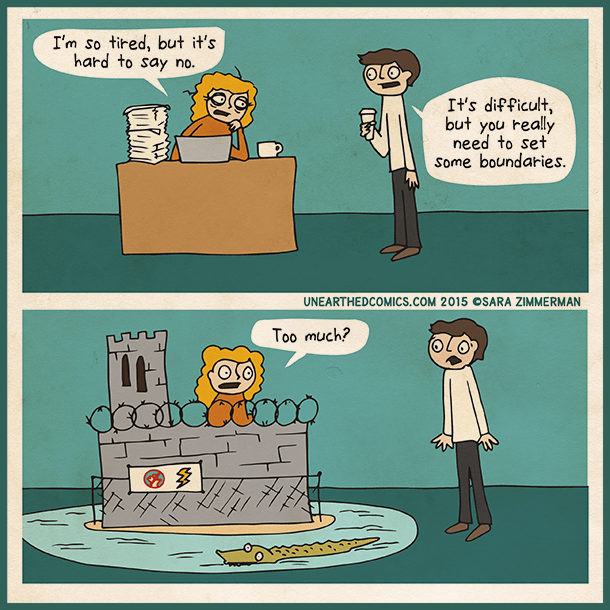
"Boundaries" by Sarah Zimmerman - Unearthed Comics

The Simple Step to Achieve Great Work-Life Balance

Featured image: “Boundaries” by Sarah Zimmerman – Unearthed Comics

The issue of life and work balance is so common that you hear it being discussed all the time – you read articles about it, talk about it with your colleagues, with your family, so on and so on. It’s a struggle that many of us have, sometimes for a lot longer than we anticipate, and oftentimes we sort of give up on trying to fix it; we say “it is what it is,” or “I do what I have to do.” Meanwhile, we, as well as the people we care about, are unable to escape the consequences.

In reality, the step to achieve a good work-life balance is a lot simpler than we’d think, although simple does not mean easy. However, you’re going to find out that although it may sometimes be difficult to apply this step, it is well worth it in the long run. Not only will it keep you from going insane, but family and loved ones will be grateful for it too. So what’s the secret? Simple: setting Clear Boundaries.

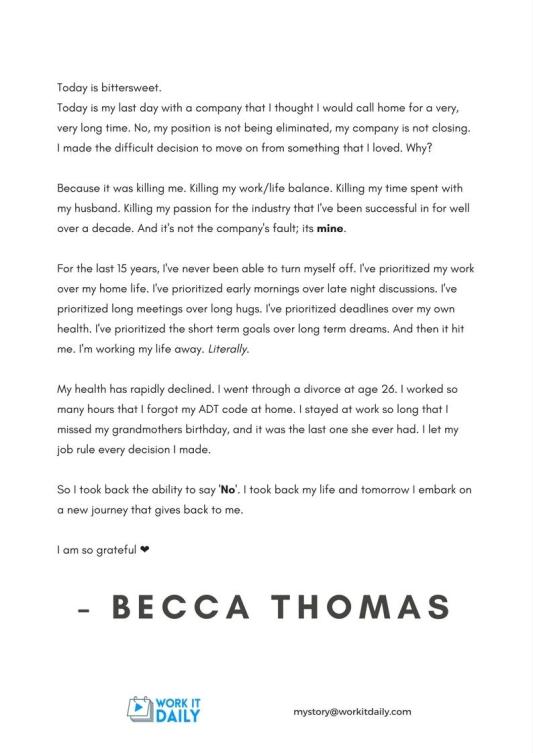
I want to emphasize the word “clear” because a lot of times we say that we’re setting boundaries between our work and our personal life, but in reality we just put up a fort with bendy straws. Having clear boundaries means you have specifics; you set a specific line for yourself that you will not cross when it comes to your work interfering with your personal life at home, and vice versa. Sometimes we realize our need to do this too late, and we might end up telling a story similar to the one below:
6a64f6f0-6a11-4e08-9606-c056bf5f48ab-original

Shared story from Work it Daily

Becca Thomas mentioned how she “took back the ability to say ‘No’,” and while that is essentially what setting a boundary entails, for some of us simply saying “No.” is virtually impossible (at least for me it is). If you’re like me and have a relatively tough time saying “No.” to requests, there are other things you can do for yourself that make it easier to do so, like your time management.

When it comes to time management, there are a couple of ways you can go about it. For example, there are times when my husband has to do some work from home after a full day of work at the office. When this is the case, his boundary is to spend no more than 20 minutes working at home. You could also simply say “I will not work past 6:00pm,” and have that be your boundary instead.

These kinds of boundaries are clear, making them simple to follow, thus making them very effective. Are they easy to follow? Not always – there has been one or two times where Patrick goes a little over the 20 minute limit, but these are very rare occasions. The fact that the boundary has already been established makes it easier to be aware of how you’re handling your work-life balance, preventing you from going on a downward spiral of unbalance like Becca Thomas. Although, with stories like hers I would still argue that it’s better late than never, as you could see from her testimony this wouldn’t be a situation in which “fashionably late” is a good thing either.

So, what will your clear boundary be? Will it be “no working past 6pm”? No checking emails during dinner time? No more than 20 minutes working at home? Or maybe it’s “Thursdays are strictly family days – no phones, no emails”? Of course, it’s hard to decide to step away from your work at times, especially if your role is extremely involved in essential operations of a company. However, there are certain things that will always be more important, that also need your care and time – yourself being one of these. Having clear boundaries to maintain work-life balance will always work out in your favor, and you’ll also find that the business world will not fall apart when you decide not to be a 24/7 working robot. So have at it and take back the ability to say “No.” 🙂

computer20people20-20talia-3875-final_zpsynpbyivy

By Nayadee Wilson

Stop Wasting Your Talent

I’m at the point in my journey where I’m questioning and thinking about what it is that I truly want to do with my life, and how can I get there. So far everything seems to be running smoothly, and all the pieces seem to be falling into place, but I’m still not certain of the image these pieces are forming; i.e. where my life is headed. Which leads me to the next question: What are my gifts? What are my talents?

Last week, one of our pastoral leaders at my church said this:

Let’s say you’ve been planning for quite some time the perfect gift for someone you love. You’ve put a lot of thought, time, and maybe even a lot of money into it. The day comes when you see this person and you finally get to give him/her that very special gift – the one that you personally chose to fit him/her, because that’s how well you know this person. You finally gave that person your gift, and you’re ecstatic about it!

Then a month goes by, and you happen to come across that special gift that you gave to that special person. It’s sitting on a shelf, unopened, certainly not used, and collecting dust. Imagine the feeling you would have, knowing that after making that gift so very special for your loved one, that person didn’t really care for it.

That’s how God feels when you don’t use the gifts that He’s given you.

Whether you believe in a God or not, I believe we can agree that most of us here on earth do feel that we’re alive for a reason and a purpose. We have certain gifts and talents that we were born with, or developed over time, that were meant to impact the world around us. Of course, some of the impacts we make are very small, while others are very big, but they are significant nonetheless.

From time to time we may think that we’re aware of our skills, and that we’re working towards our goals. However, especially when it comes to our careers, oftentimes we let our talents take a back-seat. We follow orders blindly and conform to just making ends meet, justifying our decision to leave our gifts unopened.

The truth is, that when you don’t use your talents you’re not only doing a disservice to humanity, but also to yourself; you were meant to use these! Why should you be stuck at a dead-end job, where your talents aren’t used to their full potential? Why should your gift sit on a shelf?  When searching for a job and taking steps to pursue your career, these steps should always be part of your life marathon, not your practice treadmill.

Maybe you’re taking solid steps in your career, but you still fell stuck. Perhaps the reason you’re in a career rut is because you honestly don’t know what you want to do – you don’t know what your gifts are. Well, that’s a common struggle, but there’s a way around that. You can ask yourself these three questions:

1. What did I want to do as kid?

2. What makes me come alive when I do it?

3. What opportunities have I been given? 

The third question is particularly useful because it’s one we don’t often think about. Maybe you don’t know what you’re passionate about, and maybe you no longer like what you loved as a child, but one thing may still help you: that thing in which you stand out to others. Was there ever a time when someone said to you: “Hey, have you thought about doing XYZ? I think you’d be really great at it!” This is your ticket to exploration. There may be a hidden talent that you didn’t know you had that might be what you were meant to do. You just have to take the opportunity to try it. And if it’s not your thing, then keep searching.

Not everyone believes that we all have a purpose, but even if you don’t believe so, that doesn’t mean you have to wander aimlessly in life ignoring your natural abilities; we can find our gifts and put them to good use. If you know what your talent is, don’t hesitate to use and perfect it – find the job/career/course that will use these to their full potential! If you don’t know what your gift is, then be diligent in searching for it – you can start a “hobby career” and move on from there 🙂 . But whatever you do, don’t waste your talents – they are valuable to the human kind!

computer20people20-20talia-3875-final_zpsynpbyivy

By Nayadee Wilson

**Featured Title Image: [MAYMA-tiiii♥♥♥......] by A♥**

All Hail the Buddy System

Featured image: Sisters Holding Hands After Kids Race, by Alexander Knoch

When I was little, I never really participated in any sort of buddy system (that I can remember). I spent most of my childhood in the Dominican Republic, so my education was a little different. I have, however, heard of the childhood buddy system through friends and what not, but I never really thought much of it. Two weeks ago, I was attending a group teaching at my church that talked about the need of having an “accountability partner” – which is basically the adult version of the buddy system.

As the discussion begins and we all speak up about our experiences, I begin to take a whole new perspective on the importance and the benefits of incorporating the buddy system into our lives – both personal and professional. There are several reasons why we should be using this underappreciated tool to its full potential. Even if you hated having to hold your buddy’s hand during a field trip, you may be surprised to find the kind of impact that “hand-holding” can have. 🙂

  1. My buddy has to find me, and I have to find my buddy.
    .
    The great, yet dreadful, thing about having an accountability partner – which I will refer to as “buddy” throughout this blog – is that it forces us to be responsible and accountable for our actions. Having a buddy means you’re letting that person in to the messy closet that you don’t let anyone see when they come over to your place. (I wish I could say I just thought of that analogy, but I actually heard it from one of our teachers 🙂 ). When this is the case, you truly do think twice about making decisions that you will later have to talk about with your buddy. Being held accountable forces you to take more steps in the right direction, following the natural, human fear of avoiding “shame” and embarrassment that come out of making the wrong ones.
    .
  2. My buddy and I share the same road.
    .
    What’s greatly beneficial about having a buddy is that you can always find someone that has shared/is sharing your journey; someone who can relate to you. I was reading an article called “Why you need a mentor, and how to find one to advance your career,” which makes excellent points on the need for a mentor. A mentor can be a somewhat less “invasive” kind of buddy – one that has most likely walked your current career path and can hence guide you in the right direction. When your buddy has gone/is going through a similar situation as yours, it makes it a lot easier for you (or both of you!) to navigate through it. Although the phrase “misery loves company” isn’t a favorite, in this sense it’s a good thing; the added support can make a world of difference and keep you from falling into holes down the road!
    .
  3. My buddy has a mirror.

    Can you believe that most humans suffer from a lack of self-awareness? Not me!  – Kidding; oftentimes I, too, need a good reality check >_<. But, as you can see, another benefit of having a buddy is that they’re able to see what you can’t – yourself. They can look at your situation from the outside in, and give you the perspective you may be lacking. One of the amazing things that I saw during our group teaching was the amount of people that were simply coming forth about something they needed to change in themselves, and how having a buddy to (lovingly) point this out made it that much easier to act on it. Of course, this is not to say you need to start confessing your problems to a big crowd; these people did that out of choice and support for others. However, do try to find someone you can trust to let into your messy closet/office.
    .
  4. A bad buddy can make us get lost.

    Last, but not least, my favorite thing to keep in mind when choosing a buddy is this: bad company corrupts good character. One thing that someone pointed out during our group study was that you want an accountability partner who will tell you the right things, not point you towards destruction. It really does you no good to get an accountability partner that will not actually hold you accountable when you need to be – that would be pointless and dangerous. When choosing a buddy, choose one that you know to be wise, has your best interest in mind, and is not afraid of telling you the truth (in a loving way). If you’re not sure how to tell, this is where reading and research comes in: if your mentor gave you career advice, what is that advice based on? What were the results in the past? What else supports that kind of advice?Finally, in terms of your personal life, you may want to choose someone other than your spouse or partner (making sure that this someone does not present a threat to your relationship), because you may be biased when having tough conversations. What happens when the issue is about your relationship? Don’t choose your wife/husband/bf/gf as your buddy; it might not end well.

It’s OK to hold hands.

Sometimes we want to do everything by ourselves and prove to the world that we can. For some reason, we’re either afraid or too proud to ask for help or guidance. However, doing everything alone can also hinder our success, and oftentimes even lead us to failure – with no one to tell us where we’re headed. As you can see, many times, two will be better than one. Give the buddy system a try! And, if nothing else, you could just make some great friends and connections in the process – they can always be a beacon of light. 🙂


Unearthed-BeaconOfLight-1611-1-web

Beacon of Light by Sara Zimmerman – Unearthed Comics


computer20people20-20talia-3875-final_zpsynpbyivy

By Nayadee Wilson



Screenshot taken by Nayadee Wilson from YouTube.

Why You Should Listen to Ron Swanson

If you’ve never watched Parks and Recreation, let me tell you that you’re missing out on a major treat and should definitely put it on your watch list. Parks and Rec is a documentary style, political comedy about a group of local government employees (within the parks and recreation department) in the fictional town of Pawnee, Indiana. Some of the major characters in the show are Leslie Knope, a passionate and strong-minded woman who is determined to make Pawnee a better place, and Ron Swanson, a simple, straight-to-the-point libertarian who could care less for the government, yet is the director of the Parks and Rec department. Ron is one of my favorite characters because, 1. It’s impossible not to laugh with him, 2. Throughout the show he actually provides great, useful advice to basically everyone, and 3. His quotes are the best.

In episode 16 of season 4 (Sweet Sixteen), Leslie is trying to manage her campaign for city council while also handling her deputy director job in the Parks department. Ron keeps insisting that she take a leave of absence and focus on one thing at a time, but determined Leslie refuses to do so. Why am I writing about this? Well, because if I had a quarter for every time a job seeker said “I’m great at multitasking,” or every time an employer stated “We need a candidate with the ability to multitask,” I probably could have paid off my house by now. Episode 16 of Parks and Rec can teach all of us an often overlooked truth: multitasking isn’t all it’s cracked up to be; it’s actually not the “greatest” skill of all.

  1. Leslie had super powers. Which were fake.

    Leslie believes she can do it all. And, frankly, she’s usually very good at accomplishing what she wants. Nonetheless, during this episode, where she attempts to use her “I-am-Leslie-Knope” multitasking powers, she fails to see how they aren’t working when things begin to fall apart. As Ron begins to take notice, he immediately advises her to “take a sabbatical.” When Leslie ignores his advice, Ron decides to keep an eye on her while being amused by her mishaps, waiting for her to figure out on her own that she’s overworked.

    Like Leslie, most of us who pride ourselves on being great at multitasking believe that we can do it all. However, research shows that our productivity actually goes down by as much as 40%, and we get a lot less done. So, if you’re like Leslie and have tricked yourself into thinking you’re Superman or Superwoman, this serves to show that you should probably just listen to Ron Swanson.

  2. Leslie was in control. Of nothing; she was in control of nothing.
    .
    Leslie was so used to tackling a million things at once that this was a no biggie for her. She had been multitasking for so long that she was great at it, and had everything under control – except, she didn’t. While Leslie tries to manage her job and her campaign at the same time, she eventually loses control of her situations and mentally crashes (she ends up falling asleep during the surprise party that she was throwing for her coworker, Jerry). 

    The reality is that we don’t actually multitask, we just switch from one task to another – some can just do this quicker than others. When this happens, we become less competent in what we are trying to achieve – and the more we do it the worse it gets. “Practice makes perfect” doesn’t actually work in this case, no matter how badly we want to believe that it does. If you find yourself losing control while trying to do it all, then you should probably listen to Ron Swanson.
    .
  3. Leslie dropped the ball. More than once. More than twice.
    .
    In the episode of “Sweet Sixteen,” Leslie made mistakes. A lot of them. For example, Leslie is always very caring about her coworkers, and never misses their birthdays. But, this time she forgets Jerry’s birthday and attempts to throw him a belated “sweet 16” party (he’s 64, but his birthday is on February 29th so she reasons that he’s only had 16 actual birthdays). She then forgets to invite Jerry. She also forgets to pick up the cake. In the meantime, she realizes that they’ve also messed up her campaign signs, so she rushes back to the printer to have them fixed, and then replaces every single sign in Pawnee herself. They finally make it to the party sometime in the middle of the night, waking everyone up, and she then falls asleep on the couch, on top of Jerry. 

    What happened to Leslie is far from unusual; we actually suffer a fall in IQ when we become distracted by multiple things (which can be the same impact as losing a night of sleep). As it often seems to happen with most of us, while Leslie is usually on top of her game, everything came crashing down when she attempted to do it all – she should have just listened to Ron in the first place.

Listen To Ron Swanson

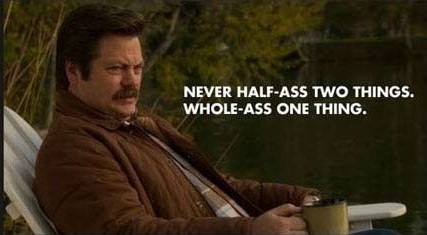
The next morning, Ron takes Leslie out by the lake and has a talk with her, finally convincing her to take a leave of absence. It was this sole moment in the entire episode that made me want to write about it, and it is one my favorite Ron Swanson quotes as of yet (depending on what else he says – I’ve recently discovered this show, so I’m a little behind). Like many of Ron Swanson’s quotes, what he said to her was simple, to the point, and had a sense of eloquence. The reality is that when we give our attention and focus to one thing at a time, the results are usually ten times better than what they would be otherwise. So, the next time you’re in a multitasking nightmare, you should just take a deep breath, and listen to Ron Swanson: “Never half-butt two things. Whole-butt one thing.” Of course, his actual quote is slightly jazzier than how I put it:

The-best-quotes-by-Ron-Swanson - from Thumbpress
For some of Ron’s funniest quotes, go here. And to tap into some Ron Swanson wisdom, check this out.

computer20people20-20talia-3875-final_zpsynpbyivy

By Nayadee Wilson

Maybe You Should Just Start Showing Up

*Featured image: Delana Flowers (far right and front) during a performance in 2015*

I think that the greatest talent that humanity has is making excuses, and the greatest impediment to our goals is actually having these said excuses. However, a lot of us have been able to get around those impediments and work toward our goals anyway. Some of us have come to a place in our lives where we tell ourselves, “So, I can’t do this… but I’m going to do it anyway and see what happens.” Woody Allen once said “80% of success is showing up,” and I can’t think of a better example of this notion than our very own Delana Flowers, who starred as Lorrell in the musical, Dreamgirls, at Pittsburgh Musical Theater this past week.

Delana Flowers, our awesome admin at FinancialPeople Staffing in Pittsburgh, has an incredible preforming talent, and some pretty amazing pipes – the girl can sing! As we all began to talk about her show around the office, I asked Delana to tell me more about her performing side. As it turns out, most of Delana’s performing success all started with her decision to simply show up to things she didn’t even intend to take part in. As she went on to tell me her story, something she said immediately stood out to me:

“I moved to Pittsburgh where there was plenty of Community Theater. I got involved almost immediately, but totally by accident, after being dragged to a rehearsal supposedly to observe. From then on, God continued to open doors for me.”

Delana went to a rehearsal just to “observe,” and out of this no-biggie attendance to something she wasn’t even a part of, she began to be involved in the things she was passionate about. What’s interesting is how she stated that she was “dragged” to this rehearsal, so it doesn’t look like her heart was necessarily set on going to this – but she went anyway. So, what happened? Well, she showed up, which led to her being cast in Ain’t Misbehavin in 2008, she was cast as Dinah Washington in 2015 (a show with 25 plus songs she had to learn from scratch), she was cast in JH: Mechanics of a Legend, and, in Delana’s own words, she “did more community shows than I can count at this point.”

The story of attending that rehearsal alone demonstrates the power of showing up, but it doesn’t end there. To land her role as Lorrell in Dreamgirls, Delana had some more showing-up to do. Not only did she have to show up, but she had to do what most of us dread: wait (Ugh! – right?). This is what she had to say about her audition for Dreamgirls:

“I saw an ad for a regional theater holding auditions for Dreamgirls. I wasn’t going to go because I didn’t feel like I knew how to audition on a professional level. My leading man in John Henry pushed me to go. He told me I had nothing to lose. I was nervous, but I went. They called me back 3 times and a whole month went by before I heard anything. Meanwhile, my co-star who pushed me to go to the audition found out in a matter of days that he had been cast. Finally, the call came and rehearsals were to start a week later.”

I’m sure we can all empathize with Delana in one way or another, like being a nervous wreck before an interview, doubting yourself, waiting for that call afterwards to know whether or not you got the job – just to mention a few. Nevertheless, she hung in there, she showed up, and boy did it pay off! Of course, this is not to say that all you need to do is just “be there,” Delana also talks about the hard work that came afterwards:

“I walked into a room full of actors and dancers… with musical theater degrees, music and/or dance degrees and classical training. I came with none of these things! We had a 3 week rehearsal process to put up this Broadway level show. If you added up the rehearsal hours which were typically 8 hours a day, it amounted to about a week and a half. It felt like boot camp! …This was my first professional show and my first show at one of the big theaters downtown. I was terrified and I had several meltdowns along the way.”

Finally, with heartwarming joy, Delana ended her story with this:

“I made wonderful new friends who refused to let me doubt myself. They worked tirelessly with me to learn everything I needed to learn. This was the hardest and biggest thing I have ever done. All I could do was keep showing up, keep working, and cry when overwhelmed. By the time we closed the show last Sunday, I couldn’t believe I had been part of such a spectacular show. It was an absolutely amazing experience I will never forget.”

Needless to say, working toward your goals will most definitely require hard work, but the hard work will never get started unless you start showing up – like Delana did. There will always be times in which the possibilities we dream of seem almost unattainable, where we will doubt ourselves, have meltdowns, and wonder if that small step will even be worth it. Well, Delana’s success story raises two very important questions that we should always keep in mind: How many doors could be opened for you, if you simply show up? How many doors will you continue to miss? Maybe you should just start showing up. 😉 

Check out some clips of Delana’s performance!:

computer20people20-20talia-3875-final_zpsynpbyivy

By Nayadee Wilson

“If Your Resume is More Than a Page Long, They Won’t Even Look at It”

A few weeks ago, maybe even a few months ago, I responded to a Facebook post of a friend who was asking for advice on the appropriate length of a resume. She was particularly interested in knowing if having a resume longer than one page would actually hurt her chances of getting a job. As I was skimming through the answers that she was being given, it amazed me how many people have such a misconception about resumes. I was seeing things such as “It should always be one page,” and “Nope! If it’s more than one page they won’t even look at it.” That last one actually made my eye twitch, because there was a time where I, too, fell for that lie. Part of what I do involves looking over and adjusting resumes for a lot of candidates, making them appropriate and relevant for our clients to see. So I can be the first one to tell you that a one page resume is not the be-all and end-all of resumes. Since I am still learning myself, I decided to do a quick survey around the office with some of our top recruiters in order to find out what is really essential within a resume. Here are some key things you should consider when putting together your resume.

  1. How many pages?
    The truth is: it depends. Although it truly bugged me when I heard someone say that if your resume is more than one page “no one will look at it,” there are situations in which your resume should in fact be no longer than one page. But in most cases, it can be. After my survey, we can safely come to the conclusion that the magic number, if you will, is two pages, but never more than three. But don’t take it from me; take a look at some of our recruiters’ responses:

    “It really depends on the years of experience the candidate has worked in a related field and their area of expertise.  In Finance & Accounting, a resume really should not be more than 2 pages.” – Debbie Kriess, Managing Partner at FinancialPeople Staffing – Pittsburgh.

     “Length depends on experience level.  Someone with five or less years of experience could probably get it on one page.  In IT, it’s not uncommon for someone to have a three page resume but I really don’t recommend any longer than that. For someone with 10-20 years of experience, I would expect a two page resume.” – Brooke DeLucia, Technical Recruiter / Manager at ComputerPeople Staffing.

    “A new college grad/entry level candidate: one page.  Someone with 10+ years of relevant experience: 2-3 pages. Beyond three you risk losing the attention of the reader.” – Kara Bermingham, Managing Partner at MedicalPeople Staffing.

     “A recent college graduate should most likely have a one page resume, where as an experienced professional (10+ yrs.) could very well have a three page resume. I do believe, however that three should be the limit.” – Faith Drew, Research Analyst at FinancialPeople Staffing.

    “A one page resume is perfect for early to mid-career employees but a two page resume is fine for people who are further along in their career. Except for rare exceptions, a three page or longer resume usually is not a good idea.” – Beth Courtney, Sr. Technical Sourcing Specialist at ComputerPeople Staffing.

  2. How should it be written?

    Too often I’ve come across a lot of resumes that look either too cluttered, have too much space, are not formatted properly or are just plain difficult to read. This would also include having too much jargon or words that seem out of place; i.e. words to make you sound “smarter.” Founder and CEO of Human Workplace, Liz Ryan, talks about this aspect and explains how your resume should have a “human voice,” and should not be laid out as if it’s some form of legal document. What you want to do is make sure that your resume is easy to read by organizing it appropriately, having a proper format, have a “human voice,” and being precise. Here are some tips from our recruiters:

     “Most people scan resumes – you want it to flow and have bolded or underlined words that highlight the important parts such as job title and company.” – Faith Drew.

     “Drop the objective! Use a summary style paragraph that pinpoints the role you are looking for along with your areas of expertise and what you can bring to the table. It’s like a quick “sell” that is meant to draw the reader in and make them want to learn more about you.” – Brooke DeLucia.

    “If a resume has long paragraphs without a break, it’s very unappealing to read and I often skip over that section. I like to see bullets (but not too many) and enough white space between sections that it’s easy to read. I’d much rather read a well-spaced 2 page resume than a one pager that’s all crammed together. Also VERY important to check for typos and remember that spell-check doesn’t catch everything. Have someone else proofread your resume for typos, misspellings, etc. ” – Beth Courtney.

  3. What should I put in it?
    So now you have an idea of how long your resume should be and how it should be written, but you’re not sure what exactly you should actually put in it. A lot of people, myself included, have believed the notion that you should put all of your experience on your resume, explaining what your responsibilities were during each position. However, while this is important, I will say that something we often forget is to include results in our resumes. A results-oriented resume will be a lot more appealing to a recruiter than a resume that simply states “I was in charge of accounts receivables.” Showing results, such as “I increased sales profit by 10% using procedure ABC,” shows the recruiters not only what you’re capable of but also what makes you valuable. Here are some additional tips from our recruiters on content:

    “(These are specific to a Technical resume), Skills section containing keywords/skills – Allows me to quickly skim the resume to see if the candidate has the basic skill set for a specific position. Highlight Accomplishments – To me this is important because it shows how the candidate differentiated themselves from their peers.” – Kevin Pyle, Technical Recruiter at ComputerPeople Staffing.

    “chronological work history, is usually the best way to go unless you are trying to change careers.  If so, a transitional resume which highlights skills may be the preferred way to go, just be sure to include work history at the bottom.” – Beth

    “For Technical resumes, it’s important to list the relevant technology ‘buzzwords’ in context with each job.  It’s good to have a Technical Skills section as a general overview but you still need to show where you used a particular skill and what you did with it.  Try framing your bullets as ‘Project, Action, Result,’ (saved or made the company money, saved time, improved a process or service)”. – Brooke DeLucia

    “Don’t forget accomplishments!  Does your resume sound like a generic HR job description? Your resume should set you apart from your competition and be very personal to you and the unique attributes and accomplishments you bring to the table.” – Brooke DeLucia

    “A resume should include key technical skills, and should be a mix of accomplishments and tactical day to day responsibilities” – Debbie Kriess

    “Dates – resumes that do not have dates of employment are a huge red flag. I want to see when you worked at certain companies, take note of any gaps in employment, and know if you are currently employed or unemployed” – Faith Drew

Now that you’ve gotten some tips, you can go ahead and make sure that your resume is in top shape. Make sure that you have someone else proof-read your resume, to ensure that all typos and inconsistencies are taken care of, and don’t forget to include important elements such as achievements and skills! Happy writing! 🙂

computer20people20-20talia-3875-final_zpsynpbyivy

By Nayadee Wilson

How to Win an Argument – Once and for All

Featured Image: Ways To Settle Arguments

So, lately I have witnessed my fair share of intense arguments, not only on my Facebook feed, but also on my LinkedIn, Twitter, as well as among my friends and family (I have actually partaken in some of these). It is no hidden fact that as a society we will have differences, which can result in conflict, but sometimes healthy debates are necessary and good in order for our society to function. I mean, could you imagine? A world where we all had the same thoughts, same likes, and same passions? Not sure about you, but to me, that sounds unpleasantly robotic. However, nowadays we see very few friendly debates; we mainly see full-blown arguments, with the sole intent of attaining victory and to change our opponent’s mind, as opposed to inform and simply listen to one another’s point of view. So, what is the fool-proof way of winning these arguments? That’s simple: avoid them – and here’s why.

  1. “You have a duty to speak up.” 

    I can see how the circumstances of unfairness and the human responsibility to look out for one another can send us into a down spiral “discussion.” However, the belief that we have a duty to always give our opinion is not true, and it is not what “speak up” means. When you start/enter into an argument in which your thoughts were not necessarily requested, it will only cause hostility. Doing this will not make your opponent like you; it will only make him/her strike back. I once saw a quote that said “instead of attacking what you hate, start promoting what you love,” and it truly stuck with me. If you truly want to speak up, start upholding and working towards what you believe in, and stay away from the unwanted, pull-your-hair-out arguments 🙂 .

  2. “You can prove them wrong.” 

    Yes, you can provide amazing facts, charts, examples, and use many other great tools all for the sake of proving your opponent wrong – but, at what cost? Although these things are great when used in friendly debates (those discussions that lead to information and communication rather than confrontation), it is counterproductive when used in a heated argument. Within the environment of an escalated dispute, proving someone “wrong” will not only insult your challenger’s intelligence, but it will also make that individual feel inferior, hurting whatever relationship you have (or could’ve had) with that person – even if the damage doesn’t show immediately. The take-away from this: always aim to simply inform and communicate, rather than using these great tools to humiliate and insult.

  3. “You win.” 

    Actually, you don’t. When you lose an argument, you lose. When you win an argument, you also lose. How? Because even though you will feel awesome, triumphant, and will want to tell your mom all about it, the other person does not. Their pride has been hurt, he/she feels degraded, their self-respect and judgment feel attacked, and most importantly: that person will just resent you for your great “win.” Oftentimes we believe that by proving someone wrong and proving ourselves to be right, we have won the person’s opinion in favor of ours. However, the truth is, as Dale Carnegie put it, “a man convinced against his will is of the same opinion still.” Winning an argument will never change anyone’s mind. What can change people’s minds, however, is your life example as to how you live by what you preach. This is not to say that you will never make mistakes; I have made plenty – yet it does not mean I have to advocate for the mistakes I’ve made. If you fall, pick yourself right back up; acknowledge and learn from your downfall. Doing so will not show that you’re a “hypocrite,” it will rather deepen your credibility and show your ability to correct yourself when you have failed.

I hope that by now you are as turned off from arguments as I am – it truly serves no good purpose! Of course, as I previously stated, friendly and informative debates/discussions are healthy, and needed for our society to function. Nevertheless, keep in mind that heated and escalated arguments are not debates; they fail to be properly informative (because the other person is not interested in listening), they do not serve the purpose of good communication, and they cause more harm than good. I am certainly not saying that I have not been caught up in these myself, especially when it comes to topics that I am passionate about, but slowly and steadily I am learning that this is not an effective way to have your voice be heard. Take the time to do some reading, keep yourself well-informed, and remember these words from Dale Carnegie:

Why prove to a man he is wrong? Is that going to make him like you? Why not let him save face? He didn’t ask for your opinion. He didn’t want it. Why argue with him? You can’t win an argument, because if you lose, you lose it; and if you win it, you lose it. Why? You will feel fine. But what about him? You have made him feel inferior, you hurt his pride, insult his intelligence, his judgment, and his self-respect, and he’ll resent your triumph. That will make him strike back, but it will never make him want to change his mind. A man convinced against his will is of the same opinion still.” – How to Win Friends and Influence People, by Dale Carnegie.

computer20people20-20talia-3875-final_zpsynpbyivy

By Nayadee Wilson

Getting Your Mojo Back After The Holidays

Even as I write this I am struggling to keep my focus and motivation. What others would call “writer’s block,” I am calling procrastination. To be fair, I believe that this is simply the effect from a cause that we all know too well: the “After-Holiday Blues” (I think I just made that name up, but you get my drift). There is no doubt that returning to work after the freedom of the holidays is hard; the heavy thought of “I don’t feel like going to work today” fills our mind like an ugly plague. To get out of the wishing-for-a-never-ending-holiday stage, here are some ideas that may help in getting your mojo back and start up some motivation.

Music heals all.

One thing you may want to try is playing some cheery music (quietly, if allowed) while you’re working. Music has the amazing effect of altering the way we feel. Playing music while you work will make you feel happier, and in turn, more productive and motivated to work. I, for example, like to listen to talk shows while I work – not necessarily “music,” I know, but it is something that soothes me and makes me feel good. When I don’t have my talk shows on, I love to listen to upbeat songs and have my own little party – you could do the same 🙂 . Additionally, if you wanted to keep the holiday season going in your own way, go ahead and play songs like “Sleigh Ride” (one of my favorites) over and over until you’re satisfied – whatever makes you happy! Whether cheery music means sad country songs or super upbeat Christmas songs, choose whatever works for you; get working while enjoying the beat.

Something nice to have.

I am always like a little kid on a sugar rush any time I have anything new – it could be something as simple as a nice pen (I do love nice pens *_*). If you’ve received something nice during the holidays and you can bring it to work, go ahead and take that with you. Having something nice to look at, especially something you really enjoy, will make you feel more at home and boost your mood. I’d recommend even getting some nice office supplies of your own (or something related to the job that you do) so that you’re motivated to use it. New things are always exciting! These can range from really cool mouse pads, to awesome pens, a fancy calculator, or even just a plant for your desk or a new picture for your screen background. Today, for me, my nice thing to have was a really nice sweater that I got over the holidays. I feel pretty and uplifted, and that is what counts! 🙂 Of course, not everyone has the same likes/dislikes, just make sure that you find something that makes you feel inspired and bring it with you – whatever that may be.

There is always a first step.

This blog is a prime example of the power of this tip. I was not initially motivated to start this, but without thinking I just opened up Word Document and started writing – now here we have a blog. Every job or task that you have needs to start somewhere, and all you have to do is take that first step. Chances are that once you get started on your task, you will gain momentum and follow through with the project; even if it is just for that day (then you have to take that first step again, the next day). Usually the first step is always the hardest to take, but, in most cases, it will always be the most simple. You will quickly find that just a few minutes after taking that step, you’ve actually already made some great progress. 🙂

We can be merry all year round.

I know there are times in which we all wish for longer breaks, but what fun would that be? After all, our breaks serve as great satisfaction after a job well done. Although some may be wishing for the holiday season to just be over with, most of us can agree that, even so, coming back to work can be mentally challenging. At least now you know that there is no need to fret, and you can easily get your groove back in the workplace. Just because the holiday season is over doesn’t mean that you can’t carry it on in your own way, if you wanted to. For this New Year, remember to stay merry, and never stop showcasing the best of your talents – that is what you are there to do!

computer20people20-20talia-3875-final_zpsynpbyivy

By Nayadee Wilson


4 Traits of a Company You’ll Want to Work for

Searching for a new job is not always nice and easy. It takes a lot of time, preparation, diligence, you name it! Not only is this search mentally exhausting, but it’s hard enough just getting an interview, let alone finding that awesome company you’ve always wanted to work with. Sometimes we get so caught up in our temporary state of desperation that we are ready to take whatever comes first. Or, the opposite may happen, where we are so stuck in our financial requirements or desired job title that we refuse to work with any company that does not meet those specific needs. Well, you may find that in either situation the decision to accept/refuse a job offer without considering the kind of company you will work for may cost you. Here are some things that I’ve learned say a lot about a company’s structure, which can help you make the right decision when it comes to your next career move.

  1. Let’s not forget about our community.

    13445778_733886806714802_800525899345431082_n_zpskfk2pq0g

    Cindy and Kaitlyn at the Susan B. Coleman Race for a Cure – June 2016

    One of my favorite traits of CP Staffing Solutions is the company’s ability and desire to care and be involved in the community that we are part of. Willingness to give and take care of the community says a lot about a company because it shows that they care about more than just making a profit. When the company cares about others, it means that they will care about you. When they care about you, it means you will have opportunity. Here is one of the messages our president, Cindy Neese, has sent to us:
    “Team,
    I wanted to share this email with everyone in the office.  Kaitlyn recently made me aware of this Volunteer WNY Newsletter that goes out by United Way.  If you sign up, you will get then notifications of different opportunities with non-for-profit organizations locally that are looking for volunteers for different fundraisers. As a company, I would like to see us do at least 2 of these each calendar year, but there may be opportunities for you to sign up as individual or family event that you might like to do.  Also, if we see something that we can do as a team, this would be a great way to get those notifications.   If you click on www.volunteerwny.org, it will take you to the main site where you can register for the monthly newsletter.

    Thank you, Cindy”

    If you’re not sure whether the company you’re interviewing with has much involvement in their community, then feel free to do some research. Additionally, this could be a good question for you to ask during the interview. When the dreaded “do you have any questions for me?” statement comes up at the end and you draw a blank, you could ask, “Do you have any outside projects that you participate in as company, such as volunteer work or anything like that?”

  2. Our employees make this baby run!

    untitled20design_zpstplhepqq

    Employee Appreciation Happy Hour!

    So maybe the company you’ve encountered doesn’t have the chance to do much volunteer work, but they have other ways in which they show they care: the unquestionable value of their employees. When higher management openly expresses appreciation for their employees, it says a lot about the kind of environment you will be working in. I’ve never met anyone who is a greater example of this than our very own Cindy Neese (I will talk about her a lot, because she truly is awesome).

    In a previous blog titled “Note from the President; Cindy Neese on Leadership,” Cindy wrote how “Many leaders could never imagine leading a company with Love – the verb not the emotion.  I am talking about actions, not feelings,” and I could honestly say she practices what she preaches. Cindy never misses the opportunity to let us know when we do a good job, (no matter how small the task is), she lets us know the ways in which our job is valuable and useful – just this morning she came in to ring a bell to tell everyone how they’re doing a wonderful job, due to some good news she had just received – and she does her best to do really nice gestures for us all. Not only does this kind of appreciation motivate employees, but it makes us happy to come and work with her.

  3. We’re like a second family.

    turtur_zpshvoh4wrx

    Facebook post from a valued employee 🙂

    One of the most important facts about valuing employees is that the expression of care is contagious! As a leader, Cindy teaches all of us how to treat each other in the same manner, which makes for a great atmosphere in the workplace. A great company will not only have top management care for you, but it will also have its employees caring for each other. It is a huge sign of good leadership. The same way our president gives praise to her employees, we also give praise to each other. The same way she makes great, small gestures, we also do those kinds of gestures for each other (as you can see from the picture on the right). I love our team! 🙂

    When you decide to work for a particular company, it might be a good idea to scope out the atmosphere. How do employees treat each other, talk to (or about) each other? If you can’t really tell at first glance, you could check out some of the company reviews online. Additionally, if you know someone already in the company, you can ask them for their opinion on how they feel about the environment. Having a good crew to work with means you will have a much more relaxed environment, making you feel more motivated to come to work, as opposed to having to come in to work with people that just… don’t necessarily make for a great experience. 🙂

  4. No more drama!

    The very last thing you would want to deal with at your new job is drama. This is not always very easy to spot from a first interview, but it will not take long for it to surface if you’ve already started the job. One way you can spot this trait is by watching for the kinds of things your interviewer decides to share about the company or its staff. A previous coworker and friend (from a previous company I used to work for), told me about their interview experience. This individual was completely in shock because, during the interview, the manager began to talk about the employees, and not necessarily in a positive way. The interviewing manager talked about some of the employee’s personalities, using phrases such as “so-and-so can be very defensive,” as well as, “we have someone who doesn’t seem to want be here,” and, “everything is a mess because so-and-so did this,” etc.

    When the interviewer blatantly discredits his/her employees, it may be a sign of mistrust, favoritism, and undervalue. This is the part where you start to look at your other options (red flag alert!). Having this kind of environment in the workplace can attribute to significant levels of stress, as well as interfere with your ability and skills to do your job in the first place. It also makes you question the kind of opportunity you’ll really have in the company if it will mainly depend on how much your boss “likes you.” 

Choose success, but don’t forget peace of mind.

Before making the decision to jump on board or “swipe left” on a particular company, make sure you take note of the little things. Working for an unethical company or one that does not value its employees and/or their talents will only hurt you in the long run, and you will be miserable – no matter what your title is or how much they pay you. If you’ve already started working for the company, these traits (or the lack thereof) can be easy to spot. If you see some issues, your best bet is to run as soon as you can – while never forgetting to be professional. Even if you’re not being directly affected, it is only a matter of time before it catches up to you. By all means, choose a career path that will bring you success, but be very careful to choose the right company to help you get there! 🙂

computer20people20-20talia-3875-final_zpsynpbyivy

By Nayadee Wilson

4 Staffing Agency Myths You Probably Believed

Since I’ve started working for CP Staffing Solutions (we’re awesome, by the way), I’ve come into several conversations about staffing agencies with some of my friends that have left me a little surprised – well, maybe not so much “surprised” as much as “curious.” I came to find that some of the things that people think and believe about staffing agencies are incredibly misconstrued. Furthermore, it made me wonder, how is it that these misconceptions have gone on for so long? Working for one directly, I can be the first to tell you that many of these are just simply not true; you’ve been bamboozled! Let’s tackle some of these myths and uncover some great truths.

  1. The fee
    Myth: A staffing agency will take a cut from your salary.
    Fact: The hiring company pays a staffing fee to the agency, not you.

    I can see how people can come to this conclusion; I thought the same thing when I started searching for a job through a staffing agency. However, the reality is that the hiring company pays a staffing fee to the agency based on, but separate from, your salary. A few years ago I took some time away from the workforce to travel, and when I came back I needed a job (like ASAP), so I went through a staffing agency. Not only did I not have to pay a fee, but they also did all the job searching for me and I got a job in less than a week after meeting with them. Working with an agency actually has some pretty good perks, and it will not cost you a dime. Here is what some of our recruiters had to say on the subject:”It’s amazing how many people still think that’s true.  It WAS true many, many years ago when I went through an agency.  They wanted a percentage of your first year’s salary but that is not the case now.”  – Beth Courtney, Sr. Sourcing Specialist at ComputerPeople Staffing.

    “A company that decides not to make an investment in an employee because of an agency fee likely isn’t a company you would want to work for anyway.” – Faith Drew, Recruiter at FinancialPeople Staffing.

  2. The pay negotiation
    Myth: An agency job will probably be low-pay, and you won’t be able to negotiate.
    Fact: Agencies provide a wide range of salaries, from entry level to experienced positions, and will facilitate negotiation.

    So this one is kind of a two-fer; not only do people believe that agencies will offer them a poor salary, but they also believe that the option of negotiation is off the table. What actually happens is that a recruiter will look at your resume and your experience, talk to you about what you’re looking for, and give you a realistic and honest perspective on what you should expect. The great thing is, you don’t have to be afraid of telling your recruiter what you want or what your absolute minimum is. In fact, some of the best chances of negotiation will happen with your recruiter because they are the ones that deal with the company directly; they can negotiate the best pay according to your salary preference and experience. Oftentimes negotiating on your own can be awkward and/or stressful (at least for me it would be O_O), while recruiters are usually trained in this area. Instead of running the chance of starting your new job on a wrong note, having your recruiter negotiate your salary will ensure that everything goes smoothly, and you would still look like a superstar 😉 . See? This actually works out in your favor. 🙂

  3. The temporary job
    Myth: Agencies only offer temp jobs.
    Fact: Agencies offer all kinds of jobs.

    Simple and to the point: we have a wide variety of jobs, not just temporary jobs. The misconception may come from the fact that a lot of these jobs may start out as a temporary role, but often times these temporary jobs will turn into full-time, permanent ones. Good companies like to keep good talent; if you do end up starting out with a temporary gig, make sure you showcase your best! 🙂 Here is what one of our recruiters had to say on the matter:

    “We work with all position types—permanent, contract/temp, temp to perm, and per diem.” – Liz Ragan, Recruiter at MedicalPeople Staffing.

  4. The low quality factor
    Myth: Agencies don’t have good “big girl/big boy” jobs; you’d be lowering your standards.
    Fact: A lot of great, high paying jobs can only be found through a good agency.
    Really take the time to think about it: why would a company go through the trouble of paying professional recruiters to find them employees? Well, simply put, because they want the best talent for the best jobs. Otherwise the company would be, basically,  wasting their money. An agency can find you jobs that you could otherwise miss, so it’s certainly worth your time. Here is our last thought:

    “Most of the clients we work with only work through recruiters. This is especially true at large companies when it comes to contract roles, and small companies when it comes to permanent roles. So working with an agency is often the only way to find jobs like that. Companies invest in agencies to find them the best talent that will stay long term and be a good fit long term.” – Faith Drew, Recruiter at FinancialPeople Staffing.

Now that we’ve uncovered some truths, if you’re looking for a change of pace, a new job, or a new career path, give the staffing agency a shot! You never know – you could very well find your dream job when you least expect it. And just to let you in on one last, little secret: no one will go out of their way to prep you for an interview the way your recruiter will (at least all of our recruiters do!), optimizing your chances of getting the job. What more is there to say? Give it a try, and see how it goes. From my personal experience, staffing agencies have always been a great help in my career search, and they could very well do the same for you!

*This blog was expanded from the original blog “Five Misleading Myths About Getting A Job Through a Staffing Company“*

computer20people20-20talia-3875-final_zpsynpbyivy

By Nayadee Wilson