Category Archives: goals

CP STAFFING PARTNERS WITH JOURNEY’S END REFUGEE SERVICES TO GIVE BACK

What is Journey’s End?

Journey’s End Refugee Services, Inc. is a Christian community-based refugee resettlement organization. Their mission is to welcome refugees without regard to ethnic origin or creed and to assist them to become healthy, independent, contributing members of the WNY community. Journey’s End offers an array of services on top of assistance with refugee resettlement including education services, employment services, immigration legal services, and interpreting services.


How did we get involved?

Immigration and refugees are such important topics in the US, but one of our ComputerPeople Staffing employees, Beth Courtney,  was really inspired to help incoming refugees from her son.

Beth’s son and two friends spent the summer of their junior year at Notre Dame researching the refugee crisis in Europe.  They spent two months visiting refugee camps and hearing the heartbreaking stories of brave families from war torn countries who were fleeing for their lives.  He showed Beth hundreds of pictures of these families and shared their stories which inspired her to do something to help.

Beth found out about Journey’s End and suggested our company could help by volunteering with their Home Again Program.  This program has groups of volunteers clean, furnish and set up an apartment or home for incoming refugee families. Journey’s End describes it this way, “Barren apartments are transformed into cozy homes for newly arrived refugee families. After long and arduous journeys to the United States, a warm and cozy apartment brings a sense of security to families that have lost and left so much.”


About Friday.

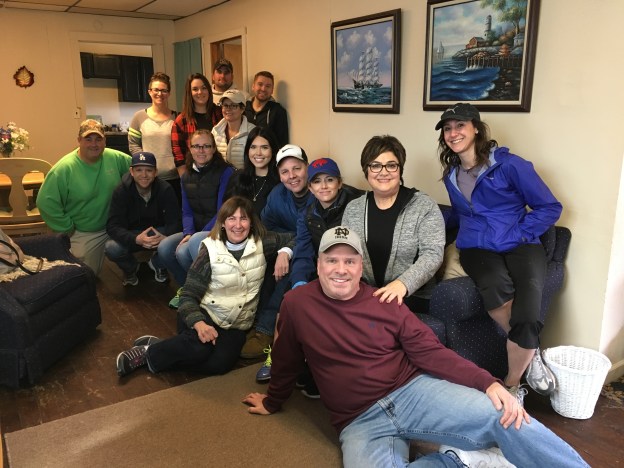
The CP Staffing divisions of ComputerPeople, FinancialPeople, and MedicalPeople spent two months working together to collect furniture, bedding, lamps, dishes, pots, pans, and everything else needed to furnish a home. On Friday, the staff from our Buffalo office went to work and scrubbed the house down, moved in, set up all of the furniture and household items, and decorated the house to make it feel like a home.  This week, a refugee family from the Congo with four boys arrived and moved into the house for their new start in Buffalo. We are so grateful to have had the opportunity to work with Journey’s End and give this family a brand new start!

You can view video highlights from Friday’s home upgrade on the YouTube Video by FinancialPeople’s own Faith Drew


dsc_5490-1.jpg

Written by Kaitlyn Gahagen

What Happens When You Have a Personal Mission Statement

From our early stages of life, usually we all have goals and dreams. Some of our goals may change along our journey, some may remain the same, but depending on what they are and who you are, these can be very versatile. One thing that can always remain constant, however, is something we often forget to even define for ourselves: our personal mission statement.

I was listening to a radio talk show a little while ago, and while the main topic of that discussion has slipped from my mind, one thing from the conversation did stick with me. Someone was asked what their company’s mission statement was, and afterwards they were asked, “and what is your personal mission statement?” That’s when it hit me: a defined, personal mission statement can be a very powerful thing, and here’s why you should know what yours is.

  1. Your mission statement is your guide.

    Here at CP Staffing, our mission statement is
    “CP Staffing Solutions is committed to being the clear partner of choice to our client employers and the individuals that we represent.  This is achieved by working tirelessly to understand our client’s needs and delivering staffing solutions that improve their competitiveness.  We strive to serve as a lifetime source of career management for the individuals we represent.”

    This statement is what drives everything we work towards, and how we get there. My point: your personal mission statement does the same thing; it’s where all your goals and aspirations will come from in the first place – what drives you to do what you do. Once you know what you want your life to represent, what you want to stand for (what you’d like your legacy to be), it becomes easier to map out your life goals in order to abide by your mission.

  2. Your mission statement keeps you on track.

    Because your statement is your guide, it means that when you’re going the wrong way, taking a look at your mission statement can sound off the alarm. A lot of times we’ll make goals for ourselves, want things, or make decisions that seem great at first, but can hinder us instead of move us forward. Just because we fit in somewhere, it doesn’t mean that’s where we belong. Having a mission statement can help you determine not only where you fit in, but where you actually belong, because of what you want to represent. So, when you start to steer off your personal road, your guide is there to lead you back in the right direction.

  3. Your mission statement helps clarify your purpose.

    Ah, there’s that tricky subject of “purpose” again. Some people believe wholeheartedly that we all have a purpose in life, while others firmly believe that we’re just passing by, with no real intent in the universe. Well, no matter where you fall on the spectrum, your life certainly is not meant to be wasted. If you’re having difficulty figuring out what you’re meant to do while you’re walking this earth, then figuring out and writing a personal mission statement can help you live your life with meaning. It can help you make better decisions at work, in difficult situations, and in everyday encounters. Even if you’re not fond of the word “purpose,” no harm can come from finding a way to always try and show what you consider to be your best self!

What’s your mission statement? 

One thing that the special guest on that talk show said was that, when it comes to mission statements, it’s probably best to have no more than 20 words; this can help prevent you from wandering away from it in the first place. So, there’s a start – you can go ahead and figure out a 20-word sentence or phrase of what you’d like your life to represent: your personal mission statement. And hey, if the 20-word limit isn’t for you, then feel free to add more and find whatever works best. Go ahead and give it a go! If and when you figure it out, please share with us what your personal mission statement is!

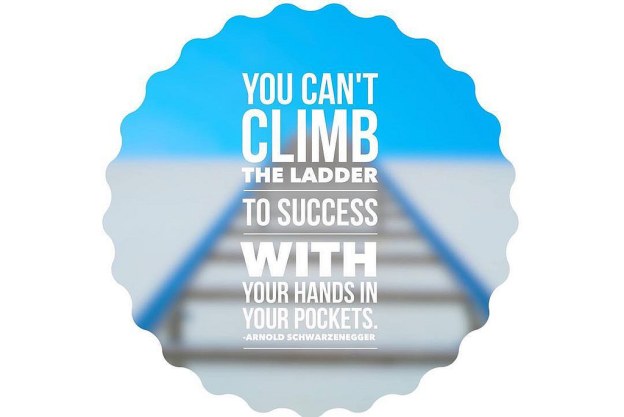
Featured image: created on Piktochart
computer20people20-20talia-3875-final_zpsynpbyivy

Written By Nayadee Wilson

How Consistency Leads to Success in 3 Simple Steps

Featured imageRaphael Love

I used to think it was just me, but the more I observe myself and others the more I find a majority of people having a tough time achieving consistency in any given area. Time and time again I hear people say that consistency is a big key to success, so it makes me wonder why so few of us take it into account. As for me, sometimes I feel “creatively stuck,” or have a lack of motivation to carry out consistency – as may also be the case for you. But here’s why consistency should be our top priority when reaching our goals, and why you should join me on a 5-week long consistency challenge!

  1. Consistency provides real substance.
    How many times have you tried a new “life-hack,” skincare/hair-care routine, etc., to then give up a few days later and say “I tried that and it didn’t work for me”? Well, how do you know whether or not something is effective if you don’t have realistic, consistent measurements? Until you perform a task consistently for a proper period of time, you will not be able to determine if it works or not. Being consistent helps you become successful by allowing you to see which tactics work for you, and which ones don’t. Otherwise you’re just doing random, incomplete experiments; getting no real answers.
    .
  2. Consistency creates discipline.
    There’s no question about it: in order to be successful, you must have a good level of discipline. Without discipline, you must rely on a great amount of luck in order to achieve your goals – and that’s highly unlikely to happen. When you develop consistency in what you do (your tasks, your strategies, your daily plan of action), you begin to form a good disciplinary habit, getting closer to achieving your goals. I read somewhere that it takes an average of 66 days for something to become habitual (I always thought it was 21 days), so this goes to show how strong and important the power of consistency is!
    .
  3. Discipline creates success.
    So you’ve gotten a few things down: you’ve become consistent in your work, you’ve developed discipline with your daily/weekly/(whatever applies to you) routine, and now you get to watch the results. You get to see whether what you’re doing is working, or if it’s not. And no matter what the result is, you’ve become successful. How? By being able to weed out what doesn’t work from what does work – and that’s a success in your journey! The great thing is that once you’ve found what works really well, you’ve become disciplined enough in your tactics that it’s easy to continue the work you’ve already put in and accomplish even more. Ergo, you’ve achieved success. 🙂

In his article, “No Consistency, No Success,” Grant Cardone stated that “Successful people don’t change their approach unless it doesn’t work—they only change to change with conditions.” So, unless it’s broken, don’t fix it – keep working consistently towards your goals! And if you’re finding yourself stuck in a rut wondering why your goals seem so unattainable, then perhaps it’s time create a consistent plan of action 😉 . Join me on my 5-week long challenge (pick any one task that you want to start doing consistently) and let us know how it goes – grab hold of your success!

computer20people20-20talia-3875-final_zpsynpbyivy

Written by Nayadee Wilson

Stop Wasting Your Talent

I’m at the point in my journey where I’m questioning and thinking about what it is that I truly want to do with my life, and how can I get there. So far everything seems to be running smoothly, and all the pieces seem to be falling into place, but I’m still not certain of the image these pieces are forming; i.e. where my life is headed. Which leads me to the next question: What are my gifts? What are my talents?

Last week, one of our pastoral leaders at my church said this:

Let’s say you’ve been planning for quite some time the perfect gift for someone you love. You’ve put a lot of thought, time, and maybe even a lot of money into it. The day comes when you see this person and you finally get to give him/her that very special gift – the one that you personally chose to fit him/her, because that’s how well you know this person. You finally gave that person your gift, and you’re ecstatic about it!

Then a month goes by, and you happen to come across that special gift that you gave to that special person. It’s sitting on a shelf, unopened, certainly not used, and collecting dust. Imagine the feeling you would have, knowing that after making that gift so very special for your loved one, that person didn’t really care for it.

That’s how God feels when you don’t use the gifts that He’s given you.

Whether you believe in a God or not, I believe we can agree that most of us here on earth do feel that we’re alive for a reason and a purpose. We have certain gifts and talents that we were born with, or developed over time, that were meant to impact the world around us. Of course, some of the impacts we make are very small, while others are very big, but they are significant nonetheless.

From time to time we may think that we’re aware of our skills, and that we’re working towards our goals. However, especially when it comes to our careers, oftentimes we let our talents take a back-seat. We follow orders blindly and conform to just making ends meet, justifying our decision to leave our gifts unopened.

The truth is, that when you don’t use your talents you’re not only doing a disservice to humanity, but also to yourself; you were meant to use these! Why should you be stuck at a dead-end job, where your talents aren’t used to their full potential? Why should your gift sit on a shelf?  When searching for a job and taking steps to pursue your career, these steps should always be part of your life marathon, not your practice treadmill.

Maybe you’re taking solid steps in your career, but you still fell stuck. Perhaps the reason you’re in a career rut is because you honestly don’t know what you want to do – you don’t know what your gifts are. Well, that’s a common struggle, but there’s a way around that. You can ask yourself these three questions:

1. What did I want to do as kid?

2. What makes me come alive when I do it?

3. What opportunities have I been given? 

The third question is particularly useful because it’s one we don’t often think about. Maybe you don’t know what you’re passionate about, and maybe you no longer like what you loved as a child, but one thing may still help you: that thing in which you stand out to others. Was there ever a time when someone said to you: “Hey, have you thought about doing XYZ? I think you’d be really great at it!” This is your ticket to exploration. There may be a hidden talent that you didn’t know you had that might be what you were meant to do. You just have to take the opportunity to try it. And if it’s not your thing, then keep searching.

Not everyone believes that we all have a purpose, but even if you don’t believe so, that doesn’t mean you have to wander aimlessly in life ignoring your natural abilities; we can find our gifts and put them to good use. If you know what your talent is, don’t hesitate to use and perfect it – find the job/career/course that will use these to their full potential! If you don’t know what your gift is, then be diligent in searching for it – you can start a “hobby career” and move on from there 🙂 . But whatever you do, don’t waste your talents – they are valuable to the human kind!

computer20people20-20talia-3875-final_zpsynpbyivy

By Nayadee Wilson

**Featured Title Image: [MAYMA-tiiii♥♥♥......] by A♥**

I Want To Be Like Them

Featured image: “The National Guard” by Oklahoma National Guard

With Memorial Day coming upon us, I find myself getting into deep thought as I think about the men and women who lost their lives fighting for what they believed to be valuable. I have never known anyone who has died in battle, or anyone who’s lost someone in battle, so I don’t have any sort of emotional connection to this holiday. And if you’re in the same boat as me, have you ever stopped and just wondered what kind of people they must have been? The kind of impact they left? What their loved ones remember them by? This is what I’ve been pondering.

A little while ago I wrote about my husband’s grandmother who passed away, and the legacy she left behind. While considering the lives of those who died during their military service, it brings me back to the legacy topic. It makes me think about the kinds of things they left behind; the things they would be remembered by – even if I didn’t personally know them. Incidentally, with my mind going farther away by the minute, this makes me ask the question “how would I want to be remembered?” Even though I’ve never known them, I can think of a few things that these men and women would most likely be remembered as, and character traits that I would also want to strive for in my own life.

  1. Courageous.
    It doesn’t take a lot of thinking to know that these people had guts. It takes a special kind of someone to go into a task knowing that the outcome could be deadly. Yet, that did not stop them. They had the kind of courage that most of us dream of having, sometimes for just the tiniest situations. I will admit I do not consider myself a courageous person; I certainly lack some skill in this department. But, to have the kind of courage that these individuals had is honorable and, like them, I also want to strive to be courageous and be remembered as such.
    .
  2. Giving.
    I consider this another “no-brainer” kind of trait for all those who gave their lives in service. These people literally sacrificed themselves for the benefit of others. Now there’s a word we don’t put to practical use very often: sacrifice. Our human nature is to strive for comfort, and our inclination is often towards the easy way of doing things. But, these people disciplined themselves to put others first; to do what may be harder for them in order to make it easier for others. Although I am not in military service, I like to think that I am in the service of people; I love to do volunteer work when possible (even if sometimes I complain about the actual work). Like them, I want to be remembered as giving and generous, and strive to help those in need by giving what I can.
    .
  3. Wise.
    As previously stated, our human nature is to favor the easy way in most situations, even if it ultimately makes things harder for us. Sometimes it takes an incredible amount of maturity and wisdom to look ahead and opt for the right decision, which can sometimes mean the harder way. Although they met a deadly fate, these men and women were wise enough to know what was important, and wise enough to follow through with their values. They teach us what it’s like to make the tough choices, even when we may not want to. With their discipline and never-ending devotion they also teach us that the wisdom tank will never be full; there will always be more room to learn and more room to grow. And so, just like King Solomon, and like these men and women, one of the things I want most in the world is wisdom.
    .
  4. Purposeful.
    Last, but certainly not least, my favorite trait that I find in these great men and women is purpose. These warriors had a purpose in their life, and they followed it all the way to the end. These men and women served a great purpose that maybe none of us will ever truly understand, and it is admirable to see how dedicated they were to fulfilling it. Some people know what their purpose is in life, while some may be in the process of finding it, but all of us have a purpose, nonetheless. As for me, I’ve come to know my purpose in my faith, and that part of that purpose is to strive to shine the light within the many dark places of this world in any way that I can. Like them, I want to be remembered as someone who fulfilled her purpose.

Live like them.

Many of us will never know what these soldiers went through, and many can’t even imagine it. Nevertheless, they left a great example for us to follow when it comes to being honorable human beings. The men and women who lost their lives in service did so while showing us how to be giving, courageous, wise, and purposeful. While you celebrate Memorial Day this weekend, consider all they had to teach us, and honor them in living out those teachings as best as you can. Have a happy Memorial Day! 🙂

computer20people20-20talia-3875-final_zpsynpbyivy

By Nayadee Wilson

All Hail the Buddy System

Featured image: Sisters Holding Hands After Kids Race, by Alexander Knoch

When I was little, I never really participated in any sort of buddy system (that I can remember). I spent most of my childhood in the Dominican Republic, so my education was a little different. I have, however, heard of the childhood buddy system through friends and what not, but I never really thought much of it. Two weeks ago, I was attending a group teaching at my church that talked about the need of having an “accountability partner” – which is basically the adult version of the buddy system.

As the discussion begins and we all speak up about our experiences, I begin to take a whole new perspective on the importance and the benefits of incorporating the buddy system into our lives – both personal and professional. There are several reasons why we should be using this underappreciated tool to its full potential. Even if you hated having to hold your buddy’s hand during a field trip, you may be surprised to find the kind of impact that “hand-holding” can have. 🙂

  1. My buddy has to find me, and I have to find my buddy.
    .
    The great, yet dreadful, thing about having an accountability partner – which I will refer to as “buddy” throughout this blog – is that it forces us to be responsible and accountable for our actions. Having a buddy means you’re letting that person in to the messy closet that you don’t let anyone see when they come over to your place. (I wish I could say I just thought of that analogy, but I actually heard it from one of our teachers 🙂 ). When this is the case, you truly do think twice about making decisions that you will later have to talk about with your buddy. Being held accountable forces you to take more steps in the right direction, following the natural, human fear of avoiding “shame” and embarrassment that come out of making the wrong ones.
    .
  2. My buddy and I share the same road.
    .
    What’s greatly beneficial about having a buddy is that you can always find someone that has shared/is sharing your journey; someone who can relate to you. I was reading an article called “Why you need a mentor, and how to find one to advance your career,” which makes excellent points on the need for a mentor. A mentor can be a somewhat less “invasive” kind of buddy – one that has most likely walked your current career path and can hence guide you in the right direction. When your buddy has gone/is going through a similar situation as yours, it makes it a lot easier for you (or both of you!) to navigate through it. Although the phrase “misery loves company” isn’t a favorite, in this sense it’s a good thing; the added support can make a world of difference and keep you from falling into holes down the road!
    .
  3. My buddy has a mirror.

    Can you believe that most humans suffer from a lack of self-awareness? Not me!  – Kidding; oftentimes I, too, need a good reality check >_<. But, as you can see, another benefit of having a buddy is that they’re able to see what you can’t – yourself. They can look at your situation from the outside in, and give you the perspective you may be lacking. One of the amazing things that I saw during our group teaching was the amount of people that were simply coming forth about something they needed to change in themselves, and how having a buddy to (lovingly) point this out made it that much easier to act on it. Of course, this is not to say you need to start confessing your problems to a big crowd; these people did that out of choice and support for others. However, do try to find someone you can trust to let into your messy closet/office.
    .
  4. A bad buddy can make us get lost.

    Last, but not least, my favorite thing to keep in mind when choosing a buddy is this: bad company corrupts good character. One thing that someone pointed out during our group study was that you want an accountability partner who will tell you the right things, not point you towards destruction. It really does you no good to get an accountability partner that will not actually hold you accountable when you need to be – that would be pointless and dangerous. When choosing a buddy, choose one that you know to be wise, has your best interest in mind, and is not afraid of telling you the truth (in a loving way). If you’re not sure how to tell, this is where reading and research comes in: if your mentor gave you career advice, what is that advice based on? What were the results in the past? What else supports that kind of advice?Finally, in terms of your personal life, you may want to choose someone other than your spouse or partner (making sure that this someone does not present a threat to your relationship), because you may be biased when having tough conversations. What happens when the issue is about your relationship? Don’t choose your wife/husband/bf/gf as your buddy; it might not end well.

It’s OK to hold hands.

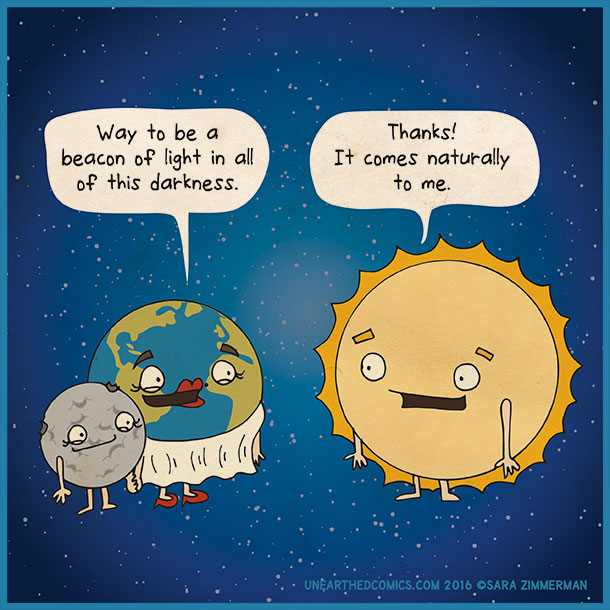
Sometimes we want to do everything by ourselves and prove to the world that we can. For some reason, we’re either afraid or too proud to ask for help or guidance. However, doing everything alone can also hinder our success, and oftentimes even lead us to failure – with no one to tell us where we’re headed. As you can see, many times, two will be better than one. Give the buddy system a try! And, if nothing else, you could just make some great friends and connections in the process – they can always be a beacon of light. 🙂


Unearthed-BeaconOfLight-1611-1-web

Beacon of Light by Sara Zimmerman – Unearthed Comics


computer20people20-20talia-3875-final_zpsynpbyivy

By Nayadee Wilson


Maybe You Should Just Start Showing Up

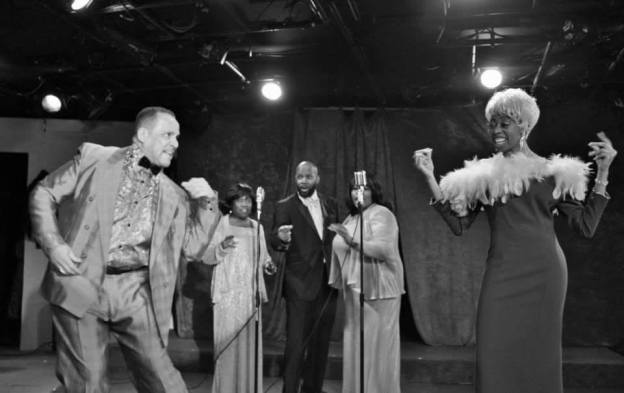
*Featured image: Delana Flowers (far right and front) during a performance in 2015*

I think that the greatest talent that humanity has is making excuses, and the greatest impediment to our goals is actually having these said excuses. However, a lot of us have been able to get around those impediments and work toward our goals anyway. Some of us have come to a place in our lives where we tell ourselves, “So, I can’t do this… but I’m going to do it anyway and see what happens.” Woody Allen once said “80% of success is showing up,” and I can’t think of a better example of this notion than our very own Delana Flowers, who starred as Lorrell in the musical, Dreamgirls, at Pittsburgh Musical Theater this past week.

Delana Flowers, our awesome admin at FinancialPeople Staffing in Pittsburgh, has an incredible preforming talent, and some pretty amazing pipes – the girl can sing! As we all began to talk about her show around the office, I asked Delana to tell me more about her performing side. As it turns out, most of Delana’s performing success all started with her decision to simply show up to things she didn’t even intend to take part in. As she went on to tell me her story, something she said immediately stood out to me:

“I moved to Pittsburgh where there was plenty of Community Theater. I got involved almost immediately, but totally by accident, after being dragged to a rehearsal supposedly to observe. From then on, God continued to open doors for me.”

Delana went to a rehearsal just to “observe,” and out of this no-biggie attendance to something she wasn’t even a part of, she began to be involved in the things she was passionate about. What’s interesting is how she stated that she was “dragged” to this rehearsal, so it doesn’t look like her heart was necessarily set on going to this – but she went anyway. So, what happened? Well, she showed up, which led to her being cast in Ain’t Misbehavin in 2008, she was cast as Dinah Washington in 2015 (a show with 25 plus songs she had to learn from scratch), she was cast in JH: Mechanics of a Legend, and, in Delana’s own words, she “did more community shows than I can count at this point.”

The story of attending that rehearsal alone demonstrates the power of showing up, but it doesn’t end there. To land her role as Lorrell in Dreamgirls, Delana had some more showing-up to do. Not only did she have to show up, but she had to do what most of us dread: wait (Ugh! – right?). This is what she had to say about her audition for Dreamgirls:

“I saw an ad for a regional theater holding auditions for Dreamgirls. I wasn’t going to go because I didn’t feel like I knew how to audition on a professional level. My leading man in John Henry pushed me to go. He told me I had nothing to lose. I was nervous, but I went. They called me back 3 times and a whole month went by before I heard anything. Meanwhile, my co-star who pushed me to go to the audition found out in a matter of days that he had been cast. Finally, the call came and rehearsals were to start a week later.”

I’m sure we can all empathize with Delana in one way or another, like being a nervous wreck before an interview, doubting yourself, waiting for that call afterwards to know whether or not you got the job – just to mention a few. Nevertheless, she hung in there, she showed up, and boy did it pay off! Of course, this is not to say that all you need to do is just “be there,” Delana also talks about the hard work that came afterwards:

“I walked into a room full of actors and dancers… with musical theater degrees, music and/or dance degrees and classical training. I came with none of these things! We had a 3 week rehearsal process to put up this Broadway level show. If you added up the rehearsal hours which were typically 8 hours a day, it amounted to about a week and a half. It felt like boot camp! …This was my first professional show and my first show at one of the big theaters downtown. I was terrified and I had several meltdowns along the way.”

Finally, with heartwarming joy, Delana ended her story with this:

“I made wonderful new friends who refused to let me doubt myself. They worked tirelessly with me to learn everything I needed to learn. This was the hardest and biggest thing I have ever done. All I could do was keep showing up, keep working, and cry when overwhelmed. By the time we closed the show last Sunday, I couldn’t believe I had been part of such a spectacular show. It was an absolutely amazing experience I will never forget.”

Needless to say, working toward your goals will most definitely require hard work, but the hard work will never get started unless you start showing up – like Delana did. There will always be times in which the possibilities we dream of seem almost unattainable, where we will doubt ourselves, have meltdowns, and wonder if that small step will even be worth it. Well, Delana’s success story raises two very important questions that we should always keep in mind: How many doors could be opened for you, if you simply show up? How many doors will you continue to miss? Maybe you should just start showing up. 😉 

Check out some clips of Delana’s performance!:

computer20people20-20talia-3875-final_zpsynpbyivy

By Nayadee Wilson

Living Long After We’ve Died

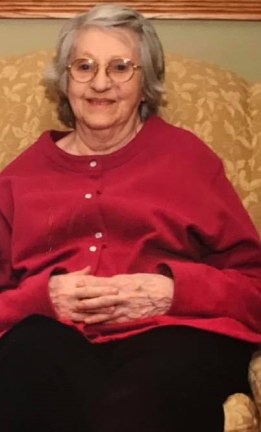
Last month, our family encountered a deep loss when my husband’s grandmother, Marian F. Wilson, passed away at the age of 94. Although I never had a chance to know her, since she was severely affected by Alzheimer’s by the time I came into the family, I couldn’t help but be moved by everything everyone had to say about her during the funeral. This, along with a message series we’ve been coincidentally studying at my church, got me thinking: our life on this earth is not over once we die. It wasn’t until this funeral that I truly resonated with the significance of this concept. There is something incredibly genuine that comes with our death, and that is the impact of our legacy.

16999059_1520263557991918_1954582548492505593_n_zpsfw5bktgqI’ve got my job.

This lovely lady had what some may call one of the best and most honorable jobs in the country: she was a U.S. Marine (a WWII veteran, to be exact). Needless to say, this wasn’t the kind of profession that you’d nonchalantly refer to as a “job.” This was different; this was a calling and devotion. Even still, as prestigious as this profession was, it was interesting to see how every person that spoke about her didn’t really mention much about what she did while she served, but rather the areas of her character that were simply shaped by her service. We heard wonderful stories of how she raised her children, the values that she instituted in her family, and the adversities that she had to overcome as a single mother when her husband died unexpectedly. And to top it all off, the one and only thing I remember anyone saying about her regular, non-military job was: “she worked at the store.”

Oftentimes we become so indulged and submerged in our jobs and career paths, buying into the lie that what we do for a living is our identity that it makes us forget about what really matters. Your job, no matter how amazing, should not be your identity. The reality is that no one at your funeral will remember you as “John the accountant” – at least, not the ones who truly get to know you. So, take some time to disconnect from your “job” and invest time in those you love. Start building your legacy with the people and things that matter most.
img_4208_zpsq1mzxgvjI’ve got my things.

As the eulogies kept coming, greater and funnier stories kept being told. All of those stories were about her car, how big her house was, and all the wonderful things she had. I’m kidding – they were about none of that. Nope; Mrs. Wilson didn’t exactly have what would be classified as a glamorous life. As a matter of fact, the only thing I remember on this topic is someone saying “we grew up poor.” But man, was her life rich. The stories about Mrs. Wilson and her dedication to her family and loved ones just kept pouring, and laughter amidst mourning filled the entire room. The stories of her chasing after my father-in-law as a kid were especially funny (of course, Ken, my father-in-law, clarified that his mischiefs were only a result of his older brother’s leadership). 🙂

No one talked about this lady’s possessions, or her money, or the things she had. Yet so often we become so incredibly stressed, drowning in debt due to buying things we can’t afford. Here’s another reality: those things will not go to the grave with you. Your possessions and your money ultimately do not define you, and these should also not be your identity. So why not take some time to de-clutter? Or make a plan to get out of debt? I doubt that you’d want your legacy to be “John, the one with lots of stuff.”
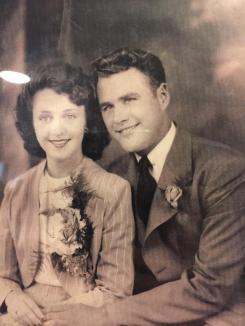
img_4203_zpsvkjou3kgI’ve got my looks.

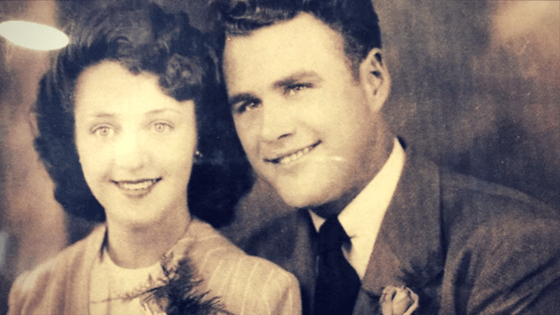
Marian Wilson was as beautiful as an angel. During the wake, the place was filled with old pictures from her earlier years. I remember looking at every single one and being amazed, mainly because her husband could have been my husband Patrick’s twin, but also because she truly was beautiful. As great as she looked, no one talked about her looks, either. I remember someone telling the story of asking Mrs. Wilson, “Grandma, how come you won’t get married again?” to which she comically responded: “What kind of man do you think would be so out of his mind to take on a woman with six kids?”

Yup, Mrs. Wilson was full of personality that went beyond her looks. Then I thought, how often do I spend endless minutes trying to get the perfect selfie? We’ve become such a surface-level society where appearances have become the center by which we rotate, that we are slowly being consumed by it. I was reading an article today about a young lady who was sent home during an interview due to her outfit. Although I do believe she was wrongly judged and shouldn’t have gone through that experience, I was really disappointed by something she said: “I realize that my appearance is who I am.” There is so much more to our legacy than our looks; your appearance is not your identity. So how about you take a day off from having the perfect look, and maybe just go serve someone in need?
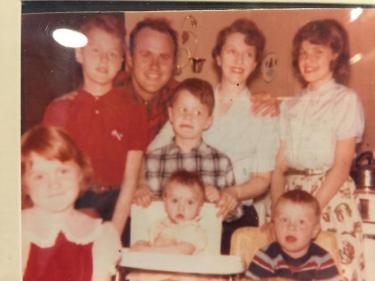
img_4206_zpsmfmwdaysI’ve got my kids.

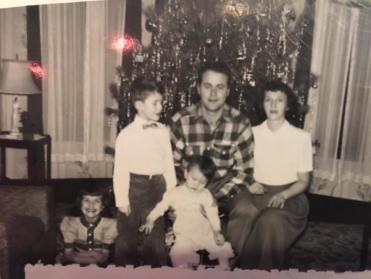
“So if it’s not my job, my things, or my looks, then I guess my legacy is in my kids?” Well, I’m not so sure about that. Mrs. Wilson had six kids all together, all of whom grew up to be wonderful people. Yet, I wouldn’t call them her legacy directly. When it came to the topic of her children, most of what I heard about this woman had to do with everything she had taught them. Her children didn’t become her legacy; the things she taught them did. Her kids didn’t represent who she was; their morals did. Her kids didn’t show the world around them what she was about; their values did. While her children may not be her legacy, her children will carry it out long after she’s left them.

Our lives truly do continue to speak to the world long after we’ve gone. And so, I stop today and think: “What am I teaching my children? Where am I leading them? What values am I imprinting in their lives? What am I imprinting in others’ lives? How well am I loving my husband?” Our legacy will continue to speak to the world, whether it’s a good one, or a not so great one. Take some time to reflect on your life, and ask yourself “what will be my legacy?”

In loving memory of Marian F. Wilson
16996210_1520263981325209_6932893240739788039_n_zpsuv8sv7cy

computer20people20-20talia-3875-final_zpsynpbyivy

by Nayadee Wilson
Is Your New-Year’s Resolution Useless?

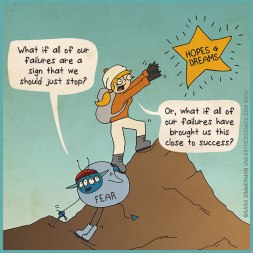
As the new year approaches most of us have decided on, or are thinking about, a New Year’s resolution. Being carried away in my thoughts earlier today, it suddenly dawned on me: why do we have New Year’s resolutions, anyway? I mean, most of the time, let’s face it; we don’t exactly follow through. Time and time again I see myself, and others, fail miserably before the end of January to attain the infamous purpose that we had so excitedly set forth. Nevertheless, I did brainstorm a few reasons why having a New Year’s resolution is actually pretty beneficial, whether you’re able to achieve your goal or not.

  1. Everyone likes purpose.

    One thing that I know for sure is that having goals in life is essential for your overall wellbeing – it gives us a sense of purpose and meaning. Having goals, such as a New Year’s resolution, to work towards gives us the intrinsic motivation that otherwise we may not always find elsewhere. Although sometimes hard to achieve, and oftentimes we may fail to achieve the desired end result from these, we shouldn’t be too quick to overlook the inevitable impacts that come simply  as a side-effect of pursuing a goal. Whether your goal this year is to start a business, or to just be able to get out of bed before noon, goals are important no matter how big or small. 🙂

    Tip: if you’re having a hard time achieving your New Year’s resolution, try examining what your goals are. If you have too many of them, it can be overwhelming and will ultimately cause you lose focus on what should be your priority. Try listing all of your goals on paper, pick the top three that are most important, and focus solely on those instead. This will give you a greater chance of success.

  2. Adulting like a rock-star.

    What’s another great side-effect of setting goals? It forces you to be responsible. Of course, this will depend on how committed you are to your goals. Nevertheless, it is a great way to make you feel like you are awesome at being an adult :). I personally miss the time when I was 7 years old and had no idea where money came from. I remember asking my mom: “Where do you get money? Is it like a building where you go and they just give it to you?” Good times… Then, of course, I came to a rude awakening when I found out that people don’t just “hand” you money. Point is, we don’t always like living the responsible adult life, yet when we have goals, being responsible becomes a little easier and more habitual.

    Tip #1: One way to spark the responsibility side-effect is to set a time line for your goals. Want to lose/gain 10 pounds? What’s a reasonable timeline for accomplishing this? Or maybe you want to write a book; how many chapters or paragraphs would you like to have completed in a month? And so on, and so on.

    Tip #2
    :  Unless you’re incredibly disciplined, it may be hard to achieve your goal without some accountability. Find someone you trust to hold you accountable for your goals. This way, if you start to slack off, you’ll have someone to encourage you to keep going.

  3. More to come.

    Another awesome goal side-effect is that while we are pursuing goals we become hopeful. Hope is that thing that gives any human being motivation to do one thing: keep moving forward. Think about it; if you had no hope for anything lying ahead, what would be the point of doing anything towards your future? When you pursue your goals, you are being hopeful that you can achieve it, and a good result will come out of it – this is why you set it in motion in the first place.

    Tip #1: If you’re having a hard time having any hope of achieving your goals, what you might want to do is take some time to focus on the end result (although being careful not to dwell on it – remember that you also get lots of small victories in the process). If you can picture yourself at the end of it all, and remember why you wanted to do this in the first place, it can motivate you to keep working – one step at a time.

    Tip #2
    : To pick up on that first tip – take it one step at a time. Celebrate the small victories! So maybe you haven’t started your business yet, but perhaps you’ve made some great connections in the process. Or maybe you haven’t written a book, but you’ve written a few paragraphs and placed your heart on paper, letting yourself know you can do it – that’s a start!

  4. I can only get better.

    What else can we get out of having goals? We learn a lot about ourselves in the process. We learn what makes us tick, what doesn’t, what works for us, and what harms us. Anytime you take the initiative to work towards anything, it brings within itself an opportunity to learn. (For example, I have learned that no matter how hard I try or what I try, I am not a morning person… at all). No matter what the end result is, whether you succeed or fail, there is no doubt that you will learn things about yourself you might have not known before. And as you know – Knowledge is power!

    Tip
    : This will probably sound repetitive and cliché, but it is so true. If you’ve failed at achieving your goal, this failure is simply a lesson to be learned. When you fail, you learn about the things that did not work for you. Use this knowledge to improve yourself rather than to self-criticize.


  5. Time to straighten up.

    Lastly, as Jim Rohn put it, “Discipline is the bridge between goals and accomplishment.” When you are committed to your goals, the inevitable happens: self-discipline. A “goal” is something you have not achieved before, that you are willing to work towards; a desired result in your life. Working towards your goals will require you to do things that you may have never done before, forcing you to create new habits and commit to these – and this is a great thing! When you create self-discipline, it is a trait that stays with you past the desired achieved (or failed) result. So, regardless of the outcome, remember that the process of this very same pursuit will only benefit you in the end.

    Tip: If at first you don’t succeed, you can dust it off and try again! Don’t forget that there is always next year. 🙂

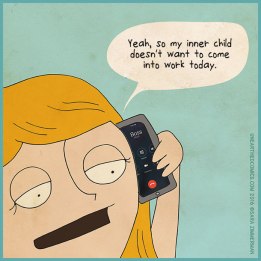
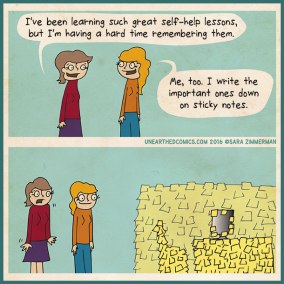
*All images/comics used in this blog were obtained from Unearthed Comics*

computer20people20-20talia-3875-final_zpsynpbyivy

By Nayadee Wilson