Category Archives: jobs

Recruiter Spotlight: Kevin Pyle

Kevin Pyle has been with us at ComputerPeople for almost four years. He is hardworking, funny, he is an excellent recruiter, and his kids are probably the cutest twins that we have ever seen. We sat down with Kevin to find out a little bit more about how he gets the job done. Here is what he had to say!

How do you find candidates for a new job order? 

Several methods – LinkedIn, job boards (Indeed, Dice, etc.), referrals, posting job on website, and networking.

What is the most important quality that a candidate can have to make them standout from the rest?

I’ll give you two….personality and drive.

What advice do you have for someone that is just starting his or her job search? 

Be patient!  Finding a position is a full-time job in itself, especially for someone just starting their career.  Utilize as many resources as possible, including recruiters, applying for jobs on your own though employment agencies (career builder, indeed, etc) and networking. Also, it is worth the time to get several opinions on your resume to make sure it’s solid!

What inspires you to be the best recruiter you can be? 

Just knowing the potential positive impact I can have on someone’s life.  It’s a great feeling to place someone in a position that I know they are going to enjoy and love.


Thanks for all you do, Kevin! We are so glad to have you at ComputerPeople.

If you want to work with Kevin as your recruiter, contact him at kpyle@cpstaffing.com

Written by Kaitlyn Gahagen


Just Starting Your Job Search? Perfect Your Resume First.

Beth Courtney knows recruiting.

She originally started recruiting in the airline industry in New Jersey over 30 years ago.  She believes that there is a job out there for everyone who is willing to work hard.  Currently, she focuses on sourcing technical candidates for ComputerPeople through her position as Sr. Internet Recruiter. We asked Beth what advice she would give to someone BRAND NEW to their job search. Here is what she had to say. 

Beth photo

Beth Courtney, Sr. Internet Recruiter

“A good resume is key since your resume is typically an employer or recruiter’s first impression of you. Make sure it is easy to read— no long paragraphs of verbiage please! Triple check for typos and misspellings. If you don’t have a lot of job experience, include internships/volunteer experience and highlight the skills you used in each.   Keep an open mind and be willing to interview for a less than perfect position to get your foot in the door of a great company.”

Thanks for the the advice, Beth!


Written by Kaitlyn Gahagen

How Do I Standout From All The Other Candidates During My Job Search? Wise Words from Our Rockstar Recruiter Brooke DeLucia.

Brooke DeLucia has been a recruiter at ComputerPeople for over 20 years. She has seen it all and has worked with candidates from all over the world. We asked Brooke one simple question. What is the most important quality that a candidate can have to make them standout from the rest?

Brooke’s Response is gold.

“Drive & Professionalism.   Having the ability to sell yourself as a driven individual with the aptitude and hunger to learn can make all the difference.   Your body language can make or break an opportunity, no matter how qualified you are for the job. It’s still important to be respectful, attentive and professional when you are interviewing.  Don’t slouch in your chair, don’t pick lint off your suit, don’t chew gum or swear. It may seem basic but sometimes the people you least expect are the ones making these mistakes!”

Thanks for the words of wisdom, Brooke! Connect with Brooke Here.


dsc_5490-1.jpg

Written by Kaitlyn Gahagen


Memory-Increasing Tips For All To Try

“When is this project due again?”

“What did my boss say to focus on during this presentation?”

“Wait, was my intern’s birthday today or tomorrow?”

It has been found that people remember 10% of what they read, 20% of what they see, and 30% of what they hear. While different scholars have found that this concept may be inaccurate, one basic idea shines through – People don’t remember very much. So what can you do to increase your memory? Maybe try some of these tips, if you can remember them!

  1. Become interested in what you’re learning. It is so much easier to learn about stuff you care about instead of trying to advance in a field that you have no desire to learn about. If you can’t become interested, try learning about something else.
  2. Leverage your visual and auditory memory. These are the areas where your memory will be most effective, so if you need to remember something, you should say it out loud! In addition, if you can think of a way to link a visual to what you need to remember, your chances of remembering are definitely going to increase.
  3. Associate new information with what you already know. Make comparisons, remind yourself of past memories, or link new information to something else.
  4. Write out things you need to remember. If you are reading something, try summarizing each page by writing out key facts. It may take longer, but you will definitely remember more!
  5. Sleep! Without proper sleep, you won’t be able to remember anything. So do what you have to do in order to get to bed on time.


dsc_5490-1.jpg

Written by Kaitlyn Gahagen

How To Handle The Last Question of Every Interview

You made it to your interview early. You are dressed to impress. You have the perfect resume. You have clearly articulated your career accomplishments and future goals. But oh no…here it comes…the question that you did not prepare for…the interviewer asks, “do YOU have any questions for me?” Should you ask something? Should you just smile and shake your head?

Have no fear. Ask one or two of the following questions in order to get a little but more info and show the interviewer just how prepared you really are!


GENERAL QUESTIONS FOR THE INTERVIEWER

What character traits do you look for in your employees?

Where have you seen personal growth occur due to the company’s investment in its employees?

Why did you come to this company?

What’s your favorite part about working here?

 What gets you most excited about the company’s future?


JOB SPECIFIC QUESTIONS

Is this a new role that has been created?

What are the biggest challenges that someone in this position would face?

What attributes does someone need to have in order to be really successful in this position?

What training programs are available to your employees?

Where have successful employees in this position progressed to in the past?

What is the performance review process like here?

How often would I be formally reviewed?

Is there anything that concerns you about my background being a fit for this role?


dsc_5490-1.jpg

Written by Kaitlyn Gahagen

Applying for a new job? Don’t be surprised if you have to take a test.

Your test-taking days are not over!

Personality tests are becoming more and more popular for candidates and new hires. Sometimes it is part of the hiring process, and sometimes it is post-hire for training and learning purposes. Either way, personality tests can be stressful because testers can begin to feel concerned that they have to answer the way management would want them to answer. However, this thought process does not work. Here are a few tips if you have to take a personality test.

  1. Be yourself. You cannot outsmart the test, so don’t try to. You want to answer truthfully so that you don’t end up looking indecisive or dishonest.
  2. Don’t rush. Personality tests can be boring and draining but you should try to take your time and do your best.
  3. Enjoy the opportunity for honesty. It is a lot easier to admit your faults to a screen than it is to a person, and no one will hold it against you for doing just that. Everyone has strengths and weaknesses, and letting your employers know what they are ahead of time will help them to set you up for success in the workplace.

You should not be afraid of a personality test. Be yourself, don’t rush, and enjoy the opportunity for open communication.

Have you ever had to take a personality test? What was it like?


dsc_5490-1.jpg

Written by Kaitlyn Gahagen

Top Perks of Working With a CP Staffing Recruiter


I have previously discussed the facts and myths of working with a staffing agency, but the great thing about letting a recruiter help you in your career search is the amount of awesome perks that come along with it. Although many people will come across a staffing agency at some point in their career, a lot are hesitant to jump on board. However, I can give you at least five great pros for working with a great staffing agency, particularly CP Staffing Solutions, which will make you want to ditch the endless online job applications. 😉

  1. Delegation of job search.

    The greatest perk of working with our recruiters is that the recruiter works for you! Instead of you spending countless days and hours filling out online applications for a countless amount of jobs, we will do the job search for you – so you can relax! 😉 . Not only will we be aware of what you need and what you are looking for, but we also know what our client needs and what they want, so we can make sure that we link you with the right employer, on all accounts.

  2. Open door to hidden jobs.

    Perhaps equally as good as (or even better than) doing the job search for you is the fact that our recruiters have access to jobs that you would otherwise never find. Top employers hire employment agencies to find top talent, and so you might never see these top-quality jobs posted online. And so, while you’re pulling your hair out trying to find your dream job, you may be missing out on it because it’s actually hidden – with us!

  3. Untapped potential.

    Another great benefit of working with CP Staffing Solutions is that with over 125 combined years of recruiting experience, we know talent when we see it. We are able to pinpoint strengths and skills that fit a particular job, that you may not have even been aware of yourself. With our ability to recognize key skills and experience, we are able to introduce you to new career options that you may have not considered before.

  4. Coaching.

    What is a great staffing agency without that personal touch? The best part of CP Staffing (in my opinion and from my experience) is that our recruiters don’t throw you out on a limb; they prepare you for your interviews, making sure that you are your best professional self when meeting with your potential employer. How many times do you stay up tossing and turning the night before a big interview because you’re not sure of how prepared you are? CP Staffing recruiters make that preparation a lot easier, so you can get a good night sleep (we hope!). 🙂

  5. Salary negotiation.

    A big, and oftentimes uncomfortable, part of the hiring process is the salary negotiation. I used to get knots in my stomach just thinking about that whenever I knew that conversation was coming. We make this a whole lot easier for you due to our long standing relationships with our clients. While we will absolutely remain realistic with the salary expectations (which depend on your experience, skills, etc.) we are also able to get you the best negotiation for your salary, so you don’t feel like you have to throw up at the thought of this discussion.

Save yourself the trouble.

As you can see, you can save yourself a lot of headaches when you let us help you. Helping you find the best possible career fit is what we are here to do, and we love doing it! So, the next time you’re in the market and you’re looking for a more effective and efficient way to find a job, give us a call! We promise we won’t bite – we are here to help. 🙂

computer20people20-20talia-3875-final_zpsynpbyivy

By Nayadee Wilson

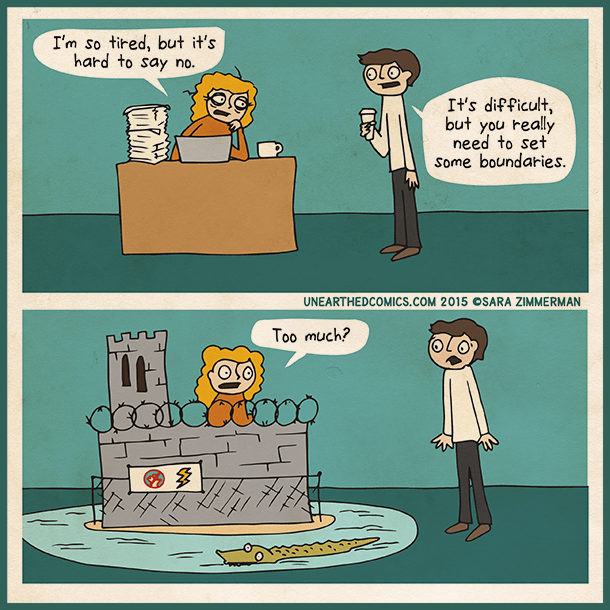
"Boundaries" by Sarah Zimmerman - Unearthed Comics

The Simple Step to Achieve Great Work-Life Balance

Featured image: “Boundaries” by Sarah Zimmerman – Unearthed Comics

The issue of life and work balance is so common that you hear it being discussed all the time – you read articles about it, talk about it with your colleagues, with your family, so on and so on. It’s a struggle that many of us have, sometimes for a lot longer than we anticipate, and oftentimes we sort of give up on trying to fix it; we say “it is what it is,” or “I do what I have to do.” Meanwhile, we, as well as the people we care about, are unable to escape the consequences.

In reality, the step to achieve a good work-life balance is a lot simpler than we’d think, although simple does not mean easy. However, you’re going to find out that although it may sometimes be difficult to apply this step, it is well worth it in the long run. Not only will it keep you from going insane, but family and loved ones will be grateful for it too. So what’s the secret? Simple: setting Clear Boundaries.

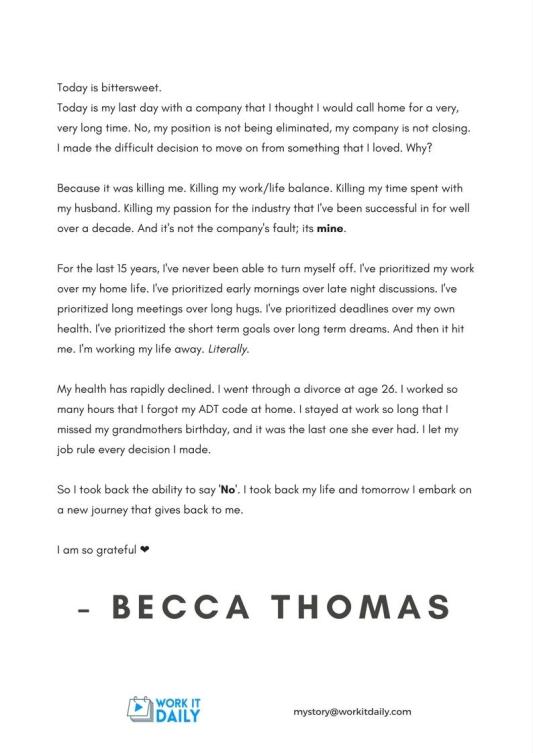
I want to emphasize the word “clear” because a lot of times we say that we’re setting boundaries between our work and our personal life, but in reality we just put up a fort with bendy straws. Having clear boundaries means you have specifics; you set a specific line for yourself that you will not cross when it comes to your work interfering with your personal life at home, and vice versa. Sometimes we realize our need to do this too late, and we might end up telling a story similar to the one below:

6a64f6f0-6a11-4e08-9606-c056bf5f48ab-original

Shared story from Work it Daily

Becca Thomas mentioned how she “took back the ability to say ‘No’,” and while that is essentially what setting a boundary entails, for some of us simply saying “No.” is virtually impossible (at least for me it is). If you’re like me and have a relatively tough time saying “No.” to requests, there are other things you can do for yourself that make it easier to do so, like your time management.

When it comes to time management, there are a couple of ways you can go about it. For example, there are times when my husband has to do some work from home after a full day of work at the office. When this is the case, his boundary is to spend no more than 20 minutes working at home. You could also simply say “I will not work past 6:00pm,” and have that be your boundary instead.

These kinds of boundaries are clear, making them simple to follow, thus making them very effective. Are they easy to follow? Not always – there has been one or two times where Patrick goes a little over the 20 minute limit, but these are very rare occasions. The fact that the boundary has already been established makes it easier to be aware of how you’re handling your work-life balance, preventing you from going on a downward spiral of unbalance like Becca Thomas. Although, with stories like hers I would still argue that it’s better late than never, as you could see from her testimony this wouldn’t be a situation in which “fashionably late” is a good thing either.

So, what will your clear boundary be? Will it be “no working past 6pm”? No checking emails during dinner time? No more than 20 minutes working at home? Or maybe it’s “Thursdays are strictly family days – no phones, no emails”? Of course, it’s hard to decide to step away from your work at times, especially if your role is extremely involved in essential operations of a company. However, there are certain things that will always be more important, that also need your care and time – yourself being one of these. Having clear boundaries to maintain work-life balance will always work out in your favor, and you’ll also find that the business world will not fall apart when you decide not to be a 24/7 working robot. So have at it and take back the ability to say “No.” 🙂

computer20people20-20talia-3875-final_zpsynpbyivy

By Nayadee Wilson

Stop Wasting Your Talent

I’m at the point in my journey where I’m questioning and thinking about what it is that I truly want to do with my life, and how can I get there. So far everything seems to be running smoothly, and all the pieces seem to be falling into place, but I’m still not certain of the image these pieces are forming; i.e. where my life is headed. Which leads me to the next question: What are my gifts? What are my talents?

Last week, one of our pastoral leaders at my church said this:

Let’s say you’ve been planning for quite some time the perfect gift for someone you love. You’ve put a lot of thought, time, and maybe even a lot of money into it. The day comes when you see this person and you finally get to give him/her that very special gift – the one that you personally chose to fit him/her, because that’s how well you know this person. You finally gave that person your gift, and you’re ecstatic about it!

Then a month goes by, and you happen to come across that special gift that you gave to that special person. It’s sitting on a shelf, unopened, certainly not used, and collecting dust. Imagine the feeling you would have, knowing that after making that gift so very special for your loved one, that person didn’t really care for it.

That’s how God feels when you don’t use the gifts that He’s given you.

Whether you believe in a God or not, I believe we can agree that most of us here on earth do feel that we’re alive for a reason and a purpose. We have certain gifts and talents that we were born with, or developed over time, that were meant to impact the world around us. Of course, some of the impacts we make are very small, while others are very big, but they are significant nonetheless.

From time to time we may think that we’re aware of our skills, and that we’re working towards our goals. However, especially when it comes to our careers, oftentimes we let our talents take a back-seat. We follow orders blindly and conform to just making ends meet, justifying our decision to leave our gifts unopened.

The truth is, that when you don’t use your talents you’re not only doing a disservice to humanity, but also to yourself; you were meant to use these! Why should you be stuck at a dead-end job, where your talents aren’t used to their full potential? Why should your gift sit on a shelf?  When searching for a job and taking steps to pursue your career, these steps should always be part of your life marathon, not your practice treadmill.

Maybe you’re taking solid steps in your career, but you still fell stuck. Perhaps the reason you’re in a career rut is because you honestly don’t know what you want to do – you don’t know what your gifts are. Well, that’s a common struggle, but there’s a way around that. You can ask yourself these three questions:

1. What did I want to do as kid?

2. What makes me come alive when I do it?

3. What opportunities have I been given? 

The third question is particularly useful because it’s one we don’t often think about. Maybe you don’t know what you’re passionate about, and maybe you no longer like what you loved as a child, but one thing may still help you: that thing in which you stand out to others. Was there ever a time when someone said to you: “Hey, have you thought about doing XYZ? I think you’d be really great at it!” This is your ticket to exploration. There may be a hidden talent that you didn’t know you had that might be what you were meant to do. You just have to take the opportunity to try it. And if it’s not your thing, then keep searching.

Not everyone believes that we all have a purpose, but even if you don’t believe so, that doesn’t mean you have to wander aimlessly in life ignoring your natural abilities; we can find our gifts and put them to good use. If you know what your talent is, don’t hesitate to use and perfect it – find the job/career/course that will use these to their full potential! If you don’t know what your gift is, then be diligent in searching for it – you can start a “hobby career” and move on from there 🙂 . But whatever you do, don’t waste your talents – they are valuable to the human kind!

computer20people20-20talia-3875-final_zpsynpbyivy

By Nayadee Wilson

**Featured Title Image: [MAYMA-tiiii♥♥♥......] by A♥**

“If Your Resume is More Than a Page Long, They Won’t Even Look at It”

A few weeks ago, maybe even a few months ago, I responded to a Facebook post of a friend who was asking for advice on the appropriate length of a resume. She was particularly interested in knowing if having a resume longer than one page would actually hurt her chances of getting a job. As I was skimming through the answers that she was being given, it amazed me how many people have such a misconception about resumes. I was seeing things such as “It should always be one page,” and “Nope! If it’s more than one page they won’t even look at it.” That last one actually made my eye twitch, because there was a time where I, too, fell for that lie. Part of what I do involves looking over and adjusting resumes for a lot of candidates, making them appropriate and relevant for our clients to see. So I can be the first one to tell you that a one page resume is not the be-all and end-all of resumes. Since I am still learning myself, I decided to do a quick survey around the office with some of our top recruiters in order to find out what is really essential within a resume. Here are some key things you should consider when putting together your resume.

  1. How many pages?
    The truth is: it depends. Although it truly bugged me when I heard someone say that if your resume is more than one page “no one will look at it,” there are situations in which your resume should in fact be no longer than one page. But in most cases, it can be. After my survey, we can safely come to the conclusion that the magic number, if you will, is two pages, but never more than three. But don’t take it from me; take a look at some of our recruiters’ responses:

    “It really depends on the years of experience the candidate has worked in a related field and their area of expertise.  In Finance & Accounting, a resume really should not be more than 2 pages.” – Debbie Kriess, Managing Partner at FinancialPeople Staffing – Pittsburgh.

     “Length depends on experience level.  Someone with five or less years of experience could probably get it on one page.  In IT, it’s not uncommon for someone to have a three page resume but I really don’t recommend any longer than that. For someone with 10-20 years of experience, I would expect a two page resume.” – Brooke DeLucia, Technical Recruiter / Manager at ComputerPeople Staffing.

    “A new college grad/entry level candidate: one page.  Someone with 10+ years of relevant experience: 2-3 pages. Beyond three you risk losing the attention of the reader.” – Kara Bermingham, Managing Partner at MedicalPeople Staffing.

     “A recent college graduate should most likely have a one page resume, where as an experienced professional (10+ yrs.) could very well have a three page resume. I do believe, however that three should be the limit.” – Faith Drew, Research Analyst at FinancialPeople Staffing.

    “A one page resume is perfect for early to mid-career employees but a two page resume is fine for people who are further along in their career. Except for rare exceptions, a three page or longer resume usually is not a good idea.” – Beth Courtney, Sr. Technical Sourcing Specialist at ComputerPeople Staffing.

  2. How should it be written?

    Too often I’ve come across a lot of resumes that look either too cluttered, have too much space, are not formatted properly or are just plain difficult to read. This would also include having too much jargon or words that seem out of place; i.e. words to make you sound “smarter.” Founder and CEO of Human Workplace, Liz Ryan, talks about this aspect and explains how your resume should have a “human voice,” and should not be laid out as if it’s some form of legal document. What you want to do is make sure that your resume is easy to read by organizing it appropriately, having a proper format, have a “human voice,” and being precise. Here are some tips from our recruiters:

     “Most people scan resumes – you want it to flow and have bolded or underlined words that highlight the important parts such as job title and company.” – Faith Drew.

     “Drop the objective! Use a summary style paragraph that pinpoints the role you are looking for along with your areas of expertise and what you can bring to the table. It’s like a quick “sell” that is meant to draw the reader in and make them want to learn more about you.” – Brooke DeLucia.

    “If a resume has long paragraphs without a break, it’s very unappealing to read and I often skip over that section. I like to see bullets (but not too many) and enough white space between sections that it’s easy to read. I’d much rather read a well-spaced 2 page resume than a one pager that’s all crammed together. Also VERY important to check for typos and remember that spell-check doesn’t catch everything. Have someone else proofread your resume for typos, misspellings, etc. ” – Beth Courtney.

  3. What should I put in it?
    So now you have an idea of how long your resume should be and how it should be written, but you’re not sure what exactly you should actually put in it. A lot of people, myself included, have believed the notion that you should put all of your experience on your resume, explaining what your responsibilities were during each position. However, while this is important, I will say that something we often forget is to include results in our resumes. A results-oriented resume will be a lot more appealing to a recruiter than a resume that simply states “I was in charge of accounts receivables.” Showing results, such as “I increased sales profit by 10% using procedure ABC,” shows the recruiters not only what you’re capable of but also what makes you valuable. Here are some additional tips from our recruiters on content:

    “(These are specific to a Technical resume), Skills section containing keywords/skills – Allows me to quickly skim the resume to see if the candidate has the basic skill set for a specific position. Highlight Accomplishments – To me this is important because it shows how the candidate differentiated themselves from their peers.” – Kevin Pyle, Technical Recruiter at ComputerPeople Staffing.

    “chronological work history, is usually the best way to go unless you are trying to change careers.  If so, a transitional resume which highlights skills may be the preferred way to go, just be sure to include work history at the bottom.” – Beth

    “For Technical resumes, it’s important to list the relevant technology ‘buzzwords’ in context with each job.  It’s good to have a Technical Skills section as a general overview but you still need to show where you used a particular skill and what you did with it.  Try framing your bullets as ‘Project, Action, Result,’ (saved or made the company money, saved time, improved a process or service)”. – Brooke DeLucia

    “Don’t forget accomplishments!  Does your resume sound like a generic HR job description? Your resume should set you apart from your competition and be very personal to you and the unique attributes and accomplishments you bring to the table.” – Brooke DeLucia

    “A resume should include key technical skills, and should be a mix of accomplishments and tactical day to day responsibilities” – Debbie Kriess

    “Dates – resumes that do not have dates of employment are a huge red flag. I want to see when you worked at certain companies, take note of any gaps in employment, and know if you are currently employed or unemployed” – Faith Drew

Now that you’ve gotten some tips, you can go ahead and make sure that your resume is in top shape. Make sure that you have someone else proof-read your resume, to ensure that all typos and inconsistencies are taken care of, and don’t forget to include important elements such as achievements and skills! Happy writing! 🙂

computer20people20-20talia-3875-final_zpsynpbyivy

By Nayadee Wilson