Category Archives: Public Speaking

Memory-Increasing Tips For All To Try

“When is this project due again?”

“What did my boss say to focus on during this presentation?”

“Wait, was my intern’s birthday today or tomorrow?”

It has been found that people remember 10% of what they read, 20% of what they see, and 30% of what they hear. While different scholars have found that this concept may be inaccurate, one basic idea shines through – People don’t remember very much. So what can you do to increase your memory? Maybe try some of these tips, if you can remember them!

  1. Become interested in what you’re learning. It is so much easier to learn about stuff you care about instead of trying to advance in a field that you have no desire to learn about. If you can’t become interested, try learning about something else.
  2. Leverage your visual and auditory memory. These are the areas where your memory will be most effective, so if you need to remember something, you should say it out loud! In addition, if you can think of a way to link a visual to what you need to remember, your chances of remembering are definitely going to increase.
  3. Associate new information with what you already know. Make comparisons, remind yourself of past memories, or link new information to something else.
  4. Write out things you need to remember. If you are reading something, try summarizing each page by writing out key facts. It may take longer, but you will definitely remember more!
  5. Sleep! Without proper sleep, you won’t be able to remember anything. So do what you have to do in order to get to bed on time.


dsc_5490-1.jpg

Written by Kaitlyn Gahagen

How To Handle The Last Question of Every Interview

You made it to your interview early. You are dressed to impress. You have the perfect resume. You have clearly articulated your career accomplishments and future goals. But oh no…here it comes…the question that you did not prepare for…the interviewer asks, “do YOU have any questions for me?” Should you ask something? Should you just smile and shake your head?

Have no fear. Ask one or two of the following questions in order to get a little but more info and show the interviewer just how prepared you really are!


GENERAL QUESTIONS FOR THE INTERVIEWER

What character traits do you look for in your employees?

Where have you seen personal growth occur due to the company’s investment in its employees?

Why did you come to this company?

What’s your favorite part about working here?

 What gets you most excited about the company’s future?


JOB SPECIFIC QUESTIONS

Is this a new role that has been created?

What are the biggest challenges that someone in this position would face?

What attributes does someone need to have in order to be really successful in this position?

What training programs are available to your employees?

Where have successful employees in this position progressed to in the past?

What is the performance review process like here?

How often would I be formally reviewed?

Is there anything that concerns you about my background being a fit for this role?


dsc_5490-1.jpg

Written by Kaitlyn Gahagen

How to Win an Argument – Once and for All

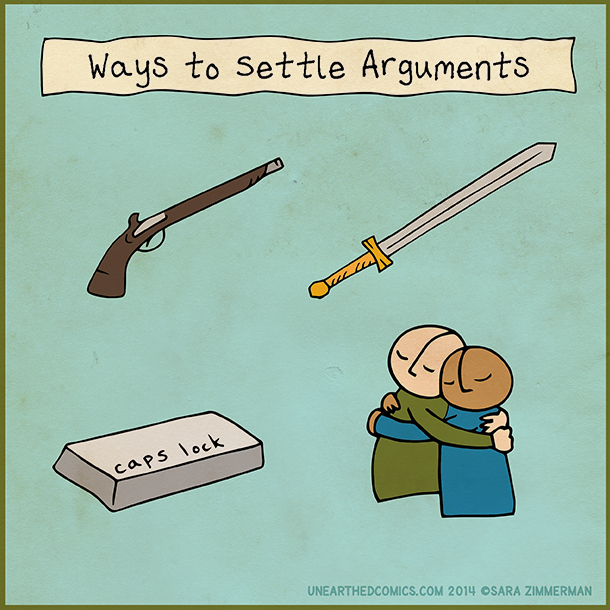
Featured Image: Ways To Settle Arguments

So, lately I have witnessed my fair share of intense arguments, not only on my Facebook feed, but also on my LinkedIn, Twitter, as well as among my friends and family (I have actually partaken in some of these). It is no hidden fact that as a society we will have differences, which can result in conflict, but sometimes healthy debates are necessary and good in order for our society to function. I mean, could you imagine? A world where we all had the same thoughts, same likes, and same passions? Not sure about you, but to me, that sounds unpleasantly robotic. However, nowadays we see very few friendly debates; we mainly see full-blown arguments, with the sole intent of attaining victory and to change our opponent’s mind, as opposed to inform and simply listen to one another’s point of view. So, what is the fool-proof way of winning these arguments? That’s simple: avoid them – and here’s why.

  1. “You have a duty to speak up.” 

    I can see how the circumstances of unfairness and the human responsibility to look out for one another can send us into a down spiral “discussion.” However, the belief that we have a duty to always give our opinion is not true, and it is not what “speak up” means. When you start/enter into an argument in which your thoughts were not necessarily requested, it will only cause hostility. Doing this will not make your opponent like you; it will only make him/her strike back. I once saw a quote that said “instead of attacking what you hate, start promoting what you love,” and it truly stuck with me. If you truly want to speak up, start upholding and working towards what you believe in, and stay away from the unwanted, pull-your-hair-out arguments 🙂 .

  2. “You can prove them wrong.” 

    Yes, you can provide amazing facts, charts, examples, and use many other great tools all for the sake of proving your opponent wrong – but, at what cost? Although these things are great when used in friendly debates (those discussions that lead to information and communication rather than confrontation), it is counterproductive when used in a heated argument. Within the environment of an escalated dispute, proving someone “wrong” will not only insult your challenger’s intelligence, but it will also make that individual feel inferior, hurting whatever relationship you have (or could’ve had) with that person – even if the damage doesn’t show immediately. The take-away from this: always aim to simply inform and communicate, rather than using these great tools to humiliate and insult.

  3. “You win.” 

    Actually, you don’t. When you lose an argument, you lose. When you win an argument, you also lose. How? Because even though you will feel awesome, triumphant, and will want to tell your mom all about it, the other person does not. Their pride has been hurt, he/she feels degraded, their self-respect and judgment feel attacked, and most importantly: that person will just resent you for your great “win.” Oftentimes we believe that by proving someone wrong and proving ourselves to be right, we have won the person’s opinion in favor of ours. However, the truth is, as Dale Carnegie put it, “a man convinced against his will is of the same opinion still.” Winning an argument will never change anyone’s mind. What can change people’s minds, however, is your life example as to how you live by what you preach. This is not to say that you will never make mistakes; I have made plenty – yet it does not mean I have to advocate for the mistakes I’ve made. If you fall, pick yourself right back up; acknowledge and learn from your downfall. Doing so will not show that you’re a “hypocrite,” it will rather deepen your credibility and show your ability to correct yourself when you have failed.

I hope that by now you are as turned off from arguments as I am – it truly serves no good purpose! Of course, as I previously stated, friendly and informative debates/discussions are healthy, and needed for our society to function. Nevertheless, keep in mind that heated and escalated arguments are not debates; they fail to be properly informative (because the other person is not interested in listening), they do not serve the purpose of good communication, and they cause more harm than good. I am certainly not saying that I have not been caught up in these myself, especially when it comes to topics that I am passionate about, but slowly and steadily I am learning that this is not an effective way to have your voice be heard. Take the time to do some reading, keep yourself well-informed, and remember these words from Dale Carnegie:

Why prove to a man he is wrong? Is that going to make him like you? Why not let him save face? He didn’t ask for your opinion. He didn’t want it. Why argue with him? You can’t win an argument, because if you lose, you lose it; and if you win it, you lose it. Why? You will feel fine. But what about him? You have made him feel inferior, you hurt his pride, insult his intelligence, his judgment, and his self-respect, and he’ll resent your triumph. That will make him strike back, but it will never make him want to change his mind. A man convinced against his will is of the same opinion still.” – How to Win Friends and Influence People, by Dale Carnegie.

computer20people20-20talia-3875-final_zpsynpbyivy

By Nayadee Wilson

What do you mean I have to give a presentation?!

*Featured image: The Meep by James Hance*

Usually, our first responsive thought to the suggestion that we might have to get up on stage may be something like this: “you mean in front of people?!” Now, by “getting up on stage” I don’t mean singing, or dancing, or performing a comedy act – most people would probably prefer to do those instead. No, I mean the big, giant, enemy of our very souls, Public Speaking! =O (Cue scary music). Whenever the time comes to give that big presentation or speech, or maybe even something as simple as asking a question during a meeting, the scary thought of public speaking can send most of us running for the hills. I’m sure that we have all heard about the infamous surveys showing that people are more afraid of public speaking than they are of dying. Can you believe it? This basically states that some people would welcome death if it meant that they wouldn’t have to be involved in public speaking. I know that public speaking can definitely be intimidating, but it does not always have to be deadly. I personally love public speaking – I like the spotlight. Sure, right before I have to start, I feel like throwing up everything I consumed the night before, but I work my way around it. Mainly by making sure I don’t do that =). Nevertheless, as you read on you’ll find that there are some things you probably wish you knew about how to handle the big monster called “Public Speaking.”

1. I wish I didn’t get so nervous!

One thing you need to know firsthand is that nerves are your body’s way of preparing; they can actually be used as a tool. Instead of thinking “I’m so nervous,” you should change your thought process to tell yourself “I’m getting so ready for this!” instead. When you start feeling nervous about your public speaking performance, you can use that energy to your advantage with just a little focus. Doing this will help you speak clearly and firmly, and this energy will serve as a drive for the correct body movement, depending on the kind of public speaking you might be involved in. Before I was married I was actually a performer – certainly not a famous one, but I did a lot of singing and some acting. This was the advice I was given by my coaches. Now, I noticed that whenever I used this tool I would always do great. However, when I let my nerves get the best of me and didn’t focus on using them to my advantage (i.e., negative talk: “What if I mess up? What if I fall? I feel nauseous! Etc.), it was not a pretty show; talk about embarrassing performances! >_<. So, before you do your public speaking, make sure you embrace those nerves. Practice positive self-talk, and focus on using these to work for you rather than against you.

(For more on self-talk, read this article: 3 Reasons You Should Talk to Yourself)

2. Eh… I’ll just wing it.

Although the term “wing it” sounds appealing to our spontaneous side, if you rely on this for public speaking you will often be in a lot of trouble. And unless you’re one of those wonderfully, naturally charming “win-the-crowd-over-with-very-little-effort” kind of people, you will always need to prepare (and even the naturals do some kind of preparation). Your amount of planning will always vary depending on what you are doing, but it will always be essential even for the most minimal kind of public speaking. For example, if you’re nervous about asking a question during a meeting, write it down before asking it and read it to yourself. This will give you more assurance in what you’re asking and will help you sound confident and firm when you speak up during the meeting. Now, when it comes to something more involved, such as giving a speech or presentation, needless to say that you should write it up beforehand – if you wing that and you don’t freeze up midsentence, then I salute you! But seriously, make sure you do your due diligence and prepare what you will say before you stand in front of your peers trying to do the old “pretend they’re all in their underwear” trick (which, by the way, absolutely never works).

3. I kind of, sort of, know what I’m talking about.

Undoubtedly, if you’re going to be involved in public speaking you should absolutely know your topic. This does tie into the preparation tip, but it is a different kind of preparation altogether. It would be really pointless if you prepared a power point presentation, reciting your fancy bullet points out loud, for you to then get stumped during Q&A because you actually don’t know your topic very well. Granted, you will most likely not know the answers for everything. When this happens it is perfectly okay to say “I don’t have the answer for that at the moment, but I will work on getting one for you.” However, you should be as prepared as you can be to encounter these kinds of situations, so make sure you do your research. Not only will you be able to answer these questions (if applicable), but doing your homework will also dramatically boost your confidence – and of course we’re all on board with a little confidence boost (whoop-whoop!). So, what happens when you feel confident? Well, you will be able to take control of your nerves, and you will also come across your audience as reliable in your subject knowledge, gaining their attention and trust. There is nothing more captivating in a presentation than someone who seems confident in what they’re presenting. If you’re not sure about the amount of research you’ve done on your topic, a good way to test this is by going through your presentation/speech and ask yourself some questions about the topic. This will not guarantee that you’ll have absolutely everything covered, but it helps tremendously. You can also practice your speech with some friends! Another set of eyes/ears will always be beneficial, and it allows you to laugh at yourself during practice time without necessarily wanting to sprint out of the room in fear.

See? Public Speaking is not so bad – certainly not worse than death! Of course, we know that people are not really more afraid of public speaking than they are of death (I’d hope not!). Although it is funny how this was the first answer that came to mind for most of these individuals when asked what they feared most; fear of death usually ranked second O_O. Coming from someone that actually welcomes the rush of public speaking, I can definitely say that it is still a nerve-wrecking and not always pleasant experience. However, following these easy and simple guidelines always helped me do my best, and I am sure it can do the same for you. So no need to jump off the bridge just yet; let’s conquer the fear of public speaking and live to tell about it! =)

me_zpsext9iuth

Written by Nayadee Wilson