Category Archives: stress

How Screen Time Can Affect Your Day at Work

You have a deadline coming up but you just can’t focus… You have material you have to present to your boss but you can’t get organized because you’re fighting the feeling of exhaustion… You promised to help a co-worker out what a project but you left all the documents at home because you were rushing to get out the door due to your lack of energy and motivation… These things could have been prevented if you had gotten a better night’s sleep.

In my household, screen time is a way to relax and wind down from the craziness of the day. And I know for a fact that my family is not the only one that uses these techniques to chill out at the end of the day. However, it is not the ideal way to accomplish this. There have been many studies showing the negative effects of too much screen time; especially too close to bedtime and how it can ruin your sleep. If you don’t get enough sleep, you guessed it, it’s harder to focus and stay awake the next day.

I’m sure everyone has had at least one good night’s sleep and can remember how good you felt in the morning. You feel refreshed, well rested, and ready to take on the day. I know that even more people can easily relate to the feelings of exhaustion, grogginess, and being irritable. This happens when you do not get a good night’s rest.

There are a few things that were suggested to do instead of staring at a screen right before bed:

Read a book! For those of you not familiar with this ancient pastime… a book is a series of pages with words on them that tell a story. Pick one up and try it, you will be pleasantly surprised!

Talk with your family! Gone are the days when people prefer to just sit down and talk with each other. It’s sad really! Talk about what you all did during the day. Talk about what you’re excited for the following day. Talk about things happening farther into the future. Make up stories! The possibilities are endless!

Color! There are the classic children’s coloring books, but they make adult coloring books now too! This is a creative way to wind down and relieve some stress!

Sleep experts suggest putting down all electronic devices two hours before bedtime. But, if that doesn’t seem realistic for you and your family, even a half hour is better than nothing. Electronic devices include: phones, iPads, computers, TVs, and laptops. I know what you’re thinking…IMPOSSIBLE!

I challenge everyone to try this for a week (that’s really not a long time!) and see if you notice a difference in yourself and/or your family members.

I bet you do!

Written by Lindsay Olewniczak

Visit our website here: http://www.cpstaffing.com/index.aspx

Visit our open jobs here: http://www.cpstaffing.com/jobs.aspx

4 Tips For a Productive Weekend

That feeling of walking out of the office on Friday afternoon is something that everyone looks forward to.  Though the weekend is most often a time to relax it may be who of you to consider different activities that could promote higher productivity and overall more success in the upcoming work week.  These activities may include:

1. Make time for your family and friends.

Having meaningful interactions with those we care about increases our overall outlook as well as positivity.   This in return results in more productivity in the work place.  So call a friend who you haven’t talked to in a while or make time to go to lunch with your mom.  These little things will make you feel good as a person and at work.

2. Exercise.

Let’s face it working out during the week always seems to be a challenge.  Either you have to wake up even earlier and hit the gym or try and motivate yourself to go after work when you are really just thinking about the commute home and what you are planning to have for dinner.  Regardless, for many exercising during the week always seems to be pushed to back burner.  Using the free time that the weekend often provides to exercise can increase your endorphins making your brain and your body feel good, allows you to focus on one activity to help clear your head and often increases your likelihood of a better night’s sleep.

3. Get Creative.

Using the creative side of your brain doesn’t have to just be a part of your weekly work day.  In fact when using creativity to do simple tasks such as organizing your closet can make you feel good as well as boost your creativity for the upcoming work week.

4. Sleep.

We all know that it is recommended that we get 7-8 hours of sleep per night.  But often times due to a busy schedule, stress etc. during the week this does not always occur.  Use the weekend to catch up on the lost hours and give your body a chance to recharge for the busy week ahead.

These four activities will make you feel good after a stressful week but also prepare you for the one ahead, happy weekend!

Weird Interview Questions That You Will Hopefully Never Have To Answer

Have you ever been asked a super random question during an interview? I have, and it definitely threw me off guard. The ComputerPeople Staffing recruiters decided to create list of the weirdest interview questions they have ever heard. I guess any question is fair game in an interview these days!

  • If you were a box of cereal, what would you be and why?
  • What would you say if a penguin walked into this room wearing a sombrero?
  • If you were to get rid of one US state what would it be and why?
  • Name 5 uses for a stapler, without staples.
  • If you were a fruit what would you be?
  • Do you make your bed every morning?
  • What is in the trunk of your car right now?
  • What did you wear for Halloween last year?
  • If you could sing one song on American Idol, what would it be?
  • Are you more of a hunter or a gatherer?
  • If you were on an island and could only bring three things, what would you bring?

Have you ever been asked a weird question during an interview? What was it?


Written by Kaitlyn Gahagen

Applying for a new job? Don’t be surprised if you have to take a test.

Your test-taking days are not over!

Personality tests are becoming more and more popular for candidates and new hires. Sometimes it is part of the hiring process, and sometimes it is post-hire for training and learning purposes. Either way, personality tests can be stressful because testers can begin to feel concerned that they have to answer the way management would want them to answer. However, this thought process does not work. Here are a few tips if you have to take a personality test.

  1. Be yourself. You cannot outsmart the test, so don’t try to. You want to answer truthfully so that you don’t end up looking indecisive or dishonest.
  2. Don’t rush. Personality tests can be boring and draining but you should try to take your time and do your best.
  3. Enjoy the opportunity for honesty. It is a lot easier to admit your faults to a screen than it is to a person, and no one will hold it against you for doing just that. Everyone has strengths and weaknesses, and letting your employers know what they are ahead of time will help them to set you up for success in the workplace.

You should not be afraid of a personality test. Be yourself, don’t rush, and enjoy the opportunity for open communication.

Have you ever had to take a personality test? What was it like?


dsc_5490-1.jpg

Written by Kaitlyn Gahagen

Don’t Stress The Tough Challenges – Do This Instead.

If you’re alive and breathing, chances are that you have been, are being, and/or will be faced with challenges; they’re just part of human nature. Although most of us feel some level of stress when dealing with a challenge, the stress does not come from the challenge itself, it comes from the ways in which we’re handling it. After all, most challenges are good and necessary – they put your mind to work, and they make you stronger and better in the end; they’re good for you!  We shouldn’t be afraid of challenges that come our way. Instead, we should embrace them. So, what’s the best way to do that? Here are a couple of things that have helped me in mine.

  1. How long will the elephant stay in your room?
    A lot of times we look at challenges from the wrong angle, missing (or refusing to look at) the main, underlying problem. The only way you can start to get rid of the elephant in the room is by acknowledging and identifying it; it’s there, and it has a name. It’s not enough to just know that there’s an issue, you should truly make yourself aware of what exactly it is that you’re dealing with.

    For example, after writing blogs for about a year (I’m a bit of a rookie), I’ve been moping in my head about my decline in writing frequency for quite some time now, but I refused to deal with this issue. It was the elephant in my room, and I finally decided to stare at it – why am I not writing as often? As I focused on the issue, it turns out my challenge was not exactly the act of writing; my actual challenge has been coming up with new topics to write about, having my creativity bucket collecting dust. And so, by identifying the essential issue I can now focus on finding an effective solution. This is the first step to overcoming any challenge: look past the surface, and identify the fundamental problem.

  2. How will you get the elephant out?
    Sometimes, identifying the real challenge can be a lot easier than finding a solution to it, but at least it gives you a start! Writing about my personal challenge helped me identify it, which was step number one. In the course of nature you’ll often find that once you take that first step, it’s a lot easier to take that second one. After you’ve done your first step of identifying, you can now focus on how you’ll overcome your challenge.

    a.) Write down your own ideas on how to approach your new challenge.

    b.) Talk to others about your struggle; share with people that have dealt with a similar challenge. Chances are that someone somewhere has gone or is going through the same thing, and could offer you some useful insight.

    c.) Put all those ideas and advice together and do some good ‘ol fashion trial and error. You may not stumble upon the greatest solution right away, but if you do nothing then your elephant might live there forever, rent-free.

The take-away.

All in all, when it comes to facing your challenges it really comes down to these three points:

1. Knowing the underlying issue allows you to focus on finding an effective solution.

2. Do some good ‘ol fashion trial and error – it’s better than doing nothing.

3. Learn from all of it.

The best thing about overcoming a challenge is that if you’re faced with it again, you’re ready for it; it becomes less “challenging,” making you ready for better and bigger challenges. You learn the good and the bad and can add another star to your “Life Experiences Board,” while also learning how to deal with other difficult situations. So, the next time you’re faced with a challenge, make sure you look at it from the right angle and tackle it like a pro! 🙂

*Featured image: Life is Stressful by Ayana

computer20people20-20talia-3875-final_zpsynpbyivy

Written by Nayadee Wilson

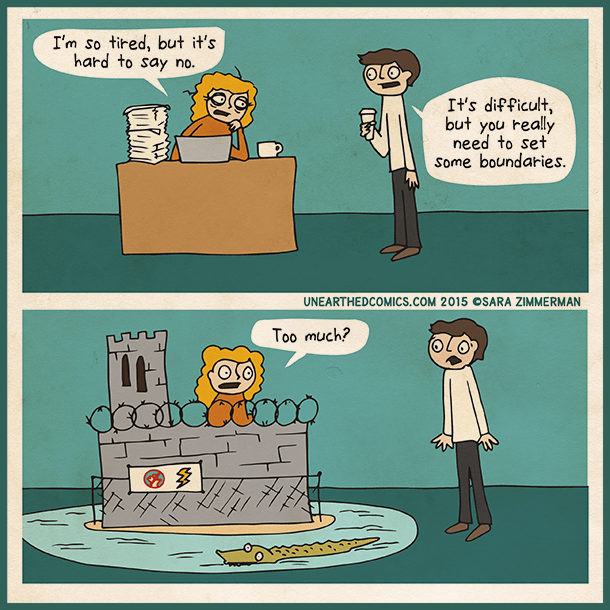
"Boundaries" by Sarah Zimmerman - Unearthed Comics

The Simple Step to Achieve Great Work-Life Balance

Featured image: “Boundaries” by Sarah Zimmerman – Unearthed Comics

The issue of life and work balance is so common that you hear it being discussed all the time – you read articles about it, talk about it with your colleagues, with your family, so on and so on. It’s a struggle that many of us have, sometimes for a lot longer than we anticipate, and oftentimes we sort of give up on trying to fix it; we say “it is what it is,” or “I do what I have to do.” Meanwhile, we, as well as the people we care about, are unable to escape the consequences.

In reality, the step to achieve a good work-life balance is a lot simpler than we’d think, although simple does not mean easy. However, you’re going to find out that although it may sometimes be difficult to apply this step, it is well worth it in the long run. Not only will it keep you from going insane, but family and loved ones will be grateful for it too. So what’s the secret? Simple: setting Clear Boundaries.

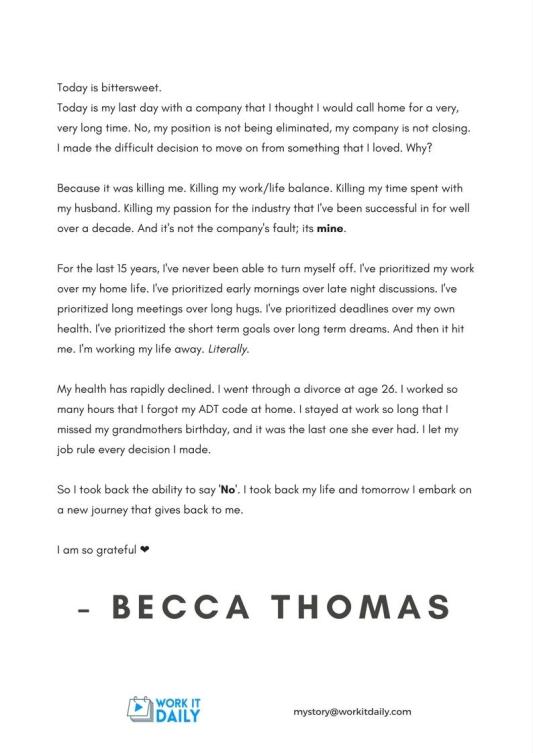
I want to emphasize the word “clear” because a lot of times we say that we’re setting boundaries between our work and our personal life, but in reality we just put up a fort with bendy straws. Having clear boundaries means you have specifics; you set a specific line for yourself that you will not cross when it comes to your work interfering with your personal life at home, and vice versa. Sometimes we realize our need to do this too late, and we might end up telling a story similar to the one below:

6a64f6f0-6a11-4e08-9606-c056bf5f48ab-original

Shared story from Work it Daily

Becca Thomas mentioned how she “took back the ability to say ‘No’,” and while that is essentially what setting a boundary entails, for some of us simply saying “No.” is virtually impossible (at least for me it is). If you’re like me and have a relatively tough time saying “No.” to requests, there are other things you can do for yourself that make it easier to do so, like your time management.

When it comes to time management, there are a couple of ways you can go about it. For example, there are times when my husband has to do some work from home after a full day of work at the office. When this is the case, his boundary is to spend no more than 20 minutes working at home. You could also simply say “I will not work past 6:00pm,” and have that be your boundary instead.

These kinds of boundaries are clear, making them simple to follow, thus making them very effective. Are they easy to follow? Not always – there has been one or two times where Patrick goes a little over the 20 minute limit, but these are very rare occasions. The fact that the boundary has already been established makes it easier to be aware of how you’re handling your work-life balance, preventing you from going on a downward spiral of unbalance like Becca Thomas. Although, with stories like hers I would still argue that it’s better late than never, as you could see from her testimony this wouldn’t be a situation in which “fashionably late” is a good thing either.

So, what will your clear boundary be? Will it be “no working past 6pm”? No checking emails during dinner time? No more than 20 minutes working at home? Or maybe it’s “Thursdays are strictly family days – no phones, no emails”? Of course, it’s hard to decide to step away from your work at times, especially if your role is extremely involved in essential operations of a company. However, there are certain things that will always be more important, that also need your care and time – yourself being one of these. Having clear boundaries to maintain work-life balance will always work out in your favor, and you’ll also find that the business world will not fall apart when you decide not to be a 24/7 working robot. So have at it and take back the ability to say “No.” 🙂

computer20people20-20talia-3875-final_zpsynpbyivy

By Nayadee Wilson

https://www.youtube.com/watch?v=XGZw50ACcys

What it Means When You Don’t Vote – The Opinion of a Humble Doritos Vending Machine, and an Immigrant

With this upcoming election, we have all seen a lot of turmoil, a lot of passion, and certainly no lack of disagreement between our fellow American voters. Additionally, I am also seeing something that I had not witnessed in the entire 15 years I have lived in this country: the immense amount of people that have decided not to vote. As a now American citizen who emigrated here with my family from the Dominican Republic in pursuit of the “American Dream,” it is heartbreaking to see how many United States citizens are choosing not to exercise this incredibly valuable right. And from the looks of it, it breaks Frito-Lay Doritos’ heart too!

Rock the vote!

In several college campuses, Frito-Lay has established Doritos chips vending machines with an interesting choice process. The vending machine first presents you with the question “Are you registered to vote?” to which you can answer either “yes” or “no.” Once you have given your answer, you go through your chip-selection process as normal. However, if your answer was “no,” then no matter what your choice of flavor was, the vending machine spits out a grey, dull Doritos bag, with cardboard chips – no flavor, no cheesy goodness, no Doritos; Oh, the atrocity! 😦 Just take a look at the poor students’ faces when denied the goodness of real Doritos.

The movement is part of a campaign that the popular chips brand has taken alongside Rock the Vote in order to motivate college students to participate in the voting process. According to Doritos, since 62% of young voters did not take part in the 2012 election, they decided to make a special bag for them. And what is the message of this new, special Doritos “flavor”? Well, I’d say it is pretty obvious: if you give up your right to vote, then you’ve given up your right to choose. Although a great means of motivation by Doritos, the unfortunate fact is that many of us have several excuses to rationalize our decision of not voting during this election. Let’s tackle some of the most common ones.

“Straight out of options”

Doritos is non-partisan, and they just want to try and get us all out there to exercise our right to vote. Yet, without a doubt, the main reason for people “sitting out” during this presidential election is the fact that a significant number of Americans believe that neither of the current presidential candidates are suitably qualified. However, I do not believe that this should be an excuse to sit this election out. Several people have decided to “vote for the lesser of two evils,” which is an option you can choose, no matter whose side you decide to take. Another option is to vote for a third party; any other presidential candidate available on your state ballot (yes, there are more than just four candidates). The best thing you could do is become well-informed; do your research (and for the love of all that is good, please conduct research outside of social media), and vote on the people/things in which you believe – because that is the point of democracy! The purpose of our vote is so that our input on what we all stand for is taken into consideration; the elections are not a time for us to just give up because the fight seems pointless – no battle has ever been won this way. I know that many will say that voting for a third party is pointless, or that your vote doesn’t matter at all, but I can show you some great ways in which your vote still does matter, even if that third party candidate you vote for has no chance at becoming our next president.

My vote doesn’t count.

If you’re like my husband, although he is voting (because his lovely wife said so 🙂 ), you might stick to the rationalization that Electoral College elects the president, not the popular vote. And yes, generally speaking, this is true. However, your vote still counts, just not in the direct way you may think. One thing to remember is that you are voting in your state’s election, not necessarily a national one. Therefore, your vote holds weight in your particular state. As an article on Fact/Myth put it, “You don’t just vote on the President, you vote on many local, state, and federal races and state-based ballot measures!” Since the complexity of how this all works may not be my area of expertise, I urge you to read David Walbert’s “Does my vote count? Understanding the electoral college” if you still have your doubts as to why or how your vote matters; there is a lot more involved in your vote than what you may think. Although your vote for a president does not directly count towards the presidential election, the many other ways in which your vote does count make me stand with Doritos: “If you don’t vote, someone else chooses for you.”

Eh, I don’t think it’s that big a deal.

As part of an immigrant family that came to the United States for opportunity, who has come to love and embrace this country, I will honestly say that the “no big deal” and the “it doesn’t count anyway” statements irk me the most 😦 . Some of us might not know our history very well, and some of us may be very well informed. Nonetheless, I have encountered people who are very aware of the United States’ history in obtaining voting rights, who still refuse to put importance on our vote. One thing we should keep in mind is that not everyone in the United States was always allowed to vote. For a long time, the only eligible citizens allowed to vote were white, rich, male men and no one else. Our right to vote in this country came with a price; it was not just given to us.

The poor – As an example, let’s reflect on Thomas Dorr. Although Dorr was a wealthy, white man, he considered it wrong that the less fortunate citizens were denied a vote in the United States, and so he fought for it. With rusty cannons against Samuel King’s government, Dorr was defeated in his fight and arrested. Yet, his cause could not be crushed (remember that thing I said about standing up for what we believe, and not just give up when the fight seems pointless? Yeah, this is why). Because of what Dorr started, by the time of the Civil War, every white male of voting age, rich or poor, was eligible to vote.

The women – If you’re a woman who’s eligible to vote, you might want to thank Alice Paul. Alice Paul and her supporters protested outside the gates of the White House and were eventually arrested. While in prison, Paul began a hunger strike for which she was then put in a psychiatric facility. There, she was force-fed through a tube, and encountered many more horrid conditions. Finally, on August 26, 1920, Paul’s battle won the women’s right to vote.

The African Americans – For African Americans, a person you might want to think about and thank is Bob Moses. Although African Americans were granted the right to vote in 1868, southern states were going out of their way to prevent black voters from voting in any election. Bob Moses, along with members of the Student Nonviolent Coordinating Committee, fought for true voting rights. During his fight, he was struck several times in the head, needing several stitches, as well as encountered gunfire from white supremacists in attempts to stop him. Finally, after all the struggle, injuries, and even deaths, the Voting Rights Act of 1965 was signed, allowing equal rights to all voters.

Do you still believe your vote is useless?

Needless to say, it saddens my heart when I see so many people tossing our precious history to a lonely corner, and reducing the value of our hard-earned voting rights. If you do your own research, there is much more that you will be able to find on how we gained our civil rights (the individuals I spoke of were mainly obtained from the Scholastic Website) and how your vote matters. Regardless of where you stand, who you support or don’t support, make sure that you honor the lives of those who fought for our voting rights in this great country (yes, I do still believe that we are a great country, despite our flaws), and appreciate the value of your vote. Don’t get stuck with yucky, plain, cardboard Doritos; make sure you get some tasty Doritos, and vote!

*Featured image: Doritos No Choice

me_zpsext9iuth

By Nayadee Wilson


Feeling Overwhelmed? End the Haunting of Stress in the Workplace.

I saw a post from a friend earlier this morning that read “stress can kill you.” And it is, indeed, a very scary thing – it would make a great Halloween costume! Stress in the workplace is such a common phenomenon, that it is no wonder there are hundreds of articles discussing the topic and offering advice on how to deal with it. After all, according to the American Psychological Association’s annual “Stress in America Survey,” a whopping 65% of Americans referred to work as a top source of stress in 2012, and in 2015 money and work still remained the top two causes of significant stress. Although I have found most articles helpful, I can’t help but notice that most of these tend to emphasize solely on stress emerging from work situations or the work environment. However, sometimes stress comes from other sources that don’t necessarily relate to our work experiences. So I’ve decided to break down the sources of stress in the workplace into three categories: Stress from home, Stress from work, and Stress within you.

My personal life is falling apart.

So maybe your job is great (yay!); maybe you love what you do and can’t truly complain about the work itself. However, even though we’ve often heard the phrase “don’t take your work home with you,” what happens when home comes to work? And yes, I know a lot of us have probably also heard the phrase “leave your personal life at home,” but that’s not always so easy, is it? Sometimes life happens, and you can’t help but stress about it all day long. Here are two steps that have helped me, and may help you as well. 🙂

  1. Get real – One of the first things to do in this situation is to grab a hold of reality, and understand that your troubles from home cannot be solved while at work. It sounds harsh, I know, but a firm grasp on the reality that worrying about your personal difficulties will not take you any closer to solving them, will help you place these worries aside and help you regain focus on work (for the time being). If it truly is an overwhelming event, you’re better off taking a personal day to work through it, and come back to work when you feel refreshed. Nonetheless, if you’re already at work and you’re having a tough time setting these worries aside, here is something I like to ponder on when I start to worry: “Can any of you by worrying add a single hour to your life?” In other words, can you gain anything extra in life by worrying? Not likely. What do you gain by worrying? Stress.
  2. Get to work – Once you leave work, get to work on solving your problem. Home-stress factors can be a lot of different things for different people. One of the most popular is usually financial troubles; are you in debt or is there an income problem? In this case, get to work and start to handle your finances wisely; take the time to develop a plan of action. It could also be marital/relationship problems, family illness, or even a more serious event like a death in the family. If this is the case, remember that there is no shame in getting help. Professional assistance is always available to help you cope with this kind of stress, as well as a trusted friend or relative you can rely on. When you make time in your personal life to resolve these issues in a healthy way, it leaves room for focus and dedication in the workplace. If you don’t, then you will most likely feel obliged to spend time thinking about these issues, as you have not dedicated any time to solve them elsewhere.

I hate my job.

Alright, so maybe you do hate your job. Maybe you are feeling undervalued, unappreciated, and unfairly treated. 😦 Perhaps your boss/supervisor is not the kindest, or perhaps your work environment is a toxic one. Regardless of the reason, it is never healthy for anyone – you or the company – to feel miserable at work. Here are some things to keep in mind.

  1. Be rational – A great thing to keep a handle on is the proper perspective; is this all in my head? One way to reflect rationally and see a situation from the outside-in, is by writing an email or note of what happened and how you’re feeling, not sending it, and reading it over to yourself (I will emphasize, do not send your angry email to your co-worker/supervisor/boss/customer – it never remedies anything, trust me 😦 ). Not only will this exercise help you re-evaluate a situation, it also serves as kind of a “woo-saah” type of healing. Reading it over will make you ask relevant questions like “am I overreacting? Is this the right thing to say? Are these the proper words to use? What could have been done differently?” etc. Additionally, it might be a good idea to save these emails for yourself and keep track of what your triggers are; i.e. what “ticks you off.” You can then transform your quick reaction to these kinds of situations into a wise and appropriate action in the future.
  2. Have boundaries – Although a great success, technology has also been our downfall. I know there are times in which we feel we have to be the “Yes-man” and be available 24/7, because why wouldn’t we be? It’s our job, right? Not exactly. Of course, there are many responsibilities that come with your job title, but there are also times in which you can say “No,” and your boss will understand. When my husband first accepted his current job, it was a great career opportunity for him and he was very excited. However, he was starting to constantly check his emails while being at home, which made it difficult for him to be a part of the family, and caused both him and the family a great deal of stress. Once he established the boundary between home and work, everyone was a lot happier. 🙂 Of course, by “everyone” I mean me; if mom is not happy, then no one is happy 😉 . But, with my attempted jokes aside, it is needless to say that placing boundaries is healthy and acceptable.
  3. Have communication – We all wish that our peers would just know when something would not sit quite well with us. Unfortunately, none of us are mind readers and we all think differently, therefore communication is needed. You may want to try simply speaking to your boss about your level of stress. By “speaking,” I cannot stress enough that this does not mean “complain.” It means discussing how you are feeling and asking what you can do to improve the situation, or how can you work together to come to a healthy and adequate solution. If you are with a good company, you can rest assured that you will be helped and encouraged – some companies even have programs that offer professional help if you need it. If you are, however, within a toxic work environment in which your concerns are not properly addressed, then you can feel at peace by making the decision to take your talents elsewhere. Being constantly stressed will contribute to short temper, anxiety, and many more health issues that will significantly impact your productivity on the job. To give a quick summary of my experience, when I worked for a previous company some time ago, I experienced all of these symptoms, which caused me to lose the quality of my once acclaimed, and even rewarded, customer service skills. This particular company was an incredibly toxic one, and although I did stress about what I would do once I left, it was the best decision I ever made. If this is the case, a great tool to use in your new job search is a staffing agency – they are wonderful and there to help! Not to mention today I work for one of the best, and could not love my job any more if I tried. 😉

I can choose to be happy.

Last, but certainly not least, is my favorite topic of almost every article/study I’ve read on managing stress: managing yourself. This was the one thing that all of my research had in common, which I will completely agree with. Many times we think that happiness is an effect of our circumstance, therefore making it a strictly dependent emotion. However, happiness is not so much an emotion reliant on context, but an action that will ultimately affect how we feel. Take talking to yourself, for example; if you constantly feed yourself negative words, your natural reaction will be to feel bad about yourself. Yet, if you choose to feed yourself uplifting words, your natural reaction will be to feel uplifted. The choice between being happy and miserable can have a huge impact on your stress level. After all, stress itself is not so much what happens around us, but more so how we perceive our circumstances. Try it out for yourself; make the choice to be happy for a whole day, and see how you feel.

  1. Stop comparing – As I came across an article discussing work tension, I loved how they phrased this idea as “leave the Joneses alone.” When you start to feel bad about yourself or how your life is going, it could be because you are comparing yourself to someone else. Your experiences will never be someone else’s, so you should focus on the accomplishments you have made, the goals you’re running towards (or the ones you need to start working on), and the joys you’ve experienced. You should also remember that what you see from people around you on the outside is not always a clear representation of what lies on the inside. We all have our struggles, and we all have amazing successes. Focus on the latter.
  2. Get some hobbies – Don’t forget to treat yourself. When you make time for the things you love, it will help you tremendously in reducing stress. It is important that you disconnect from the world for a while, and reconnect with the things that make you “tick.” If you’re not sure what you would enjoy or you don’t have any hobbies, try out some new things – or simply have a “me-day” where you can take naps if that’s what you’re into. Whatever it may be, take the time to do things that will uplift you and create positive experiences in your life.
  3. Be spiritual – This one surprises some, but being spiritual will actually help a great deal with removing stress. The American Psychological Association advises that you take the time to relax, and calls it “a state in which you actively observe experiences and thoughts without judging them.” For me, personally, prayer works wonders; my days are a million times better when I start off with a prayer and thanksgiving. Nevertheless, if that’s not your thing you may want to look into something like yoga, or meditation. Making the choice to relax, to be thankful, and to focus on positive things will automatically set up your mind and body for positive outcomes throughout your day, making it hard to see the negative side to many situations.

In Conclusion

Remember to not freak out! Although these tips were the ones I found to be most helpful, a lot of what I have written comes from my own personal experiences as well – the lessons I’ve learned the hard way, and the ones I’ve learned from studying. The truth is that there are many ways in which you can manage your stress level and take control of it, so don’t make my mistake; try to learn these tips ahead of time before you explode! >_<

Make sure that you take care of yourself, eat healthy (which I didn’t dive into, but taking care of yourself physically will also affect how you feel emotionally), find some hobbies, and ask for help when you need it. Most importantly, remember that whether at work or at home, when you feel stressed you do not have to go through it by yourself; remember that you are not alone. Stress will lead you into deceiving yourself, thinking that there is nothing you can do and that you have no one who can help, and you just want out! Remember that this is a lie. Any great company knows that we are all in this together, and when one member does not function well, the entire company does not function well. Know your worth, don’t fight it alone, and be confident that you can kick that Stress-monster’s butt! 🙂

me_zpsext9iuth

By Nayadee Wilson