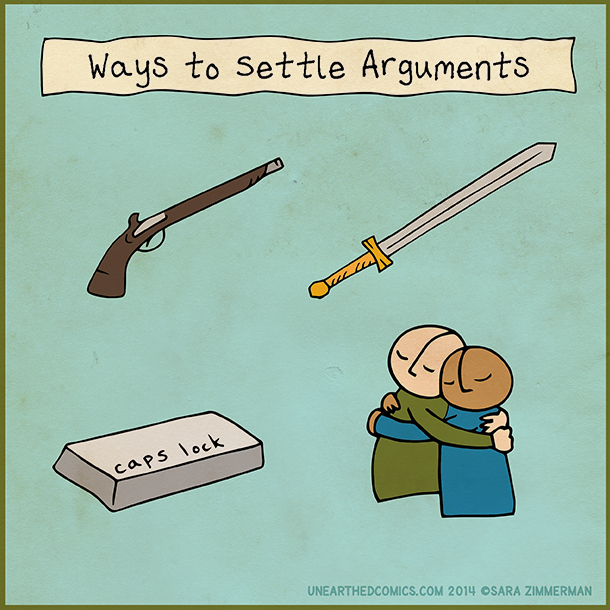
Featured Image: Ways To Settle Arguments
So, lately I have witnessed my fair share of intense arguments, not only on my Facebook feed, but also on my LinkedIn, Twitter, as well as among my friends and family (I have actually partaken in some of these). It is no hidden fact that as a society we will have differences, which can result in conflict, but sometimes healthy debates are necessary and good in order for our society to function. I mean, could you imagine? A world where we all had the same thoughts, same likes, and same passions? Not sure about you, but to me, that sounds unpleasantly robotic. However, nowadays we see very few friendly debates; we mainly see full-blown arguments, with the sole intent of attaining victory and to change our opponent’s mind, as opposed to inform and simply listen to one another’s point of view. So, what is the fool-proof way of winning these arguments? That’s simple: avoid them – and here’s why.
- “You have a duty to speak up.”
I can see how the circumstances of unfairness and the human responsibility to look out for one another can send us into a down spiral “discussion.” However, the belief that we have a duty to always give our opinion is not true, and it is not what “speak up” means. When you start/enter into an argument in which your thoughts were not necessarily requested, it will only cause hostility. Doing this will not make your opponent like you; it will only make him/her strike back. I once saw a quote that said “instead of attacking what you hate, start promoting what you love,” and it truly stuck with me. If you truly want to speak up, start upholding and working towards what you believe in, and stay away from the unwanted, pull-your-hair-out arguments 🙂 .
- “You can prove them wrong.”
Yes, you can provide amazing facts, charts, examples, and use many other great tools all for the sake of proving your opponent wrong – but, at what cost? Although these things are great when used in friendly debates (those discussions that lead to information and communication rather than confrontation), it is counterproductive when used in a heated argument. Within the environment of an escalated dispute, proving someone “wrong” will not only insult your challenger’s intelligence, but it will also make that individual feel inferior, hurting whatever relationship you have (or could’ve had) with that person – even if the damage doesn’t show immediately. The take-away from this: always aim to simply inform and communicate, rather than using these great tools to humiliate and insult.
- “You win.”
Actually, you don’t. When you lose an argument, you lose. When you win an argument, you also lose. How? Because even though you will feel awesome, triumphant, and will want to tell your mom all about it, the other person does not. Their pride has been hurt, he/she feels degraded, their self-respect and judgment feel attacked, and most importantly: that person will just resent you for your great “win.” Oftentimes we believe that by proving someone wrong and proving ourselves to be right, we have won the person’s opinion in favor of ours. However, the truth is, as Dale Carnegie put it, “a man convinced against his will is of the same opinion still.” Winning an argument will never change anyone’s mind. What can change people’s minds, however, is your life example as to how you live by what you preach. This is not to say that you will never make mistakes; I have made plenty – yet it does not mean I have to advocate for the mistakes I’ve made. If you fall, pick yourself right back up; acknowledge and learn from your downfall. Doing so will not show that you’re a “hypocrite,” it will rather deepen your credibility and show your ability to correct yourself when you have failed.
I hope that by now you are as turned off from arguments as I am – it truly serves no good purpose! Of course, as I previously stated, friendly and informative debates/discussions are healthy, and needed for our society to function. Nevertheless, keep in mind that heated and escalated arguments are not debates; they fail to be properly informative (because the other person is not interested in listening), they do not serve the purpose of good communication, and they cause more harm than good. I am certainly not saying that I have not been caught up in these myself, especially when it comes to topics that I am passionate about, but slowly and steadily I am learning that this is not an effective way to have your voice be heard. Take the time to do some reading, keep yourself well-informed, and remember these words from Dale Carnegie:
“Why prove to a man he is wrong? Is that going to make him like you? Why not let him save face? He didn’t ask for your opinion. He didn’t want it. Why argue with him? You can’t win an argument, because if you lose, you lose it; and if you win it, you lose it. Why? You will feel fine. But what about him? You have made him feel inferior, you hurt his pride, insult his intelligence, his judgment, and his self-respect, and he’ll resent your triumph. That will make him strike back, but it will never make him want to change his mind. A man convinced against his will is of the same opinion still.” – How to Win Friends and Influence People, by Dale Carnegie.

By Nayadee Wilson
 ComputerPeople Staffing Blog