Tag Archives: life

Five Hobbies That Make You Smarter

We all have hobbies. Some are fun, some are relaxing, and some are just habit.  Our brains are designed to develop new connections and pathways during stimulating activities and these connections can actually increase our intelligence. Here are five hobbies that are great catalysts for doing just that.

  1. Reading. Anything, anywhere, anytime. Study after study has shown that reading is one of the best things you can do for your brain on a daily basis. It reduces stress, increases creativity, and increases problem solving ability. If you are reading this, you are off to a great start!
  2. Writing. This is a great hobby because it engages cognitive, optical, and motor skills, especially when you are writing by hand. Writing is also a great way to find an emotional equilibrium and reduce stress.
  3. Playing an Instrument. Playing any type of instrument has been proven to actually increase your IQ. It boosts creativity, self-expression, and provides an outlet for all the pressure of everyday life.
  4. Puzzles. Sudoku, solitaire, thoughtful board games, and crossword puzzles just to name a few. These activates are relaxing, stimulating, and amazing for your brain. They all increase neuroplasticity, which can help in problem solving, understanding, and looking at problems from multiple viewpoints. It also helps us to recognize patterns and can even help prevent depression and anxiety.
  5. Working out. Regular exercise is crucial for not only your physical health, but your mental health. Regular workouts cause our cells to become flooded with BDNF, a protein that has been proven to help with memory, learning, focus, concentration and understanding.

What hobbies do think make you smarter? Send us your comments!

Written by Kaitlyn Gahagen


Employee Spotlight: President and CEO Cindy Neese

Cindy has been on the ComputerPeople team for over 34 years. She started out as a Sales Representative in May of 1984, just 14 years after ComputerPeople first opened its doors. Over the years, she worked hard to progress into the roles of Sales Manager and VP of Sales before she was promoted into her current role, President/CEO of ComputerPeople. Cindy is an excellent example of a selfless leader. She is always putting her team first and coming up with new ways to make everyone at ComputerPeople feel loved, valued, and heard. We sat down with Cindy to find out a little bit more about ComputerPeople and about Cindy herself! Read on to find out what she had to say.
 
What sets ComputerPeople apart in the recruiting/business world?

There are a few things that really set us apart from others. Our longevity in the market, the tenure of our in-house employees, and the relationships that we have built through 50 years of doing business in the Buffalo community definitely set us apart from the crowd. However, I am most proud of the fact that we make it our business to understand our customers culture. We do this in order to do a better job of determining the best candidates for a company to create the perfect employer-employee match for every job order.

What is your favorite office tradition at ComputerPeople?
My favorite office tradition is at Christmas. For this holiday, we always go out for a team lunch and then do a secret Santa gift exchange.  We have shared many laughs together as associates steal gifts from others!
 
What is something most people probably do not know about ComputerPeople?
We were the first privately owned specialized IT Staffing firm in Buffalo.
 
What is something most people probably don’t know about you?

I play the piano and I love flower gardening!

Cindy, we all appreciate everything you do to make ComputerPeople such an amazing place to be!

Written by Kaitlyn Gahagen

How To Be A Cover Letter Rockstar

Cover letters can be scary to both experienced and inexperienced job seekers. What should you include in your cover letter? Should you even include a cover letter if it isn’t required? How do you know if your cover letter is acceptable? The reality is that you should not fear the cover letter. Here are a few tips to help you write your next cover letter like a pro.

Write one. ALWAYS write a cover letter. Yes, ALWAYS. The only exception to this rule is if the application specifically says not to write one, which is rare. Since most other people do not go the extra mile to write a cover letter, choosing to do so will set you apart and show the hiring manager that you are actually interested and prepared.

Keep it the right length. Your cover letter should be short. It should never go over one page. You can play with your font and margin if you need a couple extra lines, but try not to let that be too obvious. Also, never use comic sands. For anything. EVER.

Address it correctly. “To Whom It May Concern” is not going to help you stand out. You should address your cover letter to the manager of the department where you are applying to work. If you do not know the name of that person, just address your letter to the Hiring Manager.

Include the right things. First of all, you should grab the reader’s attention. There are several ways you can do this such as creatively introducing yourself, asking the hiring manager a question about his/her needs to fill the position you are applying for, or explain your interest in the position. Next, you should capture the reader’s interest by explaining why you are qualified for the position based on your experience, education, ideas, etc. Explain what sets you apart from the multiple other people that have applied for the position. In the following paragraph, share a few notable accomplishments with the hiring manager. The idea is to write something that will cause the hiring manager to want to meet you. If you are applying for a job in another area, it is important to tell the hiring manager why you are applying for a job in that area. For example, if you live in Tampa and you are applying for a job in Buffalo, you should tell the hiring manager why you want to live in Buffalo. If you do not do this, some managers will immediately discount your job application. Finally, directly ask the hiring manager for an interview.

Feel it out. Not all companies are created equal, so you are going to have to use your judgement if you want to strike the right cord. You never want to try to be something you are not, especially in an interview situation, but if you know a company is super relaxed, you might want to play around with your wording so that you give off the right impression. However, never try to be funny or not serious in a cover letter. You want to be yourself, but your cover letter will likely be a first impression, so make it a good one!

NOTE: Always follow the instructions of the employer when applying for a job!

Good luck!


Written by Kaitlyn Gahagen

Let’s Talk Podcasts

Are you a podcast person? I am. I did not really start listening to podcasts until I discovered they were an excellent way to pass time on my 45 minute commute to work. Since then, I have started listening to them everywhere. At the gym, on road trips, and even at home. Read on to discover the top reasons why I believe everyone should listen to podcasts.

They provide listeners with a constant opportunity to learn and think.  Podcasts help listeners to think creatively and inspire innovation. Podcasts have grown so much over the years, and you can pretty much find a podcast [or 50] on just about any topic. As a business person, podcasts are a great way to constantly learn about your field. Listening to a great podcast once a day would be like attending a business conference every week.

They are free. You have to pay for most music streaming services, audiobooks, and even some sports broadcasts. But not good ole podcasts. It is free to subscribe to your favorite channels or download individual podcasts as needed.

They are convenient. Since podcasts are available right on your smartphone, you literally do not need anything to start listening to podcasts right now. Just find a podcast that you like and click play!


My Favorite Podcasts:

  • TEDTalks – Nonprofit Organization
  • Freakonomics Radio – Stephen J. Dubner


What are some of your favorite podcasts to listen to and why?


Written by Kaitlyn Gahagen

How To Increase Your Productivity By Next Week

We all want to be more productive, but it is usually easier said than done.

Productivity is something that we discuss all the time at ComputerPeople. This time, we took it one step further by talking to people with excellent habits, researching, and brainstorming how to we can more productive in the short term. We liked these five habits because they can make a huge impact on productivity AND you can definitely work them all into your routine pretty much immediately.

Hope they help!

1) Delegate, delegate, and delegate some more. The worst thing you can do for your productivity is put too much on your plate when some of your tasks could be handled by others. Do not try and to everything yourself when someone else could do it better.

2) Have a plan. You should constantly create lists and know what you need to accomplish in the next 24 hours. Prepare for the next day by getting a realistic plan in the works.

3) Take Breaks. Yes, I’m serious. You will be more focused and productive if you reward yourself with small breaks about every 90 minutes, and you will be less vulnerable to getting off track and losing motivation.

4) Find useful apps. Do not take all day to do something that an app could have done for you in an hour. There are thousands of productivity apps out there that will help you get the job done and make your life easier.

5) Get up early. They weren’t kidding when they said the early bird gets the worm. If you want to be productive, you shouldn’t waste your time sleeping the day away. Go to sleep early and start grinding when there are few distractions.


by Kaitlyn Gahagen

8 Ways To Keep Your Office Organized in 2018

Keeping an organized office is one of the simplest things you can do to increase your productivity, happiness, and efficiency at work. Although keeping your office clean can seem difficult, you can use these 8 tips to make the job easier.

  1. Go paperless. Whenever possible, you should try and reduce the amount of clutter flowing into and out of your space by transitioning to online information storage. Create folders, labels, and paths for your information to be kept online. The key with this is making sure you save your files in a place that can be easily accessed and found.
  2. Invest in a labeler. The documents that you cannot afford to store online should be put away in a distinct drawer, file, or closet that is neatly labeled.
  3. Purge your office. Go through your entire space and get rid of things that you haven’t used in a while. It can be difficult to part with some things, but your office will never be organized unless you reduce the amount of items that are inside it.
  4. Don’t wait on sorting your mail. One of the most common culprits for a disorganized office is the build up of mail. The solution to this problem is to start a habit of sorting your mail as soon as you get it so it does not build up. Throw it out, delegate it, or read and file it.
  5. Organize your desk drawers. Use dividers and separators for different items that you keep in your desk so you always know where to find what you need.
  6. Reduce the view of your cables. We know that cables are a necessary part of the electronics in your office, but there are several easy and cheap ways to hide them and get them out of site. You can attach a rain gutter to the bottom of your desk to keep the majority out of view, or buy equipment designed for managing cables. Personally, I believe this one makes SUCH a big difference.
  7. Use your wall space. Moving select items from your desk to the wall can really free up your workspace. Mounting your computer screen, calendars, or pictures is a great way to add room to your desk. This is especially effective if you have a small desk.
  8. Have a mini cleaning session at the end of the day. Never leave your office in a mess. It’s a lot easier to clean up for five minutes at the end of the day than it is to let your mess build up and have to conduct a major clean up session.

apple-apple-devices-clean-205316.jpg


Written by Kaitlyn Gahagen

Dear Working Mom, You’re Not Alone

For the most part, I feel that mothers are genuinely appreciated by everyone, but not all mothers feel appreciated. A lot of times we only show that appreciation on Mother’s Day or special occasions, like birthdays. Or, sometimes, we forget to show that appreciation at all. We forget what being a mother truly involves, which in turn diminishes our appreciation for them altogether – especially for a working mom. The truth is, there are several different kinds of working mothers, and I think they all deserve some recognition today, just because.

The mom who works full time, twice.

When we think of working mothers, this is the first and most obvious kind that we think of: the mom that’s employed full-time outside of the home (or maybe remotely, from home), with a 9-5pm schedule or some variation of that. What we sometimes fail to realize is that the work for this mother doesn’t stop when she gets home. Once she’s done with her outside employment, she is now working full time with her children, and that takes a lot of energy. There are some mothers that have two, even three jobs outside of the home – this is a kind of stamina that isn’t easily conjured.

Before getting married, I was a single mother living in a two-bedroom apartment with my special-needs child. My daughter has a rare condition known as STXBP1 Genetic Mutation, and so a lot of times (for two years straight) my daughter would have seizures in the middle of the night (around 1 or 2am), vomiting everywhere because of it, and crying frantically. I would get up, clean her and her crib, do my best to comfort her, and get her back to sleep (the seizures were so common that I stopped taking her to the ER – there was nothing they could do for her, anyway). Then I’d wake up at 6:30am to get us ready and drop her off at my mother’s house before having to go to work, full-time, 8-5pm Monday-Friday. Nights like these were common, happening two, sometimes three nights in a row; there were several physical and emotional breakdowns that came along with these. After work, I picked up my child and went home. I’d do therapy exercises with her, give her all of her medication, make sure we were both fed and everything in my apartment was at least decently in order, to then do it all over again the next day. Working full-time for an employer plus working full-time with your child is something that needs more than just hard work – it requires determination, patience, strong will, love, and a lot of strength from parts of you that you didn’t know existed.

To the twice full-time working mother: we see you, we appreciate you, and you are not alone.

The mom who works full-time, non-stop.

This kind of mom takes a lot of heat sometimes; mainly not being considered a working mom at all. This is the mom that’s constantly working with her kids: the stay-at-home mom. It amazes me how many people can have the perception (sometimes subconsciously) that these moms pretty much have it easy, staying at home drinking wine and watching Netflix – I wish. I’ve come to find that the people who think this have usually not had much experience with kids. Truth is, raising little humans (especially all day, every day) is incredibly exhausting, difficult, and not for the fainthearted.

Today I am married, have two toddlers at home, a third baby on the way, and I’m employed part-time, 2 days a week. I remember when I was talking to my cousin’s wife, telling her that I’d love to be able to stay home with my children and care for them myself. She gave me the biggest look of “you don’t say…?” as if this automatically meant that my aspiration in life was to be a stay-at-home do-nothing wife.

Whelp, here’s how my “do-nothing-wife” typical day pans out: On the days that I’m home, I also watch my little 6-month-old nephew/godson. So, on these days I’m up no later than 7am (that’s if my 2yr-old hasn’t come into our bedroom at 5 or 6am, which is never the case…), I get my 5yr-old ready for school, and put her on the bus by 7:30am. Then I tend to my 2yr-old (diapers, food, clothing, etc.) until my nephew is dropped off around 9am. Throughout the day I am feeding, changing diapers, and taking care of these two children (this includes teaching activities with my 2yr old, like ABC’s, numbers in English and Spanish, manners, how to pray, etc.), and then by 3pm my 5yr-old gets home from school and I’m now up to 3kids + the one in my belly :). And let’s not even mention the house work, like cleaning and laundry. Throughout this entire ordeal, most days I don’t get to eat lunch until about 3pm, and even then I have my toddlers lurking around me like vultures to eat my food.

By the time bedtime rolls around (8pm for the kids), I barely have enough energy to stand. Yet I don’t get to clock out from this job – I’m still mom throughout nightmares, and sick days, and random acts of defiance by my toddlers, and I simply thank God that I’m able to do it, and that I have a great husband who helps me through it all (Patrick actually makes it possible for me to have an occasional “Netflix day” without everything falling apart). But it is tough – it would take pages to truly list all the daily tasks that a stay-at-home mother has to do, over, and over, and over again.

To the full-time, non-stop working mother: we see you, we appreciate you, and you are not alone.

The invisible working mom.

I find that this kind of mom is never usually thought of; hence the “invisible” title. For the most part, this mom isn’t even referred to as a mother at all. This is the working mom that carries her child in her womb. Yes, in my opinion, expecting mothers are mothers too. Do you have any idea how physically challenging it is to support a growing human from within you? It is an incredibly taxing ordeal! While pregnant, your body is fully responsible for providing that growing baby with all of its nutrition, protection, and shelter. Your energy is drained, your blood volume increases (as well as your weight, yay…) your hormones can get out of whack, your joints and ligaments suffer, there’s back pain like no tomorrow, nausea, heart-burn, intense fatigue, etc., etc., etc. Needless to say, a pregnant woman is the kind of mother who is working 100% physically, 100% of her time, usually on top of working for an employer.

I am now pregnant for the third time, and each time has been harder than the last – I guess that’s mainly because I’ve had an additional child to chase after with each pregnancy. Don’t get me wrong, expecting a child is a wonderful thing, but as I mentioned, it certainly comes with its challenges. There are women who just love being pregnant, and we all have a different experience; it’s easier for some and harder for others. Nevertheless, it’s still hard physical work – some even compare it to climbing a mountain. My nights consist of maybe two consecutive hours of sleep before waking up to either adjust myself (because it’s almost impossible to sleep comfortably at 7-months pregnant) or to go to the bathroom, and then hopefully getting another 2 consecutive hours of sleep – if I’m lucky. After doing a few tasks throughout the day I feel like I’ve run a marathon while carrying a sack of potatoes, yet have no choice but to keep running. Keeping food down is sometimes a lost battle, I almost always need help putting on my shoes, and after about 30 seconds of chasing after my 2-yr-old to change his diaper (because he refuses to actually use his potty – he just sits there and “pretends” to go), I’m out of breath. Being a mother means doing what you can to take care of your children. Going through all that physical work in order to nurture a growing human inside of you is taking care of your unborn child – that’s a mother if I’ve ever seen one.

To the invisible working mother: we see you, we appreciate you, and you are not alone.

The retired, working mom.

This is the mom whose children are all grown up, and the “hard times” are over; you are retired – or so you thought. I am obviously not there yet, but I can tell you that mothers with adult kids are in no way not working anymore. Retired working moms are still working to help their children in their new adult needs: guidance, financial support, childcare help, and friendship – their work never stopped. Some of us wouldn’t even know where we’d be if it wasn’t for the support of our mothers.

Throughout my entire life and motherhood journey, my mother has been the biggest support I’ve ever had. When I was younger, my mother had to watch me make some really poor choices, not being able to do much about it. Watching your child go down a wrong path can be very daunting; it’s very emotionally draining, especially when you don’t know what the outcome will be for your child. Yet she roughed it out with me after my phase of bad decisions, she’s helped me with my kids, she’s been there for comfort, advice, you name it – she’s been my best friend, and she’s never stopped working with me. Then later, when I got married, I got the best mother-in-law I could ask for. I’ve heard horror stories of people with awful mother-in-law’s, but I’ve got to say I’m happy that this is not my case. She’s an incredible role model for her kids, she’s helped my husband and me tremendously in many great ways, and she is never unavailable – she never stops working. These are the never-ending working mothers.

To the retired, working mother: we see you, we appreciate you, and you are not alone.

The laid-off working mom.

Sadly, these are the mothers who have lost their child. Being confronted with unexpected life circumstances, these mothers were robbed of their children, and “laid-off” from being a mother to that particular child. I can’t say I’ve been there, I can’t say I can imagine what it’s like, because I really can’t. But I do know that these are also working mothers, still. They work every day to honor their lost child, to keep their memory alive somehow, and to move forward. Some have experienced this loss when their child was very young, some when they were older, but it’s a painful loss either way.

A little while ago, one of my closest friends died unexpectedly. His name was Thapelo Hill, and there was a multitude of people that came to honor him at his memorial service. At the end of the service, his mother got up to speak. Amazed by the amount of people that had been impacted by her son’s life, she began to speak of him, and holding back tears, she said “I knew my son’s light was bright, but I did not know it was so big.” Her work does not stop there – everyday she continues to honor her son in one way or another. This is an amazing, working mom.

To the laid-off working mother: we see you, we appreciate you, and you are not alone.

Mothers:

No matter what, whether you are employed, unemployed, expecting, etc., all mothers are working mothers. If you do the best you can to take care of your children, you are a hard-working mother. Oftentimes we make the mistake (sometimes without realizing it) of judging each other and what we do, even judging ourselves a lot harder than we would anyone else. Instead, you should take some time today to show some appreciation to all the working mothers you know, including yourself if you’re a mom. 🙂

To all the mothers out there: we see you, we appreciate you, and you are not alone.

**Featured blog image by CIA DE FOTO**
computer20people20-20talia-3875-final_zpsynpbyivy

Written by Nayadee Wilson
What Happens When You Have a Personal Mission Statement

From our early stages of life, usually we all have goals and dreams. Some of our goals may change along our journey, some may remain the same, but depending on what they are and who you are, these can be very versatile. One thing that can always remain constant, however, is something we often forget to even define for ourselves: our personal mission statement.

I was listening to a radio talk show a little while ago, and while the main topic of that discussion has slipped from my mind, one thing from the conversation did stick with me. Someone was asked what their company’s mission statement was, and afterwards they were asked, “and what is your personal mission statement?” That’s when it hit me: a defined, personal mission statement can be a very powerful thing, and here’s why you should know what yours is.

  1. Your mission statement is your guide.

    Here at CP Staffing, our mission statement is
    “CP Staffing Solutions is committed to being the clear partner of choice to our client employers and the individuals that we represent.  This is achieved by working tirelessly to understand our client’s needs and delivering staffing solutions that improve their competitiveness.  We strive to serve as a lifetime source of career management for the individuals we represent.”

    This statement is what drives everything we work towards, and how we get there. My point: your personal mission statement does the same thing; it’s where all your goals and aspirations will come from in the first place – what drives you to do what you do. Once you know what you want your life to represent, what you want to stand for (what you’d like your legacy to be), it becomes easier to map out your life goals in order to abide by your mission.

  2. Your mission statement keeps you on track.

    Because your statement is your guide, it means that when you’re going the wrong way, taking a look at your mission statement can sound off the alarm. A lot of times we’ll make goals for ourselves, want things, or make decisions that seem great at first, but can hinder us instead of move us forward. Just because we fit in somewhere, it doesn’t mean that’s where we belong. Having a mission statement can help you determine not only where you fit in, but where you actually belong, because of what you want to represent. So, when you start to steer off your personal road, your guide is there to lead you back in the right direction.

  3. Your mission statement helps clarify your purpose.

    Ah, there’s that tricky subject of “purpose” again. Some people believe wholeheartedly that we all have a purpose in life, while others firmly believe that we’re just passing by, with no real intent in the universe. Well, no matter where you fall on the spectrum, your life certainly is not meant to be wasted. If you’re having difficulty figuring out what you’re meant to do while you’re walking this earth, then figuring out and writing a personal mission statement can help you live your life with meaning. It can help you make better decisions at work, in difficult situations, and in everyday encounters. Even if you’re not fond of the word “purpose,” no harm can come from finding a way to always try and show what you consider to be your best self!

What’s your mission statement? 

One thing that the special guest on that talk show said was that, when it comes to mission statements, it’s probably best to have no more than 20 words; this can help prevent you from wandering away from it in the first place. So, there’s a start – you can go ahead and figure out a 20-word sentence or phrase of what you’d like your life to represent: your personal mission statement. And hey, if the 20-word limit isn’t for you, then feel free to add more and find whatever works best. Go ahead and give it a go! If and when you figure it out, please share with us what your personal mission statement is!

Featured image: created on Piktochart
computer20people20-20talia-3875-final_zpsynpbyivy

Written By Nayadee Wilson

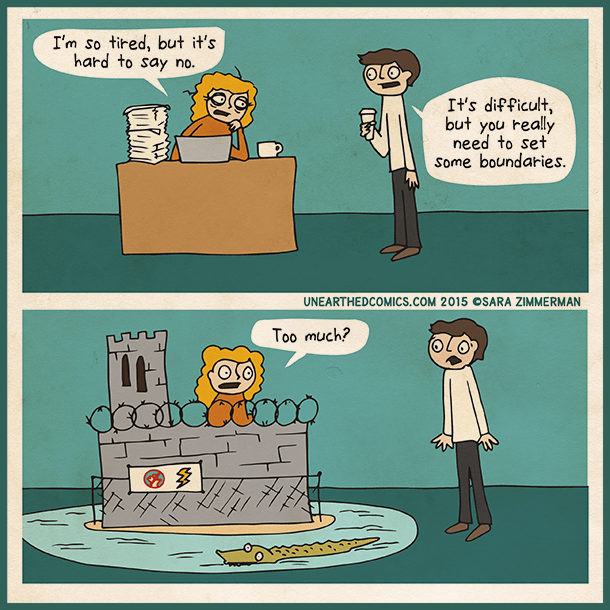
"Boundaries" by Sarah Zimmerman - Unearthed Comics

The Simple Step to Achieve Great Work-Life Balance

Featured image: “Boundaries” by Sarah Zimmerman – Unearthed Comics

The issue of life and work balance is so common that you hear it being discussed all the time – you read articles about it, talk about it with your colleagues, with your family, so on and so on. It’s a struggle that many of us have, sometimes for a lot longer than we anticipate, and oftentimes we sort of give up on trying to fix it; we say “it is what it is,” or “I do what I have to do.” Meanwhile, we, as well as the people we care about, are unable to escape the consequences.

In reality, the step to achieve a good work-life balance is a lot simpler than we’d think, although simple does not mean easy. However, you’re going to find out that although it may sometimes be difficult to apply this step, it is well worth it in the long run. Not only will it keep you from going insane, but family and loved ones will be grateful for it too. So what’s the secret? Simple: setting Clear Boundaries.

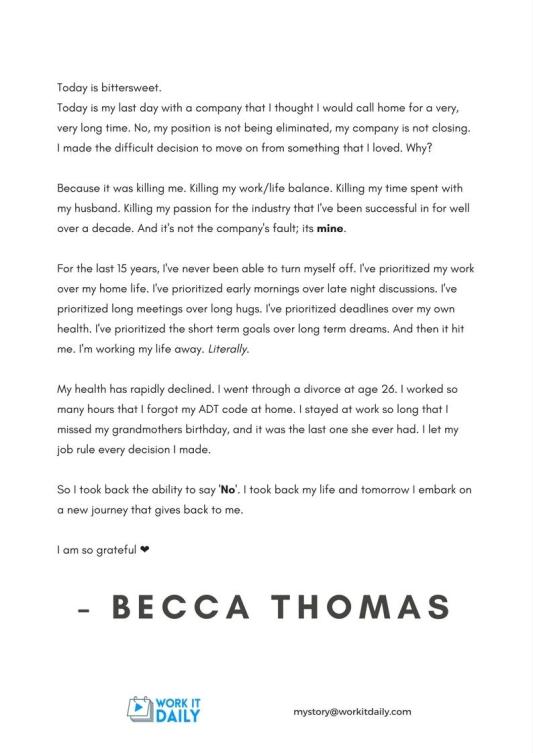
I want to emphasize the word “clear” because a lot of times we say that we’re setting boundaries between our work and our personal life, but in reality we just put up a fort with bendy straws. Having clear boundaries means you have specifics; you set a specific line for yourself that you will not cross when it comes to your work interfering with your personal life at home, and vice versa. Sometimes we realize our need to do this too late, and we might end up telling a story similar to the one below:

6a64f6f0-6a11-4e08-9606-c056bf5f48ab-original

Shared story from Work it Daily

Becca Thomas mentioned how she “took back the ability to say ‘No’,” and while that is essentially what setting a boundary entails, for some of us simply saying “No.” is virtually impossible (at least for me it is). If you’re like me and have a relatively tough time saying “No.” to requests, there are other things you can do for yourself that make it easier to do so, like your time management.

When it comes to time management, there are a couple of ways you can go about it. For example, there are times when my husband has to do some work from home after a full day of work at the office. When this is the case, his boundary is to spend no more than 20 minutes working at home. You could also simply say “I will not work past 6:00pm,” and have that be your boundary instead.

These kinds of boundaries are clear, making them simple to follow, thus making them very effective. Are they easy to follow? Not always – there has been one or two times where Patrick goes a little over the 20 minute limit, but these are very rare occasions. The fact that the boundary has already been established makes it easier to be aware of how you’re handling your work-life balance, preventing you from going on a downward spiral of unbalance like Becca Thomas. Although, with stories like hers I would still argue that it’s better late than never, as you could see from her testimony this wouldn’t be a situation in which “fashionably late” is a good thing either.

So, what will your clear boundary be? Will it be “no working past 6pm”? No checking emails during dinner time? No more than 20 minutes working at home? Or maybe it’s “Thursdays are strictly family days – no phones, no emails”? Of course, it’s hard to decide to step away from your work at times, especially if your role is extremely involved in essential operations of a company. However, there are certain things that will always be more important, that also need your care and time – yourself being one of these. Having clear boundaries to maintain work-life balance will always work out in your favor, and you’ll also find that the business world will not fall apart when you decide not to be a 24/7 working robot. So have at it and take back the ability to say “No.” 🙂

computer20people20-20talia-3875-final_zpsynpbyivy

By Nayadee Wilson

Stop Wasting Your Talent

I’m at the point in my journey where I’m questioning and thinking about what it is that I truly want to do with my life, and how can I get there. So far everything seems to be running smoothly, and all the pieces seem to be falling into place, but I’m still not certain of the image these pieces are forming; i.e. where my life is headed. Which leads me to the next question: What are my gifts? What are my talents?

Last week, one of our pastoral leaders at my church said this:

Let’s say you’ve been planning for quite some time the perfect gift for someone you love. You’ve put a lot of thought, time, and maybe even a lot of money into it. The day comes when you see this person and you finally get to give him/her that very special gift – the one that you personally chose to fit him/her, because that’s how well you know this person. You finally gave that person your gift, and you’re ecstatic about it!

Then a month goes by, and you happen to come across that special gift that you gave to that special person. It’s sitting on a shelf, unopened, certainly not used, and collecting dust. Imagine the feeling you would have, knowing that after making that gift so very special for your loved one, that person didn’t really care for it.

That’s how God feels when you don’t use the gifts that He’s given you.

Whether you believe in a God or not, I believe we can agree that most of us here on earth do feel that we’re alive for a reason and a purpose. We have certain gifts and talents that we were born with, or developed over time, that were meant to impact the world around us. Of course, some of the impacts we make are very small, while others are very big, but they are significant nonetheless.

From time to time we may think that we’re aware of our skills, and that we’re working towards our goals. However, especially when it comes to our careers, oftentimes we let our talents take a back-seat. We follow orders blindly and conform to just making ends meet, justifying our decision to leave our gifts unopened.

The truth is, that when you don’t use your talents you’re not only doing a disservice to humanity, but also to yourself; you were meant to use these! Why should you be stuck at a dead-end job, where your talents aren’t used to their full potential? Why should your gift sit on a shelf?  When searching for a job and taking steps to pursue your career, these steps should always be part of your life marathon, not your practice treadmill.

Maybe you’re taking solid steps in your career, but you still fell stuck. Perhaps the reason you’re in a career rut is because you honestly don’t know what you want to do – you don’t know what your gifts are. Well, that’s a common struggle, but there’s a way around that. You can ask yourself these three questions:

1. What did I want to do as kid?

2. What makes me come alive when I do it?

3. What opportunities have I been given? 

The third question is particularly useful because it’s one we don’t often think about. Maybe you don’t know what you’re passionate about, and maybe you no longer like what you loved as a child, but one thing may still help you: that thing in which you stand out to others. Was there ever a time when someone said to you: “Hey, have you thought about doing XYZ? I think you’d be really great at it!” This is your ticket to exploration. There may be a hidden talent that you didn’t know you had that might be what you were meant to do. You just have to take the opportunity to try it. And if it’s not your thing, then keep searching.

Not everyone believes that we all have a purpose, but even if you don’t believe so, that doesn’t mean you have to wander aimlessly in life ignoring your natural abilities; we can find our gifts and put them to good use. If you know what your talent is, don’t hesitate to use and perfect it – find the job/career/course that will use these to their full potential! If you don’t know what your gift is, then be diligent in searching for it – you can start a “hobby career” and move on from there 🙂 . But whatever you do, don’t waste your talents – they are valuable to the human kind!

computer20people20-20talia-3875-final_zpsynpbyivy

By Nayadee Wilson

**Featured Title Image: [MAYMA-tiiii♥♥♥......] by A♥**