Tag Archives: stress

Don’t Stress The Tough Challenges – Do This Instead.

If you’re alive and breathing, chances are that you have been, are being, and/or will be faced with challenges; they’re just part of human nature. Although most of us feel some level of stress when dealing with a challenge, the stress does not come from the challenge itself, it comes from the ways in which we’re handling it. After all, most challenges are good and necessary – they put your mind to work, and they make you stronger and better in the end; they’re good for you!  We shouldn’t be afraid of challenges that come our way. Instead, we should embrace them. So, what’s the best way to do that? Here are a couple of things that have helped me in mine.

  1. How long will the elephant stay in your room?
    A lot of times we look at challenges from the wrong angle, missing (or refusing to look at) the main, underlying problem. The only way you can start to get rid of the elephant in the room is by acknowledging and identifying it; it’s there, and it has a name. It’s not enough to just know that there’s an issue, you should truly make yourself aware of what exactly it is that you’re dealing with.

    For example, after writing blogs for about a year (I’m a bit of a rookie), I’ve been moping in my head about my decline in writing frequency for quite some time now, but I refused to deal with this issue. It was the elephant in my room, and I finally decided to stare at it – why am I not writing as often? As I focused on the issue, it turns out my challenge was not exactly the act of writing; my actual challenge has been coming up with new topics to write about, having my creativity bucket collecting dust. And so, by identifying the essential issue I can now focus on finding an effective solution. This is the first step to overcoming any challenge: look past the surface, and identify the fundamental problem.

  2. How will you get the elephant out?
    Sometimes, identifying the real challenge can be a lot easier than finding a solution to it, but at least it gives you a start! Writing about my personal challenge helped me identify it, which was step number one. In the course of nature you’ll often find that once you take that first step, it’s a lot easier to take that second one. After you’ve done your first step of identifying, you can now focus on how you’ll overcome your challenge.

    a.) Write down your own ideas on how to approach your new challenge.

    b.) Talk to others about your struggle; share with people that have dealt with a similar challenge. Chances are that someone somewhere has gone or is going through the same thing, and could offer you some useful insight.

    c.) Put all those ideas and advice together and do some good ‘ol fashion trial and error. You may not stumble upon the greatest solution right away, but if you do nothing then your elephant might live there forever, rent-free.

The take-away.

All in all, when it comes to facing your challenges it really comes down to these three points:

1. Knowing the underlying issue allows you to focus on finding an effective solution.

2. Do some good ‘ol fashion trial and error – it’s better than doing nothing.

3. Learn from all of it.

The best thing about overcoming a challenge is that if you’re faced with it again, you’re ready for it; it becomes less “challenging,” making you ready for better and bigger challenges. You learn the good and the bad and can add another star to your “Life Experiences Board,” while also learning how to deal with other difficult situations. So, the next time you’re faced with a challenge, make sure you look at it from the right angle and tackle it like a pro! 🙂

*Featured image: Life is Stressful by Ayana

computer20people20-20talia-3875-final_zpsynpbyivy

Written by Nayadee Wilson

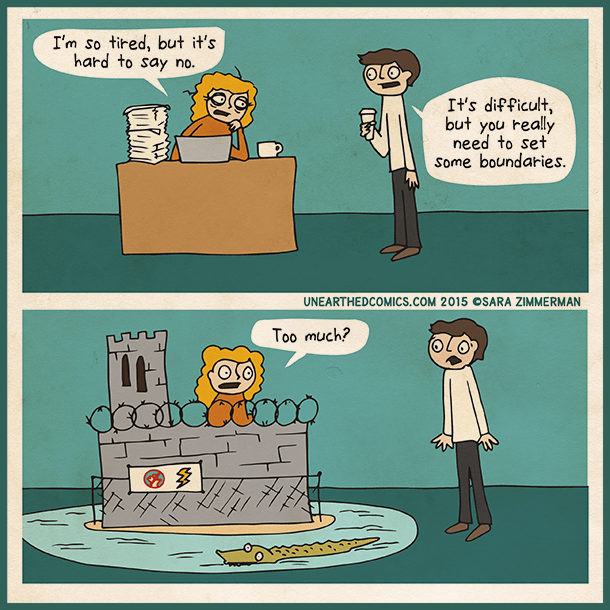
"Boundaries" by Sarah Zimmerman - Unearthed Comics

The Simple Step to Achieve Great Work-Life Balance

Featured image: “Boundaries” by Sarah Zimmerman – Unearthed Comics

The issue of life and work balance is so common that you hear it being discussed all the time – you read articles about it, talk about it with your colleagues, with your family, so on and so on. It’s a struggle that many of us have, sometimes for a lot longer than we anticipate, and oftentimes we sort of give up on trying to fix it; we say “it is what it is,” or “I do what I have to do.” Meanwhile, we, as well as the people we care about, are unable to escape the consequences.

In reality, the step to achieve a good work-life balance is a lot simpler than we’d think, although simple does not mean easy. However, you’re going to find out that although it may sometimes be difficult to apply this step, it is well worth it in the long run. Not only will it keep you from going insane, but family and loved ones will be grateful for it too. So what’s the secret? Simple: setting Clear Boundaries.

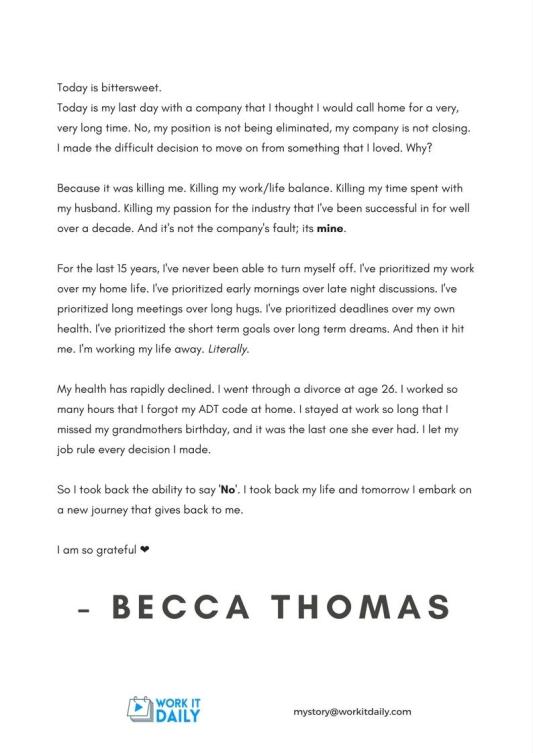
I want to emphasize the word “clear” because a lot of times we say that we’re setting boundaries between our work and our personal life, but in reality we just put up a fort with bendy straws. Having clear boundaries means you have specifics; you set a specific line for yourself that you will not cross when it comes to your work interfering with your personal life at home, and vice versa. Sometimes we realize our need to do this too late, and we might end up telling a story similar to the one below:

6a64f6f0-6a11-4e08-9606-c056bf5f48ab-original

Shared story from Work it Daily

Becca Thomas mentioned how she “took back the ability to say ‘No’,” and while that is essentially what setting a boundary entails, for some of us simply saying “No.” is virtually impossible (at least for me it is). If you’re like me and have a relatively tough time saying “No.” to requests, there are other things you can do for yourself that make it easier to do so, like your time management.

When it comes to time management, there are a couple of ways you can go about it. For example, there are times when my husband has to do some work from home after a full day of work at the office. When this is the case, his boundary is to spend no more than 20 minutes working at home. You could also simply say “I will not work past 6:00pm,” and have that be your boundary instead.

These kinds of boundaries are clear, making them simple to follow, thus making them very effective. Are they easy to follow? Not always – there has been one or two times where Patrick goes a little over the 20 minute limit, but these are very rare occasions. The fact that the boundary has already been established makes it easier to be aware of how you’re handling your work-life balance, preventing you from going on a downward spiral of unbalance like Becca Thomas. Although, with stories like hers I would still argue that it’s better late than never, as you could see from her testimony this wouldn’t be a situation in which “fashionably late” is a good thing either.

So, what will your clear boundary be? Will it be “no working past 6pm”? No checking emails during dinner time? No more than 20 minutes working at home? Or maybe it’s “Thursdays are strictly family days – no phones, no emails”? Of course, it’s hard to decide to step away from your work at times, especially if your role is extremely involved in essential operations of a company. However, there are certain things that will always be more important, that also need your care and time – yourself being one of these. Having clear boundaries to maintain work-life balance will always work out in your favor, and you’ll also find that the business world will not fall apart when you decide not to be a 24/7 working robot. So have at it and take back the ability to say “No.” 🙂

computer20people20-20talia-3875-final_zpsynpbyivy

By Nayadee Wilson

“You Can’t Make Me!” – Being Ethical VS Being Insubordinate

Have you ever been assigned a task that you felt uncomfortable with? Additionally, have you always handled these situations properly? Ahh – that’s where the tricky part comes in. The rules of ethics can often seem to be perfectly black and white, while in other instances they may appear to have a grey area. Sometimes what is ethical for some may not be ethical for others, and so unwanted confrontations and conflict can arise (sometimes more than just your typical eyebrow-raiser O_O). When it comes to the workplace, while we all want to adhere to our ethical standards, we also want to be very careful of the way in which we handle these somewhat uncomfortable, yet common situations. There are a few things you can do in order to protect yourself, and the company, from engaging in what you believe to be unethical behavior/tasks while also keeping away from being labeled as an insubordinate employee; you do not want the latter!

That’s not right, so I’m not doing it.

One of the things you should be aware of is what the meaning of insubordination actually is. Insubordination in the workplace is defined as defiance of authority (refusal to obey others), disrespectful behavior, and/or a confrontation between an employee and a supervisor/manager. So, before refusing to do a particular task due to it appearing unethical, take a moment to brainstorm over the situation. Something you definitely want to refrain from is being disrespectful. The abrupt refusal of doing your task may come off as disrespectful behavior, consequently placing you in disciplinary action or putting your job in jeopardy. Take the time to analyze whether it truly is an unethical task, or if it is a biased opinion on your behalf (which can happen, we all have awesome, unique brains 🙂 ). That being said, once you’ve properly evaluated your circumstances, if the task seems to remain unethical you are now ready to decide on what your next step should be, and ask yourself some reasonable questions.

Question no.1 – Can they do that?

The greatest tool you can have at your disposal is information. When encountering a “grey area” in the topic of ethics, something that can help you greatly is your company handbook, and/or a list of company policies and procedures. Reviewing these will often help you make the distinction between having ethical vs unethical requests. The reality is that your boss might not be a bad guy, so give her/him a break; your boss may just be trying a different means to an outcome that could or could not be in line with company policy, without having analyzed the situation further. Therefore, keeping up with proper procedures on your end is essential. Another thing you should be informed about is your legal rights. Occupational Safety and Health Administration (our great friend, OSHA) does protect you in the event that your refusal to work is truly due to an unethical issue. Hence, if you refuse to do a certain task because you believe “in good faith” that what you were asked to do is unethical, it will not be considered insubordination.

Question no.2 – This is obviously unethical! …Or is it?

Again, what may be unethical to some may not be unethical to others, so communication is important here (and use your words!). I’ll give you an example: during a previous position I held as an admin, I was in charge of all the billing. Company procedure was to bill/charge all orders once they had already shipped, and not before. During month end, however, those billing numbers were important to our goals. One of the things I personally struggled with was charging an order before it actually shipped or had been completed – it just didn’t sit quite well with me. While I was only trying to follow company procedure, there was a grey area; would you say billing an order that perhaps didn’t leave the building just yet, but would leave first thing the next morning, was unethical? What about an order that was not leaving the building until next week? This was a discussion that I needed to have with my supervisor, which resulted in a reasonable and understanding conclusion – we worked out what was acceptable without disturbing my ethical standards. While billing something that was ready to leave the very next day was reasonable to me, I was uncomfortable billing an order that was not to be complete until, say, a week later. My boss was very understanding and did not require me to do so. Moral of the story: simply refusing to perform a task may not be the best option, and it can land you in the insubordination platform. Expressing your concern to your supervisor is not only the right thing to do but it also shows your appreciation for the company and its policies, as well as your good ethical standards. Just make sure that you remain respectful, honest, and open to a reasonable discussion 😉 .

Question no.3 – Are they still expecting me to do this?

Let’s say you’ve reviewed your handbook, the company policies and procedures, you’ve spoken to your supervisor about your concern, and yet the answer is still: “just do it.” What’s there to do? In this situation, the Human Resources department becomes your best friend. Your HR department is in place to make sure that you are protected and that all company policies are being followed. If all else fails, your best option will be to bring your concerns forward to someone in HR, and explain the situation as best as you can. Additionally, as tempting as it is, what you will not want to do is bring the matter out in public by talking to your coworkers about the issue, as this may cause you to be seen as insubordinate. As Reference.com puts it, “If it becomes public knowledge then it can be considered insubordination, as the employee is considered to be ruining morale for the company.” Make sure you are well informed regarding your company’s policy, and contact HR (privately – refrain from the urge to gossip!) if you need to.

I still don’t feel comfortable here.

Whelp, you’ve done all you can, and although maybe your particular situation was resolved, it may have ended in a way which still caused you to believe that it was unfair, or unethical. This is the time you may want to think about how the company culture lines up with your own ethical standards and personality. Although the company may have not engaged in what they would consider unethical (how we love that grey area, huh?), the fact that you still feel it is may be an indicator that you will thrive much better in a different atmosphere and company culture. Of course, in cases of serious unethical behaviors such as harassment and/or illegal behavior, I’d advise you to never forget your legal rights and follow through with proper procedure when possible, but also don’t forget your health and well-being – do what is best for you. That being said, given that your situation involves, more or less, just differences in working style, if you do decide to explore different opportunities remember to do it with professionalism, and always end on a good note. Whatever your situation may be, don’t be afraid to stay true to yourself and your moral standards, all while making sure you remain professional and refrain from falling in the traps of insubordination! Nobody wants that :).

computer20people20-20talia-3875-final_zpsynpbyivy

By Nayadee Wilson (who has an awesome new pic!)

 

Feeling Overwhelmed? End the Haunting of Stress in the Workplace.

I saw a post from a friend earlier this morning that read “stress can kill you.” And it is, indeed, a very scary thing – it would make a great Halloween costume! Stress in the workplace is such a common phenomenon, that it is no wonder there are hundreds of articles discussing the topic and offering advice on how to deal with it. After all, according to the American Psychological Association’s annual “Stress in America Survey,” a whopping 65% of Americans referred to work as a top source of stress in 2012, and in 2015 money and work still remained the top two causes of significant stress. Although I have found most articles helpful, I can’t help but notice that most of these tend to emphasize solely on stress emerging from work situations or the work environment. However, sometimes stress comes from other sources that don’t necessarily relate to our work experiences. So I’ve decided to break down the sources of stress in the workplace into three categories: Stress from home, Stress from work, and Stress within you.

My personal life is falling apart.

So maybe your job is great (yay!); maybe you love what you do and can’t truly complain about the work itself. However, even though we’ve often heard the phrase “don’t take your work home with you,” what happens when home comes to work? And yes, I know a lot of us have probably also heard the phrase “leave your personal life at home,” but that’s not always so easy, is it? Sometimes life happens, and you can’t help but stress about it all day long. Here are two steps that have helped me, and may help you as well. 🙂

  1. Get real – One of the first things to do in this situation is to grab a hold of reality, and understand that your troubles from home cannot be solved while at work. It sounds harsh, I know, but a firm grasp on the reality that worrying about your personal difficulties will not take you any closer to solving them, will help you place these worries aside and help you regain focus on work (for the time being). If it truly is an overwhelming event, you’re better off taking a personal day to work through it, and come back to work when you feel refreshed. Nonetheless, if you’re already at work and you’re having a tough time setting these worries aside, here is something I like to ponder on when I start to worry: “Can any of you by worrying add a single hour to your life?” In other words, can you gain anything extra in life by worrying? Not likely. What do you gain by worrying? Stress.
  2. Get to work – Once you leave work, get to work on solving your problem. Home-stress factors can be a lot of different things for different people. One of the most popular is usually financial troubles; are you in debt or is there an income problem? In this case, get to work and start to handle your finances wisely; take the time to develop a plan of action. It could also be marital/relationship problems, family illness, or even a more serious event like a death in the family. If this is the case, remember that there is no shame in getting help. Professional assistance is always available to help you cope with this kind of stress, as well as a trusted friend or relative you can rely on. When you make time in your personal life to resolve these issues in a healthy way, it leaves room for focus and dedication in the workplace. If you don’t, then you will most likely feel obliged to spend time thinking about these issues, as you have not dedicated any time to solve them elsewhere.

I hate my job.

Alright, so maybe you do hate your job. Maybe you are feeling undervalued, unappreciated, and unfairly treated. 😦 Perhaps your boss/supervisor is not the kindest, or perhaps your work environment is a toxic one. Regardless of the reason, it is never healthy for anyone – you or the company – to feel miserable at work. Here are some things to keep in mind.

  1. Be rational – A great thing to keep a handle on is the proper perspective; is this all in my head? One way to reflect rationally and see a situation from the outside-in, is by writing an email or note of what happened and how you’re feeling, not sending it, and reading it over to yourself (I will emphasize, do not send your angry email to your co-worker/supervisor/boss/customer – it never remedies anything, trust me 😦 ). Not only will this exercise help you re-evaluate a situation, it also serves as kind of a “woo-saah” type of healing. Reading it over will make you ask relevant questions like “am I overreacting? Is this the right thing to say? Are these the proper words to use? What could have been done differently?” etc. Additionally, it might be a good idea to save these emails for yourself and keep track of what your triggers are; i.e. what “ticks you off.” You can then transform your quick reaction to these kinds of situations into a wise and appropriate action in the future.
  2. Have boundaries – Although a great success, technology has also been our downfall. I know there are times in which we feel we have to be the “Yes-man” and be available 24/7, because why wouldn’t we be? It’s our job, right? Not exactly. Of course, there are many responsibilities that come with your job title, but there are also times in which you can say “No,” and your boss will understand. When my husband first accepted his current job, it was a great career opportunity for him and he was very excited. However, he was starting to constantly check his emails while being at home, which made it difficult for him to be a part of the family, and caused both him and the family a great deal of stress. Once he established the boundary between home and work, everyone was a lot happier. 🙂 Of course, by “everyone” I mean me; if mom is not happy, then no one is happy 😉 . But, with my attempted jokes aside, it is needless to say that placing boundaries is healthy and acceptable.
  3. Have communication – We all wish that our peers would just know when something would not sit quite well with us. Unfortunately, none of us are mind readers and we all think differently, therefore communication is needed. You may want to try simply speaking to your boss about your level of stress. By “speaking,” I cannot stress enough that this does not mean “complain.” It means discussing how you are feeling and asking what you can do to improve the situation, or how can you work together to come to a healthy and adequate solution. If you are with a good company, you can rest assured that you will be helped and encouraged – some companies even have programs that offer professional help if you need it. If you are, however, within a toxic work environment in which your concerns are not properly addressed, then you can feel at peace by making the decision to take your talents elsewhere. Being constantly stressed will contribute to short temper, anxiety, and many more health issues that will significantly impact your productivity on the job. To give a quick summary of my experience, when I worked for a previous company some time ago, I experienced all of these symptoms, which caused me to lose the quality of my once acclaimed, and even rewarded, customer service skills. This particular company was an incredibly toxic one, and although I did stress about what I would do once I left, it was the best decision I ever made. If this is the case, a great tool to use in your new job search is a staffing agency – they are wonderful and there to help! Not to mention today I work for one of the best, and could not love my job any more if I tried. 😉

I can choose to be happy.

Last, but certainly not least, is my favorite topic of almost every article/study I’ve read on managing stress: managing yourself. This was the one thing that all of my research had in common, which I will completely agree with. Many times we think that happiness is an effect of our circumstance, therefore making it a strictly dependent emotion. However, happiness is not so much an emotion reliant on context, but an action that will ultimately affect how we feel. Take talking to yourself, for example; if you constantly feed yourself negative words, your natural reaction will be to feel bad about yourself. Yet, if you choose to feed yourself uplifting words, your natural reaction will be to feel uplifted. The choice between being happy and miserable can have a huge impact on your stress level. After all, stress itself is not so much what happens around us, but more so how we perceive our circumstances. Try it out for yourself; make the choice to be happy for a whole day, and see how you feel.

  1. Stop comparing – As I came across an article discussing work tension, I loved how they phrased this idea as “leave the Joneses alone.” When you start to feel bad about yourself or how your life is going, it could be because you are comparing yourself to someone else. Your experiences will never be someone else’s, so you should focus on the accomplishments you have made, the goals you’re running towards (or the ones you need to start working on), and the joys you’ve experienced. You should also remember that what you see from people around you on the outside is not always a clear representation of what lies on the inside. We all have our struggles, and we all have amazing successes. Focus on the latter.
  2. Get some hobbies – Don’t forget to treat yourself. When you make time for the things you love, it will help you tremendously in reducing stress. It is important that you disconnect from the world for a while, and reconnect with the things that make you “tick.” If you’re not sure what you would enjoy or you don’t have any hobbies, try out some new things – or simply have a “me-day” where you can take naps if that’s what you’re into. Whatever it may be, take the time to do things that will uplift you and create positive experiences in your life.
  3. Be spiritual – This one surprises some, but being spiritual will actually help a great deal with removing stress. The American Psychological Association advises that you take the time to relax, and calls it “a state in which you actively observe experiences and thoughts without judging them.” For me, personally, prayer works wonders; my days are a million times better when I start off with a prayer and thanksgiving. Nevertheless, if that’s not your thing you may want to look into something like yoga, or meditation. Making the choice to relax, to be thankful, and to focus on positive things will automatically set up your mind and body for positive outcomes throughout your day, making it hard to see the negative side to many situations.

In Conclusion

Remember to not freak out! Although these tips were the ones I found to be most helpful, a lot of what I have written comes from my own personal experiences as well – the lessons I’ve learned the hard way, and the ones I’ve learned from studying. The truth is that there are many ways in which you can manage your stress level and take control of it, so don’t make my mistake; try to learn these tips ahead of time before you explode! >_<

Make sure that you take care of yourself, eat healthy (which I didn’t dive into, but taking care of yourself physically will also affect how you feel emotionally), find some hobbies, and ask for help when you need it. Most importantly, remember that whether at work or at home, when you feel stressed you do not have to go through it by yourself; remember that you are not alone. Stress will lead you into deceiving yourself, thinking that there is nothing you can do and that you have no one who can help, and you just want out! Remember that this is a lie. Any great company knows that we are all in this together, and when one member does not function well, the entire company does not function well. Know your worth, don’t fight it alone, and be confident that you can kick that Stress-monster’s butt! 🙂

me_zpsext9iuth

By Nayadee Wilson