Tag Archives: Success

How Communicating Rejection Notices Can Help Your Businesses’ Brand

Welcome back to another edition of the ComputerPeople Staffing blog! In the competitive job market, how companies handle candidate rejection notices can significantly impact how they are perceived by active candidates. Delivering bad news is never easy, but it’s a critical aspect of the hiring process that, when done with empathy and professionalism, can turn a potentially negative experience into a positive one. Here’s how companies can improve their rejection communication to better their brand.

1. Timeliness is Key

  • Why It Matters: Prolonged silence can lead to frustration and anxiety for candidates. Timely communication shows respect for their time and effort.
  • How to Implement: Set clear timelines for each stage of the hiring process and communicate them to candidates. Send rejection notices as soon as the decision is made, ideally within a few days of the interview.

2. Personalize the Message

  • Why It Matters: Generic rejection letters often can feel impersonal and dismissive. If your company has the bandwidth to send personalized rejection messages, it can add a human layer to the situation. Personalized messages show that you value the candidate’s application and recognize their effort.
  • How to Implement: Address the candidate by name. Reference specific aspects of their application or interview. Use a warm and empathetic tone rather than a cold, formal one.

3. Express Gratitude

  • Why It Matters: Thanking candidates for their time and effort reinforces a positive impression of your company, even in the face of rejection.
  • How to Implement: Acknowledge the time and effort they put into their application and interview. Express appreciation for their interest in your company and the position.

4. Encourage Future Interaction

  • Why It Matters: Leaving the door open for future opportunities can maintain a positive relationship and potentially attract the candidate to apply for other roles.
  • How to Implement: Invite them to apply for future positions that match their skills and experience. Encourage them to follow your company on social media or join your talent community for updates on new openings.

5. Be Transparent About the Hiring Process

  • Why It Matters: Transparency builds trust and helps candidates understand your decision-making process, reducing feelings of frustration or unfairness.
  • How to Implement: Explain the hiring process and criteria used for selection. Offer insights into the qualities and experiences that were prioritized for the role. Make it human, not artificial!

6. Train Your Team

  • Why It Matters: Ensuring that everyone involved in the hiring process understands the importance of compassionate rejection communication can standardize and improve the candidate experience.
  • How to Implement: Provide training on best practices for delivering rejection notices. Share examples of well-crafted rejection letters. Encourage team members to put themselves in the candidate’s shoes, as they were once candidates!

Communicating rejection notices with care is an essential part of the hiring process that can significantly impact your company’s brand. By being timely, personal, and constructive, you can leave a positive impression on candidates, even in rejection. This approach not only enhances your employer brand but also fosters goodwill and encourages top talent to consider your company for future opportunities.

Implementing these strategies demonstrates that your company values all candidates, not just those who are hired. By treating every candidate with respect and empathy, you contribute to a positive reputation that can attract high-quality candidates and set your company apart in the competitive job market.

_____________________________________________________________________________________________

Thanks for reading! If you are a business looking to fill your important IT roles, visit us at cpstaffing.com to learn more!

If you are a candidate and are looking for dream role, visit us at jobs.cpstaffing.com for our latest job postings!

And don’t forget to follow us on LinkedIn for new jobs, insights, blog posts and more! https://www.linkedin.com/company/computerpeoplestaffing

Written by Jeff Weiss

Unleashing Success: The Power of Employer Brand

Welcome back to another edition of the ComputerPeople Staffing Blog! In today’s fast-paced and competitive business environment, attracting and retaining top talent is crucial for success. The journey to building high-performing teams begins with a compelling employer brand. As technology continues to shape our world, skilled IT professionals are not only in demand but have the luxury of choice. Hence, cultivating a positive employer brand becomes paramount for companies looking to find a competitive edge.  In this blog, we’ll explore the significance of employer brand in talent acquisition and retention, how companies can assess their brand, strategies to improve a negative brand, the crucial role of monitoring online reviews in shaping company culture and brand perception, and the impact of employer brand on bottom-line profits.

The Importance of Employer Brand

Imagine your employer brand as a beacon that guides talent to your doorstep. It’s not just about attracting applicants but drawing the right ones who align with your company culture, values, and mission. A strong employer brand not only entices candidates but also fosters loyalty among existing employees. It sets the stage for a fulfilling work environment where employees feel valued, engaged, comfortable and motivated to contribute their best.

“Focus on building the best possible business. If you are great, people will notice, and opportunities will appear.” – Mark Cuban, entrepreneur, venture capitalist, businessman

Identifying a Positive or Negative Brand

Assessing your employer brand involves listening to the pulse of your organization. Positive signs include high employee satisfaction, low turnover rates, positive online reviews, employee advocacy, and recognition in industry awards. Conversely, a negative brand may manifest through high turnover, negative reviews, low employee morale, and difficulty attracting top talent.

The Role of Monitoring Online Reviews

In today’s digital age, online platforms like Google and Glassdoor serve as windows into your company culture and employer brand. Current and potential employees often turn to these sites to gain insights and firsthand experiences from past and current employees. Monitoring online reviews provides invaluable feedback and insights into areas where opportunities for improvement lie. By taking proactive steps to address feedback and improve areas of concern, companies can not only enhance their employer brand but also attract and retain top talent. Moreover, encouraging satisfied employees to share their positive experiences can lead to a virtuous cycle of positive reviews and bolstered employer brand perception.

“Your brand is what people say about you when you are not in the room.” – Jeff Bezos, founder and CEO of Amazon

Strategies for Improving a Negative Brand

If your company finds itself with a negative employer brand, fear not. Every setback is an opportunity for growth and transformation. Start by actively listening to employee feedback, identifying pain points, and addressing them transparently. Cultivate a positive company culture that values diversity, fosters open communication, and prioritizes employee well-being. Invest in employee development programs, competitive compensation packages, and meaningful recognition initiatives. By demonstrating a genuine commitment to improvement, you can gradually rebuild trust and reshape your employer brand.

Impact on Bottom-Line Profits

The correlation between employer brand and bottom-line profits is undeniable. A positive employer brand attracts top talent, resulting in increased productivity, higher employee engagement, and lower turnover costs. Engaged employees are more likely to deliver exceptional customer service, leading to enhanced client satisfaction and retention. Ultimately, investing in your employer brand yields tangible returns in the form of enhanced profitability and sustainable growth.

“Your brand is the single most important investment you can make in your business.” – Steve Forbes, Editor in Chief of Forbes Magazine

In conclusion, the significance of employer brand cannot be overstated. It serves as a catalyst for attracting and retaining top talent, driving employee engagement, and ultimately impacting bottom-line profits. By nurturing a positive employer brand, companies can unlock a world of opportunities, foster a culture of excellence, and embark on a journey towards long-term success.

_____________________________________________________________________________________________

Thanks for reading! If you are a business in the Western New York Area and are looking to fill your important IT roles, visit us at cpstaffing.com to learn more!

If you are a candidate and are looking for dream role, visit us at jobs.cpstaffing.com for our latest job postings!

And don’t forget to follow us on LinkedIn for new jobs, insights, blog posts and more! https://www.linkedin.com/company/computerpeoplestaffing

Written by Jeff Weiss



How Do I Standout From All The Other Candidates During My Job Search? Wise Words from Our Rockstar Recruiter Brooke DeLucia.

Brooke DeLucia has been a recruiter at ComputerPeople for over 20 years. She has seen it all and has worked with candidates from all over the world. We asked Brooke one simple question. What is the most important quality that a candidate can have to make them standout from the rest?

Brooke’s Response is gold.

“Drive & Professionalism.   Having the ability to sell yourself as a driven individual with the aptitude and hunger to learn can make all the difference.   Your body language can make or break an opportunity, no matter how qualified you are for the job. It’s still important to be respectful, attentive and professional when you are interviewing.  Don’t slouch in your chair, don’t pick lint off your suit, don’t chew gum or swear. It may seem basic but sometimes the people you least expect are the ones making these mistakes!”

Thanks for the words of wisdom, Brooke! Connect with Brooke Here.


dsc_5490-1.jpg

Written by Kaitlyn Gahagen


What ‘The Walking Dead’ Taught Me About Leadership

Recently my husband and I started watching The Walking Dead. Yes, I know we’re a little late to the party, but better late than never right? So far, we’re pretty hooked on to the show, but aside from great entertainment The Walking Dead can teach us a few lessons on leadership. Granted, most of what we see in TWD is useful in the apocalyptic event of having to fight off zombie herds, but some can be applied to everyday life as well 🙂 .

  1. A leader isn’t Superman.

    The Walking Dead starts off by showing us the whereabouts of Rick Grimes, who eventually becomes the leader of a group of survivors. You come to find out that Rick had just come out of a coma, was extremely weak, alone, and to top it all off, he had absolutely no idea what was happening – imagine wandering the streets by yourself to then be greeted by a “dead” human-being trying to eat you! Nevertheless, along his journey Rick encounters friends and family who help him get on his feet and help him survive.

    Sometimes we have the misconception that a leader is supposed to be able to do it all, handle it all, and do a perfect job at it. The reality is that leaders need help too; leaders need the support of colleagues/friends/family in order to do a good job. When our leaders are struggling, it is in the team’s best interest to offer them help in any way possible. However, when the team decides to judge and criticize instead, everyone takes a step backwards. If you’re trying to become a good leader yourself, know that it’s OK to ask for help.

  2. Leaders make mistakes.

    Rick Grimes didn’t always make the right call. The first mistake he made was riding on a horse into a zombie-infested city, where he became completely trapped and was later rescued by a stranger named Glenn, who eventually welcomes Rick into the team that he will later lead. Rick also (arguably) makes some other bad calls that affect the whole team, but nevertheless they all continue to pull together.

    Sometimes, even with help, a leader might make a bad decision. To expand on the previous point, we have to remember that we are all human, and what comes with this great trait is that we will make mistakes. Once mistakes are made, the four important things to keep in mind are:

    1. What do we do to fix it? 2. What can we learn from it? 3. How do we keep from making this mistake again? 4. How can we be better prepared in the future if it does happen again?

  3. Good leaders know how to delegate.

    In Rick’s group everyone had a job to do. There was a period of time where Rick actually stepped back into a “farming lifestyle” while others took on bigger responsibilities. Rick was going through some personal issues himself, which made him take a breather from his “leadership role,” and he let others handle that part of the workload. (Of course, when you watch the show and see what happens later, you may or may not feel that this was a good call, but for the purpose of this peace we’ll focus on the positive).

    Having a leadership role is a big responsibility.  At one point or another we all experience burn-out, expressing it through frustration and sometimes even physical illness. It’s good for leaders to take a break every now and again to reboot, and they should be able to do so with the support of their peers. It can’t always just be “go, go, go, Go!” If you’re going through a rough time, but feel guilty about taking a breather, know that you’re not a robot and it’s OK to refresh – after all, how would you expect to kill zombies if you’re all worn out?

  4. Good leaders have to make tough decisions.


    In TWD there were numerous times where Rick had to make a tough call in which everyone was not in total agreement, or one he had to make completely on his own. One of Rick’s best friends, for example, attempted to get rid of him for good, and so Rick had to make the decision of defending himself and others – thus taking his best friend’s life.

    So, in the real world (thankfully!) making a tough call doesn’t involve the gruesome tasks that are required to survive a zombie attack. Nevertheless, there will be times when leaders have to make a decision that not everyone is going to like – it comes with the job. Although a leader ought to care for his people, they’re not necessarily required to be best friends. It’s kind of like parenting: you love your kids, but you’re their parent, not their buddy. If you’re afraid to make a tough decision for your group, always ask for help if possible, but know that there will be times where you have to make the tough call. And, as peers, it is always best to be respectful of a leader’s decision before declaring (like Rick’s best friend did), “I am a better man than you” – as you will come to find out, pride comes before the fall.

Bringing it all together

We are all leaders in one way or another, and we all have leaders to follow in one aspect or another. When it comes to leadership, just know this:

                   A leader is a human with a job to do, not a robot with a programmed task.

To our leaders we owe our respect, support, and understanding. As leaders we owe our peers responsibility, trust, and care. Who knew The Walking Dead had so much to teach besides the best way to kill zombies? If you haven’t had a chance to watch it yet, I would definitely recommend this enticing thriller as your next binge marathon on Netflix. Although, you may want to watch it well before going to sleep – I’ve had several zombie attack nightmares since we started watching it… but totally worth it!

Featured Image Credit: Casey Florig – The Walking Dead Season 5 trailer screenshots

computer20people20-20talia-3875-final_zpsynpbyivy

Written by Nayadee Wilson


How Consistency Leads to Success in 3 Simple Steps

Featured imageRaphael Love

I used to think it was just me, but the more I observe myself and others the more I find a majority of people having a tough time achieving consistency in any given area. Time and time again I hear people say that consistency is a big key to success, so it makes me wonder why so few of us take it into account. As for me, sometimes I feel “creatively stuck,” or have a lack of motivation to carry out consistency – as may also be the case for you. But here’s why consistency should be our top priority when reaching our goals, and why you should join me on a 5-week long consistency challenge!

  1. Consistency provides real substance.
    How many times have you tried a new “life-hack,” skincare/hair-care routine, etc., to then give up a few days later and say “I tried that and it didn’t work for me”? Well, how do you know whether or not something is effective if you don’t have realistic, consistent measurements? Until you perform a task consistently for a proper period of time, you will not be able to determine if it works or not. Being consistent helps you become successful by allowing you to see which tactics work for you, and which ones don’t. Otherwise you’re just doing random, incomplete experiments; getting no real answers.
    .
  2. Consistency creates discipline.
    There’s no question about it: in order to be successful, you must have a good level of discipline. Without discipline, you must rely on a great amount of luck in order to achieve your goals – and that’s highly unlikely to happen. When you develop consistency in what you do (your tasks, your strategies, your daily plan of action), you begin to form a good disciplinary habit, getting closer to achieving your goals. I read somewhere that it takes an average of 66 days for something to become habitual (I always thought it was 21 days), so this goes to show how strong and important the power of consistency is!
    .
  3. Discipline creates success.
    So you’ve gotten a few things down: you’ve become consistent in your work, you’ve developed discipline with your daily/weekly/(whatever applies to you) routine, and now you get to watch the results. You get to see whether what you’re doing is working, or if it’s not. And no matter what the result is, you’ve become successful. How? By being able to weed out what doesn’t work from what does work – and that’s a success in your journey! The great thing is that once you’ve found what works really well, you’ve become disciplined enough in your tactics that it’s easy to continue the work you’ve already put in and accomplish even more. Ergo, you’ve achieved success. 🙂

In his article, “No Consistency, No Success,” Grant Cardone stated that “Successful people don’t change their approach unless it doesn’t work—they only change to change with conditions.” So, unless it’s broken, don’t fix it – keep working consistently towards your goals! And if you’re finding yourself stuck in a rut wondering why your goals seem so unattainable, then perhaps it’s time create a consistent plan of action 😉 . Join me on my 5-week long challenge (pick any one task that you want to start doing consistently) and let us know how it goes – grab hold of your success!

computer20people20-20talia-3875-final_zpsynpbyivy

Written by Nayadee Wilson

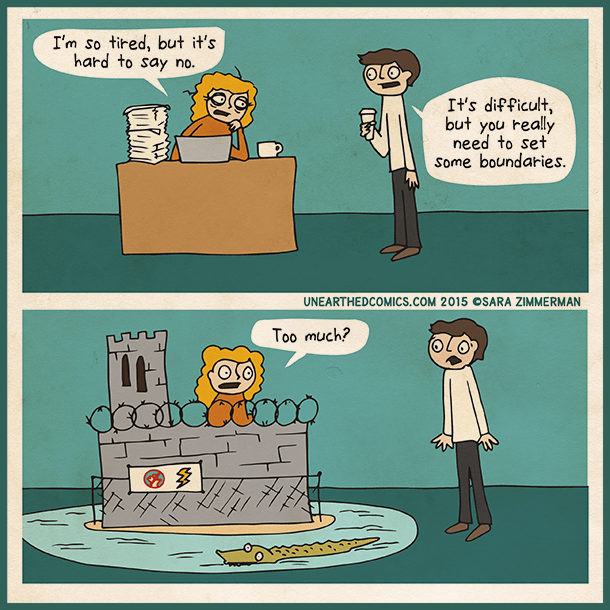
"Boundaries" by Sarah Zimmerman - Unearthed Comics

The Simple Step to Achieve Great Work-Life Balance

Featured image: “Boundaries” by Sarah Zimmerman – Unearthed Comics

The issue of life and work balance is so common that you hear it being discussed all the time – you read articles about it, talk about it with your colleagues, with your family, so on and so on. It’s a struggle that many of us have, sometimes for a lot longer than we anticipate, and oftentimes we sort of give up on trying to fix it; we say “it is what it is,” or “I do what I have to do.” Meanwhile, we, as well as the people we care about, are unable to escape the consequences.

In reality, the step to achieve a good work-life balance is a lot simpler than we’d think, although simple does not mean easy. However, you’re going to find out that although it may sometimes be difficult to apply this step, it is well worth it in the long run. Not only will it keep you from going insane, but family and loved ones will be grateful for it too. So what’s the secret? Simple: setting Clear Boundaries.

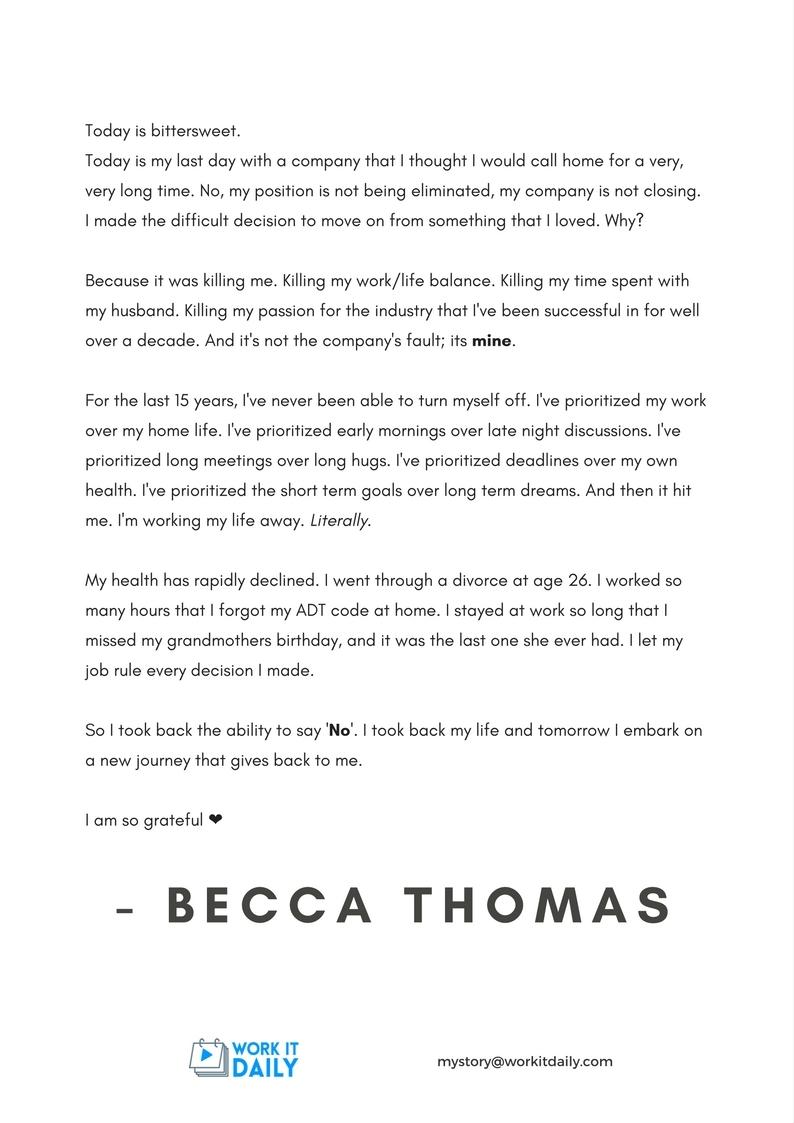
I want to emphasize the word “clear” because a lot of times we say that we’re setting boundaries between our work and our personal life, but in reality we just put up a fort with bendy straws. Having clear boundaries means you have specifics; you set a specific line for yourself that you will not cross when it comes to your work interfering with your personal life at home, and vice versa. Sometimes we realize our need to do this too late, and we might end up telling a story similar to the one below:

6a64f6f0-6a11-4e08-9606-c056bf5f48ab-original

Shared story from Work it Daily

Becca Thomas mentioned how she “took back the ability to say ‘No’,” and while that is essentially what setting a boundary entails, for some of us simply saying “No.” is virtually impossible (at least for me it is). If you’re like me and have a relatively tough time saying “No.” to requests, there are other things you can do for yourself that make it easier to do so, like your time management.

When it comes to time management, there are a couple of ways you can go about it. For example, there are times when my husband has to do some work from home after a full day of work at the office. When this is the case, his boundary is to spend no more than 20 minutes working at home. You could also simply say “I will not work past 6:00pm,” and have that be your boundary instead.

These kinds of boundaries are clear, making them simple to follow, thus making them very effective. Are they easy to follow? Not always – there has been one or two times where Patrick goes a little over the 20 minute limit, but these are very rare occasions. The fact that the boundary has already been established makes it easier to be aware of how you’re handling your work-life balance, preventing you from going on a downward spiral of unbalance like Becca Thomas. Although, with stories like hers I would still argue that it’s better late than never, as you could see from her testimony this wouldn’t be a situation in which “fashionably late” is a good thing either.

So, what will your clear boundary be? Will it be “no working past 6pm”? No checking emails during dinner time? No more than 20 minutes working at home? Or maybe it’s “Thursdays are strictly family days – no phones, no emails”? Of course, it’s hard to decide to step away from your work at times, especially if your role is extremely involved in essential operations of a company. However, there are certain things that will always be more important, that also need your care and time – yourself being one of these. Having clear boundaries to maintain work-life balance will always work out in your favor, and you’ll also find that the business world will not fall apart when you decide not to be a 24/7 working robot. So have at it and take back the ability to say “No.” 🙂

computer20people20-20talia-3875-final_zpsynpbyivy

By Nayadee Wilson